Do the Driving Modes in Cadillac Lyriq Offer Different Ranges or Battery Usages?
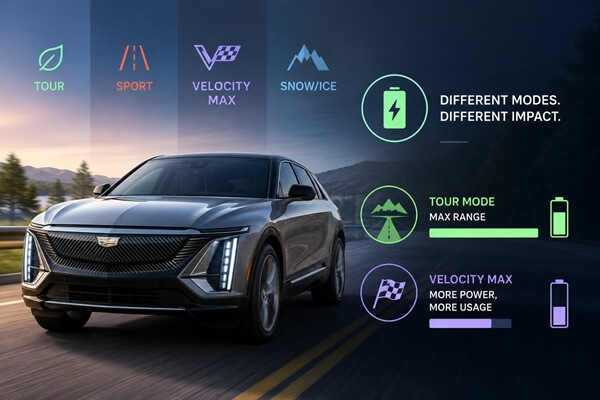
Yes, the driving modes in the Cadillac Lyriq absolutely affect range and battery usage, and understanding how they work is one of the most practical things you can do as a Lyriq owner or buyer. The difference between choosing Tour Mode and Sport Mode on the same trip, in the same traffic, at the same speed, can mean arriving at your destination with noticeably more or less charge remaining. This is not a minor margin. Depending on conditions, the range impact between the most efficient and least efficient driving mode can reach 10 to 20 percent of your total estimated range.
This article covers every driving mode available in the Cadillac Lyriq, exactly how each one interacts with the battery and motor management systems, what the real-world range implications are, and how to combine mode selection with other Lyriq features like one-pedal driving and regenerative braking to get the most out of every charge.
Understanding the Lyriq’s Driving Mode System
The 2024, 2025, and 2026 Cadillac Lyriq is built on GM’s Ultium platform, which pairs a 102 kWh battery pack with either a single rear-motor RWD setup or dual-motor AWD configuration. The EPA-estimated range on the RWD version is 314 miles, while the AWD version comes in at 307 miles. These are the figures Cadillac publishes under standardised testing conditions, meaning moderate speeds, controlled temperature, and no aggressive acceleration or braking.
What changes when you select a driving mode is how the Lyriq’s software manages the relationship between driver inputs, motor output, throttle response, regenerative braking strength, suspension behaviour, and steering feel. Each mode prioritises a different combination of these parameters. Because electric motor output is controlled entirely by software, the Lyriq can shift between aggressive power delivery and conservative efficiency without any mechanical changes — it is all happening in the vehicle’s control systems, instantly, every time you switch modes.
The Lyriq offers four primary driving modes: Tour, Sport, Snow/Ice, and My Mode. Each has a meaningfully different impact on efficiency and battery draw, and each suits a specific type of driving situation better than the others.
Tour Mode: The Default and Most Efficient Setting
Tour Mode is the Lyriq’s standard operating mode and the one it defaults to every time you start the vehicle. It is calibrated specifically for everyday driving efficiency and represents the best balance between comfort, responsiveness, and energy conservation.
In Tour Mode, the throttle mapping is linear and progressive. This means the motor responds proportionally to how far you press the accelerator pedal rather than surging power delivery when you push it. The suspension is tuned for comfort over road surfaces, and steering weight sits at a moderate, comfortable level. Regenerative braking operates at a moderate intensity, recovering energy from deceleration without the abrupt slowdown that higher regen settings can create.
From a battery perspective, Tour Mode is designed to deliver range that closely matches or exceeds the EPA estimate. Owners who drive primarily in Tour Mode in moderate weather conditions — meaning temperatures between 60 and 80 degrees Fahrenheit — regularly report real-world ranges of 290 to 315 miles on a full charge. This is the mode where the Lyriq’s 102 kWh battery is used at its highest efficiency. Acceleration requests are met with controlled, smooth power delivery that avoids the large momentary current spikes that higher-performance modes create.
If your priority is getting the maximum distance out of every charge, Tour Mode is where you should spend the majority of your time. There is no performance mode that adds more range. Tour Mode is simply the baseline from which all other modes represent varying degrees of efficiency compromise.
Sport Mode: More Power, More Battery Draw
Sport Mode transforms the Lyriq’s character noticeably. The throttle response becomes significantly sharper and more immediate — the same pedal input produces a faster, stronger acceleration response than in Tour Mode. Steering weight increases to provide a more connected, engaging feel, and the suspension firms up to reduce body roll during cornering.
These changes feel genuinely satisfying on the road. The Lyriq in Sport Mode delivers a driving experience that matches its luxury performance positioning. It is notably quicker off the line, more responsive in traffic, and more confidence-inspiring on winding roads. This is a real transformation, not a minor adjustment.
The battery and range implications are equally real. Sport Mode increases the rate at which the motors draw current from the battery pack. The sharper throttle mapping means that everyday acceleration inputs that would be modest in Tour Mode become more aggressive power requests in Sport Mode. Regenerative braking also intensifies in Sport Mode, which means more energy is recovered during deceleration, but this partial benefit is outweighed by the increased draw during acceleration.
Real-world owners and EV testing outlets consistently report range reductions of 10 to 15 percent when driving in Sport Mode compared to Tour Mode under similar conditions. On a full charge with a 314-mile estimated range in Tour Mode, switching to Sport Mode and maintaining a comparable driving style could reduce your effective range to approximately 267 to 283 miles. This is a meaningful difference if you are on a long trip without a charge stop planned.
The practical advice is straightforward: Sport Mode is ideal for stretches of road where you want the Lyriq’s full performance character, short trips where absolute range is not a concern, and situations where you simply want to enjoy the car. For highway efficiency runs, long distance travel, or maximising charge between stops, Tour Mode is the smarter choice.
Snow/Ice Mode: Safety First, Efficiency Second
Snow/Ice Mode is the Lyriq’s cold and slippery conditions setting. It is engineered specifically for maintaining traction and vehicle stability on low-grip surfaces, and its approach to battery management reflects that priority completely.
In Snow/Ice Mode, the throttle response is deliberately softened and delayed. When you press the accelerator, the system applies power gradually rather than immediately, preventing the wheel spin that would occur if full torque were delivered to a slippery surface. On AWD models, the power distribution between the front and rear motors is managed more conservatively to maintain traction across both axles simultaneously. Stability control sensitivity increases, and the overall driving character becomes calm and measured rather than responsive.
Regenerative braking in Snow/Ice Mode is reduced or eliminated in many scenarios. The reason is straightforward: aggressive regen on a slippery surface can cause the driven wheels to slow faster than the vehicle’s momentum, triggering a skid. By reducing regen intensity, the system ensures deceleration is smoother and more predictable on ice or packed snow.
The efficiency impact of Snow/Ice Mode is more nuanced than Sport Mode. The softened throttle response actually encourages gentle acceleration, which is efficient, but the reduction in regenerative braking means less energy is being recovered during deceleration. In genuinely cold weather, the battery itself also operates less efficiently — lithium-ion cells lose capacity in temperatures below 40 degrees Fahrenheit, and the Lyriq’s battery thermal management system uses energy to warm the pack to optimal operating temperature. The combination of reduced regen, cold battery chemistry, and climate control system load can reduce effective range by 15 to 25 percent compared to temperate Tour Mode driving.
Snow/Ice Mode should be used whenever road surfaces are compromised. The range impact is real but secondary to the safety and control benefits it provides. Trying to maximise range by staying in Tour Mode on an icy road would be both inefficient and unsafe.
My Mode: Customised Settings, Variable Efficiency Impact
My Mode is the Lyriq’s personalisation tier. It allows you to select your preferred settings across multiple vehicle parameters and save them as a custom profile that activates whenever you choose My Mode. The parameters you can adjust include throttle response, steering weight, suspension firmness on equipped models, regenerative braking intensity, and certain ambient interior settings.
The efficiency impact of My Mode depends entirely on how you configure it. A driver who sets My Mode to a comfortable throttle response, moderate steering weight, and higher regen intensity is effectively creating a variant of Tour Mode with personalised comfort adjustments. That configuration will deliver range close to the Tour Mode baseline.
A driver who configures My Mode with a Sport-level throttle response but softer suspension would get Sport Mode energy draw with more comfortable ride quality. The motor management and battery draw follow the throttle and regen settings you choose, not the name of the mode. My Mode gives you the flexibility to balance exactly the aspects of performance and efficiency that matter most to you, which makes it the most honest reflection of how you personally choose to drive.
The most efficient My Mode configuration would combine a gentle, progressive throttle setting with the highest available regenerative braking intensity. This pushes maximum energy recovery from every deceleration event while keeping acceleration draws conservative. Some Lyriq owners who use this type of configuration report real-world ranges that slightly exceed typical Tour Mode results on routes with frequent stops and traffic, because the high regen setting captures substantial energy that Tour Mode’s moderate regen would leave partially on the table.
Regenerative Braking: The Range Feature That Works Across All Modes
Understanding driving modes in the Lyriq is incomplete without covering regenerative braking in detail, because it is the energy recovery mechanism that operates across all modes and has a meaningful independent impact on range.
When you lift off the accelerator pedal in an EV, the electric motor can reverse its function and act as a generator, converting the vehicle’s kinetic energy back into electricity and sending it to the battery. This is regenerative braking. The stronger the regen setting, the more aggressive the slowdown when you lift off, and the more energy is recovered. In the Lyriq, regenerative braking can be adjusted independently of the driving mode in certain configurations, and it includes a one-pedal driving feature.
One-pedal driving is available in the Lyriq through a setting that allows the vehicle to come to a complete stop solely by releasing the accelerator, with no brake pedal input required. When enabled, one-pedal driving maximises energy recovery during deceleration. In city driving with frequent stops, this feature can measurably extend range by recapturing energy that would otherwise be lost entirely as heat through friction braking.
The Lyriq also offers a Regen on Demand paddle on the steering column, which allows the driver to apply stronger regen braking manually by pulling and holding the paddle. This works in any driving mode and gives fine-grained control over energy recovery without committing to full one-pedal mode. Experienced Lyriq drivers often use this paddle actively in traffic, coasting when the road ahead is clear and pulling regen when approaching stops, effectively managing battery recovery in real time.
Real-World Factors That Combine With Mode Selection
Driving mode selection is one piece of the range equation, but it interacts with several other factors that influence how far the Lyriq can travel on a charge. Understanding these interactions helps you make smarter mode decisions throughout your day.
Temperature and Climate Control
Cold weather reduces the Lyriq’s effective range through two mechanisms. First, lithium-ion battery chemistry slows in cold temperatures, reducing available capacity. Second, the cabin heating system draws energy from the battery. The Lyriq uses a heat pump on most configurations, which is more efficient than resistive heating, but energy draw from climate control is still significant. In temperatures below freezing, total range reductions of 20 to 30 percent are realistic regardless of driving mode. Using the Lyriq’s scheduled preconditioning — warming the cabin while still plugged in — reduces in-trip climate energy draw and partially offsets the cold-weather range penalty.
Highway Speed
Highway driving above 70 miles per hour increases aerodynamic drag significantly. The Lyriq has a drag coefficient of 0.31, which is competitive for a luxury SUV, but aerodynamic drag increases with the square of speed. Driving at 80 mph instead of 65 mph increases drag resistance by roughly 51 percent, directly increasing motor energy demand. At sustained highway speeds in Sport Mode, real-world range can fall well below 250 miles. At 65 mph in Tour Mode, staying above the EPA estimate is entirely realistic.
Payload and Passengers
Adding weight to the vehicle requires more energy to accelerate. Five occupants with cargo adds 500 to 700 pounds over a solo driver, increasing energy demand proportionally. This effect is most pronounced in Stop-and-go driving where frequent acceleration cycles amplify the weight penalty.
Practical Tips to Maximise Lyriq Range in Any Mode
- Use Tour Mode as your default for all everyday driving, commuting, and long-distance trips. Reserve Sport Mode for shorter drives where enjoyment outweighs the range cost.
- Enable one-pedal driving in city traffic and suburban environments with frequent stops. The energy recovery improvement is most significant in high-frequency stop-and-go conditions.
- Use the Regen on Demand paddle actively on longer drives rather than relying purely on friction braking. Every time you would have touched the brake pedal for a gentle slowdown, pull the regen paddle instead.
- Configure My Mode with moderate throttle response and high regen intensity if you want efficiency that is slightly better suited to your personal driving rhythm than stock Tour Mode.
- Pre-condition the cabin using the MyBrandFi app while still plugged in during cold weather. This ensures you start your trip with a warm battery and warm cabin without drawing those first miles of range from the battery alone.
- On highway trips, set your cruise control at or below 70 mph in Tour Mode. The aerodynamic drag reduction at lower highway speeds has a larger range impact than almost any other single variable.
- Always switch to Snow/Ice Mode in compromised road conditions regardless of the range impact. The safety benefits of that mode are not a trade-off — they are the entire point.
Frequently Asked Questions
Which Cadillac Lyriq driving mode gives the most range?
Tour Mode gives the most range. It is calibrated for maximum efficiency and is the basis for the EPA’s 314-mile RWD estimate. My Mode configured with a gentle throttle and high regen can rival or slightly exceed Tour Mode efficiency in specific driving patterns.
How much range does Sport Mode take away?
Sport Mode typically reduces effective range by 10 to 15 percent compared to Tour Mode under similar driving conditions. On a full charge at Tour Mode’s 314-mile estimate, Sport Mode driving style commonly produces 267 to 283 miles of effective range.
Does Snow/Ice Mode reduce battery range?
Yes. Snow/Ice Mode reduces range primarily by decreasing regenerative braking recovery and by operating in conditions where battery thermal management also consumes energy. Combined with the cold weather effect on battery chemistry, total range in Snow/Ice conditions can be 20 to 30 percent below standard Tour Mode estimates in temperate weather.
Does My Mode affect battery usage?
Yes, but the impact depends entirely on your configuration. My Mode does not have a fixed efficiency profile. The battery draw follows the throttle response and regen settings you choose. An efficiency-focused My Mode configuration can approach or equal Tour Mode. A performance-focused configuration approaches Sport Mode energy consumption.
What is the most efficient way to drive a Cadillac Lyriq?
Tour Mode combined with one-pedal driving enabled, cruise control at highway speeds at or below 70 mph, pre-conditioned cabin before departure in cold weather, and smooth progressive acceleration inputs delivers the closest to maximum efficiency the Lyriq can achieve in normal use.
The Bottom Line
The driving modes in the Cadillac Lyriq do not simply change how the car feels. They directly govern how the battery’s energy is drawn, at what rate, and how much of it is recovered during deceleration. Tour Mode is the efficiency leader and the right default for most driving. Sport Mode delivers the Lyriq’s full performance character at a genuine range cost of 10 to 15 percent. Snow/Ice Mode prioritises safety over efficiency in conditions where that trade-off is non-negotiable. My Mode is as efficient or as aggressive as you configure it to be.
The most important takeaway is that mode selection is not a fixed variable. It is a real-time decision you make based on the type of driving you are doing, how much charge you have, and how far you need to go. Experienced Lyriq owners switch modes throughout a single drive, using Tour Mode on the highway and in normal conditions, activating My Mode with high regen in city traffic, and engaging Snow/Ice Mode the moment the road surface changes. That kind of active mode management is how the Lyriq’s