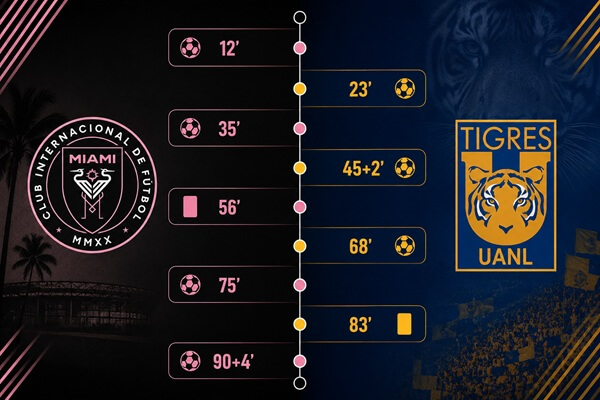
Inter Miami vs Tigres UANL Timeline: The Complete History of a Growing North American Rivalry
Two encounters. Two identical scorelines. One rivalry that is still finding its shape, yet already delivering some of the most memorable football in the brief but extraordinary history of the Leagues Cup competition. The Inter Miami vs Tigres UANL timeline is compact, but every chapter inside it has been worth reading twice.
When Inter Miami CF were founded in 2020 as MLS’s 26th franchise, no one was drawing up future rivalry charts featuring Tigres UANL from Monterrey. But football has a way of writing its own scripts, and when the Leagues Cup format paired MLS clubs against Liga MX sides in a competitive continental tournament from 2023, the conditions were created for exactly this kind of cross-border matchup to grow into something meaningful.
What we now have is a head-to-head record that sits at 1-1, a shared scoreline of 2-1 across both meetings, and the unmistakable feeling that this is a fixture both clubs will face again in tournament football as North America’s footballing calendar expands toward the 2026 FIFA World Cup era.
This complete timeline covers every competitive meeting between Inter Miami and Tigres UANL, the key goals and moments that defined each match, the players who shaped the results, the tactical stories behind the scorelines, why this cross-league rivalry matters in the context of MLS vs Liga MX history, and what the future holds for these two clubs as North American football enters its most important decade.
Background: Two Clubs, Two Football Cultures
Inter Miami CF: Ambition, Star Power, and a Rapid Rise
Inter Miami CF were co-founded by David Beckham in 2020 and quickly became one of the most talked-about clubs in MLS history, though not initially for their results. The early years were difficult. Miami finished at or near the bottom of the Eastern Conference in their first two seasons, building infrastructure and identity while struggling to translate investment into on-field success.
The transformation arrived in the summer of 2023 when Lionel Messi signed with the club. It was one of the most seismic moments in American football history. The eight-time Ballon d’Or winner’s arrival turned Inter Miami into a global media event overnight. Messi was joined by fellow Barcelona veterans Sergio Busquets and Jordi Alba, and the club immediately felt the effects. They won the 2023 Leagues Cup in their first proper run in the competition, defeating Nashville SC on penalties in the final. The Herons had arrived.
By 2025, under coach Javier Mascherano, another former Barcelona and Argentina great, Inter Miami had become a genuine Leagues Cup contender and a recognised force in MLS. The squad blended experienced European stars with promising younger talent like Tadeo Allende, Telasco Segovia, and Rodrigo De Paul, forming a team capable of competing with the best clubs in Liga MX on knockout tournament nights.
Tigres UANL: Liga MX Royalty from Nuevo León
Club de Futbol Tigres UANL, based in San Nicolás de los Garza in the metropolitan area of Monterrey, Nuevo León, are one of the most successful clubs in modern Mexican football. Funded by the Cemex industrial giant and with a passionate fanbase in one of Mexico’s largest cities, Tigres have won eight Liga MX titles and reached the 2021 FIFA Club World Cup final, where they lost narrowly to Bayern Munich but became the first CONCACAF club to reach that stage.
The club’s identity is built around high defensive organisation, physical intensity, and the ability to produce moments of individual brilliance. Their supporters, known as La Adicción, are among the loudest and most loyal in Liga MX. By the time Tigres met Inter Miami in 2024, they were one of Mexico’s most respected exports onto the continental stage, and a fixture against a star-studded Miami side carried enormous significance for their own standing in North American football.
Match 1: August 3, 2024 — Leagues Cup Group Stage
Venue: NRG Stadium, Houston, Texas
Competition: Leagues Cup 2024, Group Stage
Result: Tigres UANL 2-1 Inter Miami CF
The first competitive meeting between Inter Miami and Tigres UANL took place at NRG Stadium in Houston, Texas, on August 3, 2024, in the group stage of the Leagues Cup. Both clubs had already won their opening group games and were competing for top spot in their bracket. Neither side needed the three points desperately, but both wanted them, and the match played out like a game with meaning throughout.
First Half: Tigres Draw First Blood
Tigres UANL drew first blood through Juan Brunetta in the 18th minute. It was an early blow for Miami, who had entered the tournament in strong MLS form. Brunetta’s goal gave Tigres the initiative and set the tempo for a combative first half. Inter Miami struggled to create meaningful chances in the opening exchanges, with Tigres’ defensive organisation limiting space in central areas.
Miami went into the break trailing and needing a reaction. What they had in their favour was the individual quality capable of changing a game in a single moment — quality that would eventually show itself in the second half.
Second Half: Miami Equalise, Then Heartbreak
The second half brought Miami’s most important moment of the match. Leonardo Campana, Inter Miami’s Ecuadorian striker, converted a penalty in the 74th minute after a handball in the box was spotted by the referee. The equaliser felt like a turning point. Miami had their tails up, the crowd was engaged, and Tigres looked momentarily destabilised.
But just ten minutes later, Juan Pablo Vigón restored Tigres’ advantage. Vigón’s 84th-minute winner was the type of goal that defines group-stage outcomes — late, composed, and delivered with the game hanging in the balance. Tigres held out for the final few minutes and took the 2-1 victory, claiming top spot in their group.
The first installment of the Inter Miami vs Tigres UANL timeline had been written, and it belonged to the Mexican side. Tigres had shown that their Liga MX experience and collective organisation could overcome Miami’s individual star power on a given night. But the match also confirmed something important: these two clubs play close, absorbing games decided by margins of one goal and one moment of quality.
Key Takeaways from the 2024 Meeting
- Tigres demonstrated that disciplined defensive organisation could limit Miami’s attacking output even with star-quality players on the pitch.
- Leonardo Campana’s penalty gave Inter Miami hope and showed the Herons could fight back under pressure.
- Vigón’s late winner highlighted the Liga MX quality of game management in tight knockout-adjacent matches.
- The match confirmed that any future meetings in this cross-league fixture would be tightly contested affairs decided by individual moments rather than comprehensive tactical dominance.
Match 2: August 20-21, 2025 — Leagues Cup Quarterfinal
Venue: Chase Stadium (formerly DRV PNK Stadium), Fort Lauderdale, Florida
Competition: Leagues Cup 2025, Quarterfinal
Result: Inter Miami CF 2-1 Tigres UANL
Thirteen months after their first meeting, Inter Miami and Tigres UANL faced each other again — this time in the knockout stage of the Leagues Cup 2025, with a place in the semifinals at stake. The stakes were higher, the venue had shifted to Miami’s home ground at Chase Stadium in Fort Lauderdale, and the drama delivered was even more concentrated than their 2024 group stage encounter.
Context and Pre-Match Situation
Inter Miami entered the quarterfinal in the form of their lives. The Herons had accumulated eight points in the Leagues Cup 2025 group stage with wins over Atlas FC and Pumas UNAM and a penalty shootout victory after drawing with another opponent. Miami were the form team of the tournament heading into the quarterfinals.
Tigres, meanwhile, had qualified from their group with six points, defeating Houston Dynamo FC and San Diego FC before completing the group stage with a draw. They were not the unstoppable force of some of their Liga MX peak seasons, but they remained a dangerous, experienced knockout-round opponent.
The headline absence for Miami was enormous: Lionel Messi. The Argentine captain had picked up a mild muscle injury in the group stage match against Necaxa, missed subsequent games, returned to action with a goal and an assist against LA Galaxy, and then suffered a setback that ruled him out of the quarterfinal. His name was missing from the starting lineup when the team sheets were announced, dealing a significant psychological blow before kick-off. It was, in the words of many observers, the biggest test Javier Mascherano’s side had faced: could the Herons win a Leagues Cup knockout match without the greatest footballer of his generation?
First Half: Suárez Opens the Scoring
The answer, delivered over 90 highly charged minutes, was yes. Luis Suárez provided it in the 23rd minute, converting a penalty to give Inter Miami a 1-0 lead. The veteran Uruguayan striker, playing on what felt like borrowed time with his career but consistently proving otherwise, was calm and precise from the spot. It was his second Leagues Cup 2025 goal and another reminder that when games require someone to step into the moments that Messi would normally own, Suárez has been that man.
The first half ended 1-0 to Miami. Tigres had created moments of danger but could not find the equaliser before the break. Miami’s defensive structure without Messi was actually compact and organised — Mascherano’s side appeared liberated by the challenge rather than paralysed by it.
Second Half: Correa Equalises, Ustari Saves the Day, Suárez Wins It
Tigres came out transformed in the second half and found their equaliser in the 67th minute through Ángel Correa. The forward’s well-taken strike drew Tigres level and set up a final 25 minutes that had everything a football match can offer: tension, controversy, near-misses, and a match-winning moment.
In the 75th minute, goalkeeper Óscar Ustari produced one of the saves of the Leagues Cup tournament, denying a powerful Correa shot from inside the box that seemed destined for the net. It was the type of save that changes football matches. Without it, Tigres would have led 2-1 heading into the final ten minutes, and the storyline of this quarter-final might have been entirely different.
Mascherano’s evening had already taken a strange turn when he received a red card before the second half restart for giving tactical instructions via mobile phone — a bizarre sidebar to the main narrative that underlined the unusual intensity of the night. Miami’s staff managed the touchline situation, and the team did not lose focus.
Then came the 89th minute. With the match level at 1-1 and seemingly heading toward extra time, Inter Miami won another penalty. Suárez stepped up for his second spot kick of the night. A miss would have meant extra time at minimum, potentially penalties, and a deeply uncertain passage through. Suárez did not miss. He buried it, wheeled away in celebration, and Chase Stadium erupted. It was his fourth goal in his last four appearances across all competitions, his third of the Leagues Cup 2025 campaign, and arguably the most important penalty he had scored in pink and black.
Jordi Alba had also been forced off with a leg injury in the second half, adding to Miami’s casualty list, but nothing could diminish the significance of what had been achieved. Inter Miami had defeated Tigres UANL 2-1 in a Leagues Cup quarterfinal without their best player, through the sheer force of veteran quality, goalkeeping brilliance, and nervous system courage in the final minute.
Also read: Lucknow Super Giants vs Kolkata Knight Riders Timeline
Key Takeaways from the 2025 Quarterfinal
- Luis Suárez’s two-penalty performance was the defining individual contribution of the match and one of the most important nights of his Inter Miami career.
- Óscar Ustari’s 75th-minute save was the decisive intervention that kept Miami level and enabled Suárez’s winner.
- Inter Miami proved they could win Leagues Cup knockout matches without Lionel Messi, answering one of the central questions about the team’s genuine depth.
- Ángel Correa’s equaliser showed Tigres’ quality and why they remain one of Liga MX’s most dangerous clubs in continental competition.
- Mascherano’s red card added a subplot of chaos to an already dramatic night without derailing the team’s focus.
Head-to-Head Record: Inter Miami vs Tigres UANL
Total meetings: 2
Inter Miami wins: 1 (2025 Leagues Cup Quarterfinal)
Tigres UANL wins: 1 (2024 Leagues Cup Group Stage)
Draws: 0
Goals scored by Inter Miami: 3
Goals scored by Tigres UANL: 3
Both meetings decided by: The same 2-1 scoreline
Average goals per meeting: 3.0
The symmetry in this head-to-head record is almost poetic. Both clubs have won one game each, both by exactly 2-1. Goals conceded and scored are perfectly level. There is no statistical basis for declaring either club superior in this specific matchup, which is exactly what makes the prospect of a third meeting so compelling for supporters of both sides and for observers of North American football’s cross-league dynamics.
The Bigger Picture: MLS vs Liga MX in the Leagues Cup
The Inter Miami vs Tigres UANL head-to-head exists within the broader context of the Leagues Cup competition, which was launched in its expanded format in 2023 to create structured competitive matches between MLS and Liga MX clubs. The Leagues Cup represents the most significant attempt in the history of North American football to measure these two leagues directly against each other in a meaningful competitive environment.
Before the Leagues Cup expansion, MLS clubs occasionally met Liga MX sides in the CONCACAF Champions League, but those encounters were often complicated by squad rotation and differing levels of prioritisation. The Leagues Cup changed that. Every club in both leagues participates. The format matters. The results mean something beyond a friendly score.
Inter Miami vs Tigres UANL is one of the most high-profile individual matchups the Leagues Cup has produced, not because of the history between the clubs — which is still very short — but because of the narrative ingredients: the world’s most famous active footballer on one side, a Liga MX institution on the other, late goals, saves that change matches, and results that have always been decided by a single goal.
The broader MLS vs Liga MX debate continues to evolve. Mexican clubs have historically held the upper hand in CONCACAF competition, but MLS has been closing the gap consistently as salary caps rise, Designated Player rules allow world-class recruitment, and American football infrastructure improves. Each time an MLS club defeats a Liga MX opponent in a competitive setting, it contributes data to a larger conversation about the relative quality of the two leagues. Inter Miami’s 2025 quarterfinal win over Tigres was one such contribution.
Player Profiles: The Men Who Shaped This Timeline
Luis Suárez: The Veteran Who Defined the Rivalry
No player has shaped the Inter Miami vs Tigres UANL timeline more directly than Luis Suárez. In the one match where he had the most significant role — the 2025 quarterfinal — he scored both goals from the penalty spot, with the second arriving in the 89th minute to seal the win. Suárez joined Inter Miami in 2024 after spells at Barcelona, Atletico Madrid, Nacional, and Grêmio. His arrival in MLS at age 37 was seen by many as a final curtain tour, but he confounded expectations repeatedly. The Leagues Cup 2025 quarterfinal against Tigres was perhaps his most important night in pink and black.
Ángel Correa: Tigres’ Torch Bearer
Tigres’ Ángel Correa was the standout attacking player for the Mexican side across both meetings. His equaliser in the 67th minute of the 2025 quarterfinal showed his quality in front of goal and why Tigres trusted him as a focal point of their attack. Correa’s ability to score against one of MLS’s most prepared defensive units underlined the quality that Liga MX regularly produces at the forward position.
Lionel Messi: The Presence in Absence
Messi did not play in the 2024 group stage meeting or the 2025 quarterfinal. His absence from the second match in particular was the dominant pre-match narrative. Yet his influence on the Inter Miami project is so total that even his absence defines the context of these games. The fact that Miami beat Tigres without him in a knockout match was arguably the most important statement the Leagues Cup 2025 run made about the depth of Mascherano’s squad. Messi remains the gravitational centre of Inter Miami’s existence, and his eventual return to the pitch in future Leagues Cup editions is the single most anticipated event in this rivalry’s developing history.
Óscar Ustari: The Goalkeeper Who Changed the Match
Ustari’s save in the 75th minute of the 2025 quarterfinal was the decisive intervention that kept Miami in the match when Tigres should have taken the lead. His reading of the situation, his positioning, and the power of the save were of the highest quality. In a match of small margins, Ustari’s moment was the fulcrum around which the entire result turned.
Juan Brunetta and Juan Pablo Vigón: Tigres’ 2024 Heroes
The 2024 group stage match was shaped by two Tigres players who are less globally recognised but performed at the highest level when it counted. Juan Brunetta’s 18th-minute opener set Tigres on the right path, and Juan Pablo Vigón’s 84th-minute winner showed Tigres’ ability to close out close matches — a hallmark of their Liga MX success over recent years.
Tactical Analysis: How These Teams Play Each Other
Both meetings have followed a similar tactical pattern, which suggests there is something structural about how these two clubs match up against each other rather than circumstantial variation between games.
Tigres tend to set up in a mid-block defensive shape against Inter Miami, allowing Miami to build from the back while maintaining compact defensive lines that are difficult to play through centrally. This forces Miami wide and into crossing situations. In both meetings, Miami’s goals came from penalty kicks rather than open play build-up, which is consistent with a Tigres defensive approach that concedes individual errors or fouls in dangerous areas while resisting sustained sustained phase-of-play combination attacks.
Inter Miami’s attacking approach against Tigres has relied on the individual quality of their forwards to create moments of danger. Without the ability to consistently unlock Tigres through central combinations, Miami has depended on individual actions — Suárez’s positioning in the penalty area, Messi’s ability to create space where none exists — to generate the decisive moments.
Tigres’ attacking play against Miami has been more direct, looking to use the physical qualities of their forwards and the midfield running of players like Vigón and Correa to exploit transitions. Their equalising goal in 2025 came from exactly this type of move: a counter that finished with a composed strike rather than a patient build-up.
The tactical battle in this fixture is genuinely interesting because neither team has found a consistent way to dominate the other. Three goals each from two meetings suggests a matchup in rough equilibrium, where the result is determined by who executes the small details better on the night rather than by a systematic tactical advantage for either side.
Why This Rivalry Will Keep Growing
The Inter Miami vs Tigres UANL timeline has only two entries, but the infrastructure for its continued growth is already in place. The Leagues Cup will continue as the primary competition where MLS and Liga MX clubs face each other. Both Inter Miami and Tigres are regular Leagues Cup participants and, given their respective quality and profiles, likely to continue meeting in the competition’s knockout stages.
Beyond the Leagues Cup, the expansion of the CONCACAF Champions Cup — the rebranded CONCACAF Champions League — has increased the number of meaningful cross-league fixtures available to both organisations. If either club advances deep into the Champions Cup, the probability of a third meeting in a competitive cross-league context increases.
The timing also matters enormously. The 2026 FIFA World Cup will be held across the United States, Canada, and Mexico, which is generating an unprecedented level of investment in football infrastructure and fan engagement across North America. The commercial and cultural environment surrounding the sport in this region has never been more dynamic, and fixtures like Inter Miami vs Tigres UANL sit right at the intersection of the two largest football markets on the continent.
There is also the question of what Inter Miami will look like in the coming years. Messi has indicated his intention to finish his career in Miami, and the franchise has every incentive to continue building a squad capable of competing in both MLS and continental tournaments at the highest level. For Tigres, the drive to establish themselves as CONCACAF’s benchmark Liga MX club in continental competition remains central to their institutional identity. Both clubs have reasons to want this rivalry to continue, and to grow.
Frequently Asked Questions
How many times have Inter Miami and Tigres UANL played each other?
As of the time of writing, Inter Miami CF and Tigres UANL have met twice in competitive football. Both meetings took place in the Leagues Cup: the first in the 2024 group stage on August 3, 2024, which Tigres won 2-1, and the second in the 2025 quarterfinal on August 20-21, 2025, which Inter Miami won 2-1.
Who won the Inter Miami vs Tigres UANL head-to-head?
The head-to-head record is perfectly level. Tigres UANL won the 2024 group stage meeting 2-1 in Houston. Inter Miami won the 2025 quarterfinal 2-1 at Chase Stadium in Fort Lauderdale. Both clubs have won one match each, and the overall goals record is 3-3.
Did Lionel Messi play against Tigres UANL?
Messi did not play in either competitive meeting between Inter Miami and Tigres UANL. In the 2024 group stage match, Messi featured in the tournament but not in this specific fixture. In the 2025 quarterfinal, he was absent due to a mild muscle injury sustained in the group stage. His absence from the 2025 quarterfinal made Inter Miami’s 2-1 win particularly significant.
Who scored for Inter Miami against Tigres in the 2025 Leagues Cup quarterfinal?
Luis Suárez scored both of Inter Miami’s goals in the 2025 Leagues Cup quarterfinal against Tigres UANL. He converted penalty kicks in the 23rd and 89th minutes. Ángel Correa scored Tigres’ equalising goal in the 67th minute.
What competition do Inter Miami and Tigres UANL meet in?
Both competitive meetings between Inter Miami and Tigres UANL have taken place in the Leagues Cup, an annual tournament that pits all MLS clubs against all Liga MX clubs in a cross-league competition. The two clubs could also meet in the CONCACAF Champions Cup if both qualify and advance in that competition.
What is the significance of the Inter Miami vs Tigres UANL rivalry?
The rivalry represents a microcosm of the broader MLS vs Liga MX competition dynamic that the Leagues Cup was designed to create. Inter Miami is the most globally visible MLS club, and Tigres is one of Liga MX’s most established and successful clubs. Their meetings serve as a benchmark match for measuring the relative quality of American and Mexican football on the same competitive stage.
Conclusion: A Timeline Still Being Written
The Inter Miami vs Tigres UANL timeline is two matches old. In the context of football rivalries, that is barely a prologue. But those two matches have been tight, dramatic, decided by late goals and penalty kicks, shaped by individual moments of brilliance from veteran players, and set against the backdrop of the most watched cross-league competition in North American football history.
What makes this rivalry compelling is not just what has already happened but what is still to come. Messi against a Mexican defence. Tigres seeking revenge on Miami’s home ground. Inter Miami attempting to maintain their Leagues Cup momentum year after year. These are the chapters that have not yet been written, and the conditions for writing them are already in place.
For now, the record stands at 1-1. The goals are level. The drama has been equal in both directions. Somewhere in a stadium in Fort Lauderdale or Monterrey, the third chapter of this story is already waiting to be played.