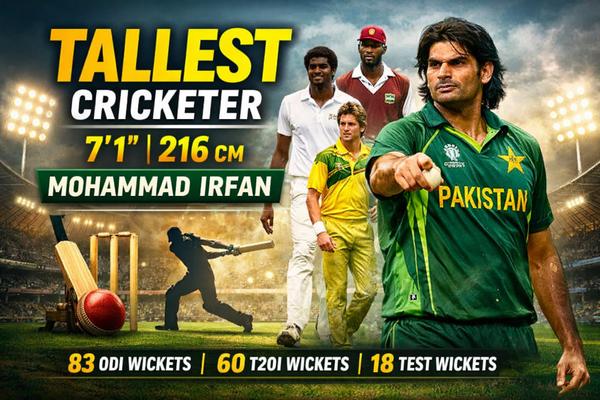
Tallest Cricketer
You notice height immediately in cricket. A batter walks out, you scan the stance. A bowler charges in, you judge the action. But when a giant runs in from the boundary and releases the ball from somewhere near the clouds, you stop thinking about technique and start thinking, “How do you even face that?”
Height changes cricket. It changes bounce, angles, intimidation, and even team strategy. So when we talk about the tallest cricketer, we do not just talk about numbers on a measuring tape. We talk about physics, psychology, and pure spectacle.
Let’s settle it properly and then break down what height really means in the game we love.
Who Holds the Title of Tallest Cricketer?
If you want a straight answer, here it is:
Mohammad Irfan stands as the tallest cricketer to play international cricket at 7 feet 1 inch (216 cm).
Yes, you read that correctly. Seven feet one inch. That height belongs in a basketball arena, not a cricket pitch. Yet Irfan used it to bowl thunderbolts for Pakistan.
He does not just edge past others. He towers over them. Even among tall fast bowlers, he looks like he plays a different sport.
Now let’s break down how he reached that position and what makes him unique.
Mohammad Irfan: The Giant of International Cricket
Early Impact
Mohammad Irfan debuted for Pakistan in 2010. He entered international cricket with one obvious advantage: height. He did not need dramatic action tweaks or mystery deliveries. He simply released the ball from a point most batters rarely experience.
When he ran in, you felt the anticipation. When he let the ball go, it felt like it came from the second floor of a building.
Why His Height Matters
Height in fast bowling creates:
-
Steeper bounce
-
Awkward angles
-
Extra carry off the surface
-
Psychological pressure
Irfan exploited all four.
Even on flat subcontinent pitches, he extracted bounce. Even defensive shots felt risky. Batters struggled to adjust because they did not face bowlers of that release point regularly.
He forced batters to rethink technique.
International Career Snapshot
Irfan played across formats and delivered solid numbers. He did not dominate like some legends, but he carved a niche as a dangerous limited-overs bowler.
He grabbed:
-
83 ODI wickets
-
60 T20I wickets
-
18 Test wickets
His height remained his biggest weapon. His control fluctuated at times, but his bounce never disappeared.
Other Extremely Tall Cricketers in History
Mohammad Irfan leads the height chart, but cricket history features several giants. Let’s talk about the players who also made batters look up—literally.
Joel Garner – The West Indian Tower
Joel Garner measured 6 feet 8 inches (203 cm). He did not just bowl fast. He dominated.
He formed part of the terrifying West Indies pace battery during the late 1970s and 1980s. That lineup bullied batting orders around the world.
Garner’s height gave him brutal bounce. His yorkers crushed toes. His control turned intimidation into destruction.
He collected:
-
259 Test wickets
-
259 ODI wickets
Yes, the same number in both formats. That stat alone deserves a double take.
Bruce Reid – Australia’s Lanky Weapon
Bruce Reid also stood at 6 feet 8 inches. Injuries limited his career, but he troubled batters whenever he played.
Reid used his height to generate sharp lift from good length. He did not rely purely on pace. He relied on awkward bounce.
He took:
-
113 Test wickets
-
63 ODI wickets
Fans often wonder what his career numbers would look like without injuries. His height and skill suggested something much bigger.
Curtly Ambrose – The Silent Assassin
Curtly Ambrose stood at 6 feet 7 inches (201 cm). He did not scream or sledge constantly. He stared. Then he destroyed.
Ambrose used his height and precision to produce relentless bounce and seam movement. He dismantled top batting lineups repeatedly.
He secured:
-
405 Test wickets
-
225 ODI wickets
He did not just use height. He mastered it.
Boyd Rankin – Ireland’s Tall Spearhead
Boyd Rankin stands at 6 feet 8 inches. He represented both England and Ireland during his international career.
Rankin delivered steep bounce, especially in helpful conditions. His height helped him challenge batters in unfamiliar ways.
He finished with:
-
62 Test wickets
-
76 ODI wickets
He did not dominate world cricket, but he consistently used his frame to create problems.
How Height Changes Fast Bowling
You cannot ignore physics. Height directly influences release point. That release point influences trajectory. That trajectory influences bounce and difficulty.
Let’s simplify it.
A taller bowler releases the ball from higher above the ground. That higher release creates a steeper angle toward the batter. The ball hits the pitch and rises sharply.
Batters prefer predictable bounce. Tall bowlers disrupt that comfort.
The Psychological Factor
Imagine facing someone over seven feet tall. You look up. He looks down. That dynamic alone creates pressure.
Batters feel rushed. They misjudge length. They push at deliveries they should leave.
Tall bowlers use intimidation even before the first ball lands.
The Tactical Advantage
Captains use tall bowlers strategically:
-
New ball bursts
-
Middle overs pressure
-
Short-ball plans
-
Exploiting cracks on dry pitches
Tall bowlers thrive when pitches offer variable bounce. They also thrive when batters attempt aggressive stroke play in limited-overs cricket.
Does Height Guarantee Success?
Not at all.
Height helps, but skill decides careers.
You still need:
-
Accuracy
-
Fitness
-
Mental strength
-
Tactical awareness
Mohammad Irfan’s career proves that height alone does not guarantee legendary status. Joel Garner and Curtly Ambrose combined height with control and discipline. That combination produced greatness.
Height amplifies talent. It does not replace it.
Tallest Cricketer vs Shorter Greats
Let’s flip the discussion.
Some of the greatest fast bowlers in history did not rely on towering frames. Think about bowlers under 6 feet who terrorized batters with pace, swing, or skill.
So what matters more: height or execution?
Execution wins.
Tall bowlers create bounce. Shorter bowlers create skid and swing. Each type brings advantages. Each type demands different adjustments from batters.
Cricket thrives on variety.
Statistical Comparison of Tallest Cricketers
Here’s a clean snapshot of the tallest cricketers and their key numbers.
| Player | Height | Country | Role | Career Span | Test Wickets | ODI Wickets | T20I Wickets |
|---|---|---|---|---|---|---|---|
| Mohammad Irfan | 7 ft 1 in (216 cm) | Pakistan | Fast Bowler | 2010–2019 | 18 | 83 | 60 |
| Joel Garner | 6 ft 8 in (203 cm) | West Indies | Fast Bowler | 1977–1987 | 259 | 259 | N/A |
| Bruce Reid | 6 ft 8 in (203 cm) | Australia | Fast Bowler | 1985–1992 | 113 | 63 | N/A |
| Curtly Ambrose | 6 ft 7 in (201 cm) | West Indies | Fast Bowler | 1988–2000 | 405 | 225 | N/A |
| Boyd Rankin | 6 ft 8 in (203 cm) | Ireland/England | Fast Bowler | 2007–2020 | 62 | 76 | Limited |
That table highlights something interesting. The tallest cricketer does not own the most wickets. Ambrose leads comfortably.
Skill plus height beats height alone.
Why Cricket Favors Tall Fast Bowlers
Modern cricket increasingly values tall pacers. Coaches actively scout players above 6 feet 5 inches. Why?
Because:
-
Taller bowlers generate bounce on flat decks.
-
They extract life from dead pitches.
-
They create awkward hitting angles in T20 cricket.
-
They reduce the margin for error for batters.
Teams build pace attacks around bounce. Bounce unsettles even technically strong players.
Tall bowlers provide that weapon.
Challenges Tall Cricketers Face
Height sounds glamorous, but it brings problems.
Injury Risks
Long limbs endure extra stress. Knees, ankles, and backs suffer more strain. Fast bowling multiplies that stress.
Many tall bowlers struggle with recurring injuries. Bruce Reid’s career illustrates that reality clearly.
Coordination and Rhythm
Taller players often need longer time to coordinate movements. Fast bowling demands perfect rhythm.
Any imbalance magnifies at that scale.
Fielding Limitations
Tall players sometimes struggle with agility in the deep. They also adjust slowly to quick ground fielding situations.
They trade mobility for reach.
Are There Tall Batters in Cricket?
Fast bowlers dominate height discussions, but tall batters exist too.
Height helps batters cover bounce and play pull shots confidently. Taller batters often handle short-pitched bowling better because the ball arrives at a comfortable zone.
However, excessive height can complicate footwork against spin. Long legs require sharper coordination.
Balance matters.
The Entertainment Factor
Let’s admit something. Fans love extremes.
We love the fastest ball. We love the longest six. We love the tallest cricketer.
Height grabs attention instantly. Broadcasters zoom in. Commentators mention it repeatedly. Social media reacts immediately.
That spectacle adds flavor to cricket.
When Mohammad Irfan stands next to teammates during the national anthem, fans stare. Cameras focus. Conversations begin.
That visual alone boosts engagement.
How Batters Prepare for Extremely Tall Bowlers
Preparation changes when you face a giant.
Batters:
-
Practice against bowling machines set for extra bounce
-
Focus on leaving balls outside off stump
-
Avoid planting feet too early
-
Keep hands soft
They also adjust mindset. They expect bounce. They accept discomfort.
Preparation reduces shock.
Youth Cricket and Height Trends
Youth academies now track physical attributes carefully. Selectors notice height early.
However, smart academies avoid selecting purely on size. They focus on skill development first.
A tall 16-year-old with raw pace excites coaches. But coaches must refine control before celebrating potential.
Height without control frustrates captains quickly.
Can Someone Taller Break the Record?
Technically, yes.
Nothing stops a 7 feet 2 inch athlete from choosing cricket. But practical limitations reduce probability.
Very tall athletes often gravitate toward basketball or volleyball. Cricket competes for that talent pool.
If cricket continues expanding globally, someone might eventually surpass Mohammad Irfan’s height record.
For now, he owns the title comfortably.
The Legacy of the Tallest Cricketer
Records fade. Performances fluctuate. Height records remain simple and clear.
Mohammad Irfan’s name will always appear when fans search for the tallest cricketer in the world. That fact secures his place in trivia forever.
Even if another player breaks the record, Irfan will still represent the first major benchmark at 7 feet 1 inch.
Cricket history loves milestones.
Height vs Pace: Which Matters More?
Let’s debate honestly.
Would you prefer a 6 feet 8 inch bowler at 130 km/h or a 5 feet 11 inch bowler at 150 km/h?
Most captains choose pace.
Height enhances bounce. Pace reduces reaction time. The best tall bowlers combine both.
Curtly Ambrose combined bounce, control, and pace. Joel Garner combined height and lethal yorkers. That blend created greatness.
Height alone never frightens elite batters. Skill amplifies fear.
My Honest Take
I love watching tall bowlers operate. They change viewing angles. They disrupt rhythm. They create awkward dismissals.
But I value execution more.
Ambrose excites me more than Irfan because Ambrose mastered every element. Garner fascinates me because he paired height with ruthless accuracy.
The tallest cricketer record impresses me. The most complete tall bowler inspires me.
Why This Topic Always Trends
Search trends reveal something interesting. Fans consistently search for:
-
Tallest cricketer in the world
-
Height of Mohammad Irfan
-
Tallest fast bowler in cricket history
People crave extremes.
Height stands out visually. It creates instant curiosity. You cannot ignore a seven-foot athlete on a cricket field.
That curiosity drives engagement.
Final Thoughts on the Tallest Cricketer
So here’s the simple answer you came for:
Mohammad Irfan stands as the tallest cricketer in international cricket history at 7 feet 1 inch (216 cm).
But the deeper story goes beyond measurement.
Height changes bounce. Height changes angles. Height changes perception. Yet skill still decides legacy.
Joel Garner and Curtly Ambrose proved that tall bowlers can dominate eras. Bruce Reid and Boyd Rankin showed how height offers opportunity but demands durability. Irfan demonstrated how extreme height creates instant global recognition.
Cricket thrives on diversity. It welcomes giants and compact dynamos equally. It rewards execution above all.
Next time you watch a tall fast bowler run in, look at the release point. Watch how the ball climbs. Notice the batter’s adjustment. That tiny battle tells the real story behind the tallest cricketer debate.
And who knows? Maybe one day someone even taller will stride onto the field and make us look up again.
Until then, Mohammad Irfan holds the crown comfortably.