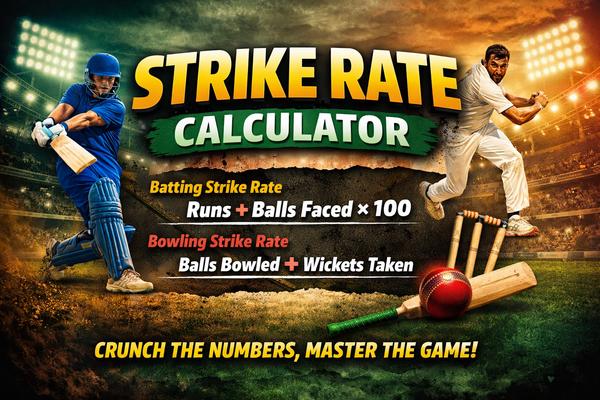
Strike Rate Calculator
You check the scoreboard in ESPN Cricket. Your favorite batter smashed 45 runs off 25 balls. Looks solid, right? But then someone asks, “What’s his strike rate?” and suddenly the conversation turns serious.
That single number tells the real story. And if you truly love cricket, you need to understand how a Strike Rate Calculator works and why it matters so much.
Let’s break it down like two fans arguing over tea during a tense chase.
What Exactly Is Strike Rate in Cricket?
Strike rate shows how fast a batter scores runs. It answers one simple question: How many runs does a player score per 100 balls?
You calculate strike rate using this formula:
Strike Rate = (Runs Scored / Balls Faced) × 100
That’s it. No rocket science. No complicated stats degree required.
If a batter scores 50 runs off 25 balls, you divide 50 by 25 and multiply by 100. That gives you 200. That means the batter scores at a rate of 200 runs per 100 balls.
Sounds explosive, right? Because it is.
Why Strike Rate Matters More Than Ever
Cricket evolved fast. T20 leagues changed everything. Players now attack from ball one.
Back in the day, fans praised a steady 60 off 120 balls. Today, fans criticize that knock in white-ball cricket. Formats shape expectations.
Here’s why strike rate carries huge importance:
-
It reflects intent.
-
It shows pressure handling.
-
It indicates match impact.
-
It separates anchors from finishers.
-
It helps teams plan roles.
Teams now scout players based on strike rate. Analysts compare performances across formats. Commentators debate it endlessly.
And yes, fans use it to win arguments.
How a Strike Rate Calculator Helps You
You could calculate strike rate manually. You grab a calculator, divide runs by balls, multiply by 100, and done.
But during a live match, who wants to do math?
A Strike Rate Calculator gives you instant results. You enter runs and balls faced. The tool calculates automatically. You save time and avoid silly calculation mistakes.
Fantasy cricket players rely on it. Cricket bloggers use it. Coaches use it during analysis sessions.
If you love stats, you’ll use it often.
Step-By-Step: How To Calculate Strike Rate Manually
Let’s keep this simple.
Step 1: Note the Runs
Write down total runs scored.
Step 2: Note the Balls Faced
Count legal deliveries faced.
Step 3: Divide Runs by Balls
This gives you runs per ball.
Step 4: Multiply by 100
That converts it into runs per 100 balls.
Example:
-
Runs: 72
-
Balls: 48
72 ÷ 48 = 1.5
1.5 × 100 = 150 strike rate
See? Easy.
But again, during a nail-biter, you probably prefer a calculator.
Strike Rate Across Different Formats
Different formats demand different strike rates. You cannot judge a Test batter using T20 standards. That makes zero sense.
Test Cricket
Test cricket rewards patience. Batters build innings. They wear down bowlers.
A strike rate between 45 and 60 often works perfectly fine in Tests. Some aggressive players push beyond 70, but teams rarely demand extreme speed here.
One Day Internationals (ODIs)
ODIs demand balance. Batters rotate strike and accelerate later.
A good ODI strike rate usually falls between 85 and 100. Modern players often cross 100 comfortably.
T20 Cricket
T20 demands aggression. Teams expect power-hitting.
A strike rate below 120 raises eyebrows. Elite T20 batters often maintain 140 to 160. Some finishers even cross 180.
So context matters. Always judge strike rate within format.
Does Higher Strike Rate Always Mean Better Performance?
Not necessarily.
Imagine this:
Player A scores 30 off 10 balls. Strike rate 300.
Player B scores 90 off 60 balls. Strike rate 150.
Who helped more?
You need context. Match situation matters. Target matters. Pitch condition matters.
Strike rate tells you speed. It does not automatically measure match-winning value.
Cricket rarely works in black and white.
Strike Rate vs Batting Average
Fans often mix these two stats. They measure different things.
-
Batting average shows consistency.
-
Strike rate shows aggression.
A player can average 50 but strike at 75. That works well in Tests.
Another player can average 25 but strike at 170 in T20. That player might still win matches.
Teams balance both metrics carefully.
Strike Rate in T20 Leagues
Franchise cricket raised the bar.
Modern T20 leagues expect batters to attack every over. Anchoring roles still exist, but even anchors maintain high strike rates.
Powerplay overs reward risk-taking. Death overs demand fearless hitting.
A Strike Rate Calculator helps fantasy players analyze player value quickly. You compare two batters instantly and decide smarter.
Data wins leagues.
How Bowlers View Strike Rate
Bowlers absolutely track this stat.
If a batter carries a strike rate of 180 in death overs, bowlers adjust plans. They change lengths. They vary pace.
Strike rate forces strategic shifts. It influences field placements. It shapes captain decisions.
One number can change the entire field setup.
Common Mistakes People Make When Calculating Strike Rate
Let’s call out the usual errors.
-
People forget to multiply by 100.
-
People include extras incorrectly.
-
People miscount balls faced.
-
People round too aggressively.
Small mistakes distort perception.
Use a calculator and avoid drama.
How Strike Rate Impacts Fantasy Cricket Points
Fantasy cricket platforms reward aggressive batting.
Many platforms add bonus points for strike rate brackets. Slow innings sometimes trigger negative points.
So you need to understand strike rate deeply if you play fantasy leagues seriously.
One explosive 20 off 8 balls might outscore a steady 40 off 45.
That surprises many beginners.
Historical Evolution of Strike Rate
Cricket changed massively over decades.
In the 1980s, ODI strike rates around 70 looked respectable. Players focused on wicket preservation.
Modern players attack from ball one. Fitness improved. Bat technology improved. Boundary sizes shrank in some venues.
The game accelerated.
Now, even Test cricket witnesses aggressive approaches. Teams chase big totals boldly.
Strike rate reflects this evolution clearly.
Sample Strike Rate Benchmarks
Below you’ll find common benchmarks across formats. Use this table for quick reference.
| Format | Average Strike Rate | Good Strike Rate | Elite Strike Rate |
|---|---|---|---|
| Test Cricket | 45–55 | 60–70 | 75+ |
| ODI Cricket | 80–90 | 95–110 | 115+ |
| T20 Cricket | 115–125 | 135–150 | 160+ |
| Powerplay T20 | 130–145 | 150–165 | 175+ |
| Death Overs T20 | 150–170 | 175–190 | 200+ |
These numbers provide general guidance. Context still rules everything.
Strike Rate for Bowlers
Yes, bowlers also have strike rate.
Bowling strike rate measures how frequently a bowler takes wickets.
You calculate it using:
Bowling Strike Rate = Balls Bowled / Wickets Taken
Lower numbers indicate better performance. A bowling strike rate of 20 means the bowler takes a wicket every 20 balls.
Fast bowlers in Tests often aim for a strike rate under 55. Elite T20 bowlers aim much lower.
Cricket loves symmetry.
Advanced Analysis: Strike Rate in Phases
Modern analytics break innings into phases.
Powerplay
Field restrictions allow aggressive shots. Teams target high strike rates here.
Middle Overs
Teams balance risk. Strike rates often dip slightly.
Death Overs
Batters go all-out. Strike rates spike dramatically.
A simple Strike Rate Calculator helps analyze each phase separately. Coaches love this breakdown.
How Coaches Use Strike Rate Data
Professional teams track ball-by-ball data.
Coaches examine:
-
Strike rate against spin.
-
Strike rate against pace.
-
Strike rate in specific venues.
-
Strike rate while chasing.
They identify strengths and weaknesses quickly.
Data-driven cricket dominates modern strategy.
When Strike Rate Misleads You
Stats can trick you.
Imagine a batter scores 12 off 3 balls at the end of an innings. That creates a strike rate of 400.
But did that innings define the match? Maybe not.
Small sample sizes distort numbers.
Always check volume. Look at balls faced before judging.
Strike Rate and Match Situations
Strike rate depends heavily on match scenario.
Chasing 200 in T20 demands aggression. Chasing 120 on a slow pitch demands patience.
You cannot apply one formula blindly.
Smart fans analyze context first, numbers second.
Why Every Cricket Fan Should Use a Strike Rate Calculator
You enjoy cricket more when you understand the numbers.
A Strike Rate Calculator:
-
Saves time.
-
Prevents math errors.
-
Enhances match analysis.
-
Improves fantasy decisions.
-
Strengthens debates with friends.
You shift from casual viewer to informed fan instantly.
And yes, you win more arguments.
Real-World Example Analysis
Let’s compare two hypothetical T20 innings:
-
Player X: 64 off 40 balls
-
Player Y: 42 off 18 balls
Player X strike rate: 160
Player Y strike rate: 233.33
Player Y played fewer balls but shifted momentum quickly. Player X built stability.
Which innings mattered more? Match situation decides.
Strike rate gives clarity, not full judgment.
How To Interpret Strike Rate Like an Expert
Ask these questions:
-
What format does this match follow?
-
What stage of the innings did the player bat?
-
What pitch conditions existed?
-
What target did the team chase?
-
How many balls did the player face?
Context transforms raw numbers into real insight.
Strike Rate Trends in Modern Cricket
Modern cricket rewards fearless batting.
Young players grow up watching high-scoring leagues. They train for power-hitting. They practice range-hitting shots.
Strike rates continue to rise across formats.
Teams now prefer batters who maintain both average and strike rate. Dual skill matters.
Balance wins championships.
The Psychological Impact of Strike Rate
Strike rate creates pressure.
A batter stuck at run-a-ball in T20 feels scoreboard pressure. That pressure forces risky shots.
On the flip side, a high strike rate intimidates bowlers. Fielding captains adjust placements constantly.
Momentum shifts fast in limited-overs cricket.
Numbers influence psychology.
Technology and Strike Rate Calculation
Scoring apps now calculate strike rate instantly.
Broadcasters flash updated stats ball by ball. Analysts track trends live.
You no longer wait until post-match reports. You get insights instantly.
Technology made cricket smarter and faster.
Personal Take: Why I Always Check Strike Rate First
Whenever I watch a T20 match, I ignore raw runs initially.
I check balls faced. Then I calculate strike rate.
A quick 25 off 10 excites me more than 40 off 35 in most T20 scenarios.
IMO, aggressive intent changes games.
You might disagree, and that’s fine. Cricket thrives on debate.
Quick Reference Formula Summary
Let’s recap both formulas clearly:
-
Batting Strike Rate = (Runs ÷ Balls Faced) × 100
-
Bowling Strike Rate = Balls Bowled ÷ Wickets Taken
Simple formulas. Powerful insights.
Final Thoughts on Strike Rate Calculator
Cricket continues to evolve. Players adapt. Formats change. Expectations rise.
But one thing stays constant: numbers tell stories.
A Strike Rate Calculator gives you instant clarity. It helps you analyze performance faster. It sharpens your cricket brain.
You move from “That knock felt slow” to “That knock carried a strike rate of 92 in T20, which hurt the chase.”
That shift matters.
So next time someone throws stats around during a heated match discussion, don’t panic. Pull out the formula. Use the calculator. Own the conversation.
And if your friend still argues after that, well, some debates never end.