Indian Cricket Coach List
You follow Indian cricket, so you already know one thing: players grab headlines, but coaches build legacies. You remember the centuries, the last-over thrillers, and the World Cup celebrations. But do you remember who sat in the dugout, pulled the strings, and handled the chaos behind the scenes?
Let’s fix that today.
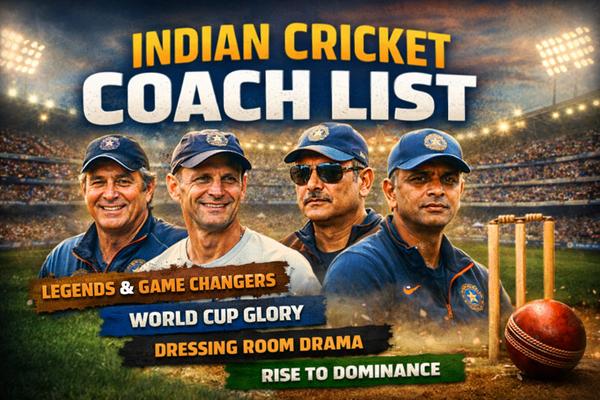
This Indian Cricket Coach List walks you through every major head coach of the Indian men’s national team. We will break down their tenures, records, controversies, and defining moments. We will talk numbers, trophies, dressing-room drama, and the evolution of Indian cricket from underdogs to global powerhouse.
Ready? Good. Let’s get into it.
Why The Indian Cricket Coach Matters More Than Ever
You might think talent wins matches. Sure, it helps. But structure, discipline, and planning win tournaments.
Modern cricket demands:
-
Tactical flexibility
-
Data-driven preparation
-
Fitness standards
-
Player rotation strategies
-
Mental conditioning
A head coach controls all of that. He shapes team culture. He backs youngsters. He handles egos. He absorbs pressure so players stay focused.
And trust me, managing Indian cricket pressure feels like juggling fire while riding a rollercoaster.
Early Era: Before Professional Coaching Took Over
Before the 1990s, Indian cricket did not obsess over structured coaching systems. Captains dominated strategy. Administrators made calls. Selection politics often influenced outcomes.
The formal head coach system became prominent in the 1990s. That shift changed everything.
Let’s look at the official list from that modern era onward.
Indian Cricket Coach List (Chronological Order)
1. Bishan Singh Bedi (1990–1991)
India appointed Bishan Singh Bedi as one of the earliest official head coaches.
He brought:
-
Old-school discipline
-
Emphasis on spin bowling
-
Technical correction methods
His tenure remained short. India struggled overseas. The team lacked consistency.
Still, Bedi helped transition India into a more structured coaching framework.
2. Abbas Ali Baig (Interim Phase)
India experimented with short-term arrangements during this period. Administrators tried to define the coaching role properly.
This phase lacked stability. India needed direction.
3. Anshuman Gaekwad (1997–1999, 2000)
Anshuman Gaekwad served two stints.
He coached during:
-
The 1999 World Cup
-
The match-fixing crisis era
Talk about tough timing.
He maintained composure while Indian cricket faced one of its darkest chapters. He did not win major trophies, but he helped steady the ship.
Sometimes survival counts as success.
4. Kapil Dev (1999–2000)
When Kapil Dev, India’s 1983 World Cup hero, took over, expectations soared.
Fans hoped magic would return.
Instead, controversy struck. Match-fixing allegations clouded the era. Results disappointed. His tenure ended quickly.
Even legends struggle in administrative chaos.
5. John Wright (2000–2005)
Here’s where things changed.
John Wright became India’s first foreign head coach. That decision transformed Indian cricket culture.
Under him, India achieved:
-
2001 Border-Gavaskar Trophy win vs Australia
-
2002 NatWest Trophy victory
-
2003 World Cup Final appearance
He backed youngsters like:
-
Virender Sehwag
-
Yuvraj Singh
-
Harbhajan Singh
He also built a strong partnership with Sourav Ganguly.
Wright brought professionalism. He introduced structure. He demanded accountability.
India stopped feeling intimidated overseas.
That shift mattered.
6. Greg Chappell (2005–2007)
Now we enter drama territory.
Greg Chappell arrived with bold ideas and zero fear of confrontation.
He pushed:
-
Youth over seniors
-
Aggressive fitness standards
-
Tactical experimentation
He also clashed publicly with Sourav Ganguly.
Results fluctuated. The 2007 World Cup exit hurt badly. India crashed out in the group stage.
His tenure ended in controversy.
IMO, he tried to modernize too quickly without managing emotions properly.
7. Ravi Shastri (Interim 2007)
India briefly appointed Ravi Shastri as interim coach during the 2007 T20 World Cup.
India won.
Yes, that tournament.
MS Dhoni lifted the trophy. Young guns delivered. India embraced fearless cricket.
Coincidence? Maybe.
But momentum started there.
8. Gary Kirsten (2008–2011)
Now we talk about gold.
Gary Kirsten led India during its most successful modern phase.
Achievements under him:
-
2011 ICC Cricket World Cup win
-
Test No. 1 ranking in 2009
-
Overseas Test victories
He allowed players to own responsibility. He maintained calm energy. He supported MS Dhoni’s leadership style.
He did not shout. He guided.
Players often call him one of the best coaches they worked with.
Results back that claim.
9. Duncan Fletcher (2011–2015)
Duncan Fletcher replaced Kirsten.
His tenure produced mixed outcomes.
India struggled overseas, especially in:
-
England (2011, 2014)
-
Australia (2011–12, 2014–15)
However, India won the 2013 Champions Trophy under his guidance.
He focused heavily on process and analytics. Fans questioned his intensity.
Transition phases rarely look pretty.
10. Anil Kumble (2016–2017)
Anil Kumble brought discipline and intensity.
Under him:
-
India dominated Test cricket at home
-
India reached No. 1 Test ranking
He demanded high fitness standards.
However, reports suggested tension between him and captain Virat Kohli.
He resigned after the 2017 Champions Trophy.
Strong personalities sometimes collide.
11. Ravi Shastri (2017–2021)
Yes, he returned.
Ravi Shastri became full-time head coach.
Under him, India achieved:
-
Historic Test series win in Australia (2018–19)
-
Border-Gavaskar Trophy win in Australia (2020–21)
-
Consistent ICC semifinal appearances
He built an aggressive, pace-driven Test side.
He backed fast bowlers relentlessly.
He trusted Kohli’s attacking mindset.
India did not win an ICC trophy during this period, but the team played fearless cricket overseas.
Fans still debate his tenure. Results abroad improved significantly.
That counts.
12. Rahul Dravid (2021–2024)
Rahul Dravid stepped in after Shastri.
He brought:
-
Technical expertise
-
Calm leadership
-
Youth integration focus
He emphasized bench strength.
Under him, India reached:
-
2023 World Test Championship Final
-
2023 ODI World Cup Final
India dominated bilateral series.
He managed heavy schedules smartly.
He prioritized workload management.
Many fans respect his methodical style.
Key Statistics Summary
Below you will find a consolidated table of major head coaches and their notable achievements.
| Coach | Tenure | Major ICC Achievement | Notable Record | Test Ranking Peak |
|---|---|---|---|---|
| John Wright | 2000–2005 | 2003 WC Final | 2001 Aus Series Win | Top 5 |
| Greg Chappell | 2005–2007 | None | Youth transition phase | Top 6 |
| Gary Kirsten | 2008–2011 | 2011 WC Winner | 2009 No.1 Test Team | No.1 |
| Duncan Fletcher | 2011–2015 | 2013 CT Winner | Overseas struggles | Top 2 |
| Anil Kumble | 2016–2017 | 2017 CT Final | Home dominance | No.1 |
| Ravi Shastri | 2017–2021 | None | 2 Aus Series Wins | No.1 |
| Rahul Dravid | 2021–2024 | 2023 WC Final | Bilateral dominance | Top 2 |
Comparing Coaching Styles
You see clear contrasts.
Aggressive Modernizers
-
Greg Chappell
-
Ravi Shastri
They pushed pace bowling depth. They emphasized bold cricket. They welcomed confrontation.
Calm Strategists
-
Gary Kirsten
-
Rahul Dravid
They built trust. They empowered captains. They avoided spotlight drama.
Discipline-First Leaders
-
Anil Kumble
-
John Wright
They valued structure and professionalism.
Each style shaped a different generation.
How Indian Coaching Philosophy Evolved
Phase 1: Survival And Stability
India tried to find consistency in the 1990s.
Phase 2: Professional Structure
John Wright introduced foreign professionalism.
Phase 3: Player Empowerment
Kirsten allowed players to lead mentally.
Phase 4: Fitness Revolution
Shastri and Kumble emphasized elite athletic standards.
Phase 5: Bench Strength Era
Dravid focused on grooming backups.
India now rotates players seamlessly across formats.
That system did not exist twenty years ago.
The Real Pressure Of Being India’s Head Coach
Let’s be honest.
No job in cricket attracts more scrutiny.
Every decision faces:
-
1.4 billion opinions
-
24/7 media analysis
-
Social media outrage
You lose one ICC knockout match and critics question everything.
You win a bilateral series and fans shrug.
That pressure breaks many.
Yet, some thrive.
What Makes A Successful Indian Coach?
Based on history, success requires:
-
Strong partnership with captain
-
Ability to manage star egos
-
Tactical adaptability
-
Emotional intelligence
-
Clear communication
Gary Kirsten nailed emotional balance.
Ravi Shastri mastered public messaging.
Rahul Dravid excels in development pathways.
Each found his niche.
Honest Opinion: Who Was The Best?
Numbers say Gary Kirsten.
Overseas Test achievements say Ravi Shastri.
Long-term structural impact says John Wright.
Calm mentorship says Rahul Dravid.
If I had to pick one? I lean toward Gary Kirsten.
Why?
He delivered the 2011 World Cup, built Test dominance, and maintained dressing-room harmony.
That combination rarely happens.
The Future Of Indian Cricket Coaching
Indian cricket no longer depends on individual brilliance alone.
The system now includes:
-
National Cricket Academy alignment
-
Data analytics teams
-
Mental conditioning staff
-
Specialized bowling and batting coaches
The head coach now acts as CEO of performance.
Future coaches must balance formats smartly.
They must handle franchise league influence.
They must maintain player freshness in a packed calendar.
Simple job description, right?
Not really.
Final Thoughts
This Indian Cricket Coach List shows more than names.
It shows evolution.
It shows how Indian cricket moved from instability to dominance.
It shows how leadership behind the scenes shapes trophies on the field.
Next time India wins a major tournament, remember the man in the dugout.
He absorbs the pressure so players can play free.
And if history tells us anything, Indian cricket will keep evolving, arguing, celebrating, and occasionally panicking.
That chaos keeps us hooked.
And honestly, we would not want it any other way.