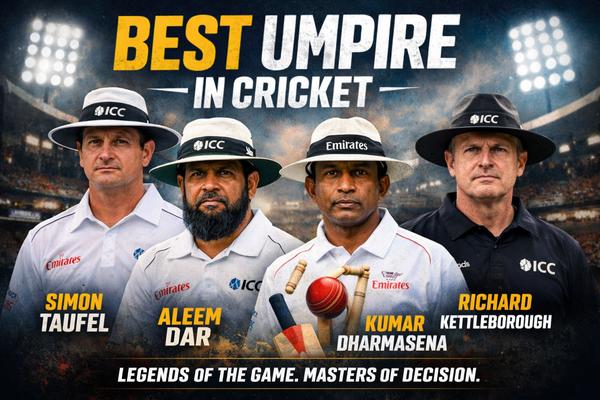
Best Umpire In Cricket
You and I both know this truth: cricket fans love arguing about everything. We debate the best batter, the best bowler, the best captain, and even the best IPL season. But what about the best umpire in cricket? Now that sparks a different kind of debate.
Umpires control the game’s rhythm. They handle pressure from 90,000 screaming fans. They make split-second decisions that players and entire nations scrutinize for years. One wrong finger raise can haunt someone forever. So who truly deserves the crown?
Let’s talk about it like proper cricket fans.
Why Umpires Matter More Than You Think
You notice umpires most when they make mistakes. That reality feels unfair, but it reflects human nature. When they get everything right, nobody talks. When they miss one edge, social media explodes.
An elite umpire controls chaos. He reads the bowler’s rhythm. He studies the batter’s movement. He senses tension in close matches. He maintains authority without arrogance.
Cricket demands more mental strength from umpires than most fans realize. A fast bowler charges at 145 km/h. The batter nicks it. The keeper dives. The crowd roars. The umpire decides in less than a second.
That job requires steel nerves.
What Makes Someone the Best Umpire In Cricket?
You cannot judge umpires by popularity. You must evaluate them on measurable factors and intangible qualities.
Here’s what truly matters:
-
Accuracy in decision-making
-
Consistency across formats
-
Control over high-pressure matches
-
Respect from players
-
ICC awards and recognitions
-
Longevity at the elite level
The best umpire in cricket excels in all these areas, not just one.
The Gold Standard: Simon Taufel
When you discuss the best umpire in cricket, you cannot avoid one name: Simon Taufel.
Taufel dominated the umpiring world during the 2000s. He built a reputation for razor-sharp decisions and calm authority. Players trusted him. Fans respected him. The ICC rewarded him.
He won the ICC Umpire of the Year award five consecutive times from 2004 to 2008. No one else achieved that streak. That fact alone tells you something.
He officiated major tournaments, including the Cricket World Cup finals and high-pressure Ashes Tests. He handled tense India-Pakistan matches without losing composure. He maintained clarity even in chaotic moments.
Many cricket experts still say, “If Taufel raised his finger, you walked.” That sentence carries weight.
Why Taufel Stands Out
Taufel focused heavily on preparation. He studied players. He analyzed bowling angles. He trained his concentration like an athlete.
He also embraced technology early. He understood DRS and adapted quickly. He never resisted change.
IMO, that mindset separates great umpires from stubborn ones.
The Iron Man: Aleem Dar
Next, you have Aleem Dar.
Dar built one of the longest elite careers in modern cricket. The International Cricket Council appointed him to the Elite Panel for nearly two decades.
He won ICC Umpire of the Year three consecutive times from 2009 to 2011. He officiated in more than 140 Test matches, which ranks among the highest in history. He also controlled over 220 ODIs and more than 70 T20Is.
That workload demands endurance.
Dar brought consistency. He rarely showed emotion. He maintained balance in heated subcontinent contests. Players respected his calm personality.
Some fans criticized him during the DRS era. Technology exposed marginal errors that human eyes once escaped. Still, he maintained one of the strongest decision accuracy percentages in ICC reports.
Longevity matters. Dar proved that point.
The Modern Benchmark: Kumar Dharmasena
Sri Lanka produced one of the sharpest cricket brains in Kumar Dharmasena.
Dharmasena played international cricket before he started umpiring. That experience gives him a different perspective. He understands player psychology because he lived it.
He stood in the 2015 and 2019 Cricket World Cup finals. Very few umpires receive that trust twice. That assignment shows ICC confidence in his judgment.
He blends authority with empathy. Players often engage in respectful dialogue with him. He rarely escalates conflicts.
His decision accuracy in ICC tournaments remains consistently above elite benchmarks.
The Precision Expert: Richard Kettleborough
England gave us another top-tier official: Richard Kettleborough.
Kettleborough commands big matches. He officiated multiple ICC knockout games and finals. Captains trust him during tight chases and tense collapses.
He uses minimal gestures. He avoids drama. He lets the game breathe.
Many players privately rank him among the most accurate LBW judges in modern cricket. He reads seam movement exceptionally well.
He also adapts quickly to T20 cricket’s fast pace. That flexibility strengthens his case in the best umpire in cricket debate.
The Statistical Comparison
You cannot crown someone without numbers. So let’s look at the hard data.
Below, I summarized the major statistics of top modern umpires in one table for clarity.
| Umpire | Test Matches | ODIs | T20Is | ICC Umpire of the Year Awards | World Cup Finals Officiated |
|---|---|---|---|---|---|
| Simon Taufel | 74 | 174 | 34 | 5 (2004–2008) | 2011 |
| Aleem Dar | 145+ | 220+ | 70+ | 3 (2009–2011) | 2011, 2015 |
| Kumar Dharmasena | 80+ | 110+ | 40+ | 1 | 2015, 2019 |
| Richard Kettleborough | 90+ | 140+ | 50+ | 1 | 2015, 2019 |
These numbers tell a clear story. Taufel dominates in awards. Dar dominates in longevity. Dharmasena and Kettleborough dominate modern ICC finals.
Statistics do not lie, but they also do not tell the full story.
Accuracy in the DRS Era
DRS changed everything. Before technology, fans relied solely on the umpire’s eye. Now slow-motion replays expose every minor mistake.
Top umpires maintain decision accuracy rates above 92–95% in most ICC reviews. That level of precision under intense scrutiny deserves respect.
Dar and Kettleborough maintained high consistency even after DRS introduction. Dharmasena adapted quickly. Taufel retired just as DRS expanded, but he embraced it during his tenure.
You cannot judge modern umpires using pre-DRS standards. The margin for error shrank dramatically.
Pressure Situations Define Greatness
Anyone can officiate a dead rubber. Only elite officials shine in finals.
Think about high-pressure games:
-
World Cup finals
-
Ashes deciders
-
India vs Pakistan clashes
-
Last-over thrillers in ICC tournaments
The ICC consistently assigns Taufel, Dar, Dharmasena, and Kettleborough to these games. That pattern reveals trust.
If you want proof of greatness, look at who stands in the middle when millions watch.
Respect From Players
Players never hide their opinions. They criticize loudly when they disagree.
Most top captains publicly praise Taufel’s clarity and fairness. Many senior players commend Dar’s consistency. Dharmasena receives appreciation for communication skills. Kettleborough earns trust for calm handling of close LBWs.
When both aggressive fast bowlers and stubborn batters respect an umpire, that umpire does something right.
You rarely see players aggressively arguing with these names. That fact matters.
Comparing Eras: Old School vs Modern
Older fans often mention legends like Dickie Bird and David Shepherd.
Bird controlled matches during the 1980s and 1990s with charisma and authority. Shepherd added personality with his famous Nelson superstition hops. Fans adored them.
However, those umpires worked without modern technology. They relied purely on eyesight and instinct. That environment allowed slightly higher human error tolerance.
Modern umpires operate under cameras from 20 angles. UltraEdge and ball tracking leave no hiding place. That scrutiny increases pressure.
So when you ask who the best umpire in cricket is, you must consider era context.
My Honest Take
If I choose purely based on awards, consistency, and impact, Simon Taufel takes the crown. Five consecutive ICC awards remain unmatched. Players and experts consistently rate him highest.
If I choose based on longevity and sheer volume, Aleem Dar makes a strong case. He sustained elite performance for nearly two decades.
If I focus on modern ICC final appearances and adaptability, Kumar Dharmasena and Richard Kettleborough compete strongly.
But one name still feels like the benchmark.
Why Simon Taufel Edges Ahead
Taufel combined accuracy, authority, preparation, and humility. He improved continuously. He trained physically and mentally. He approached umpiring like a professional athlete.
He rarely attracted controversy. When mistakes occurred, he acknowledged them. He promoted better umpiring standards after retirement through training programs.
He influenced the next generation of officials.
Greatness includes legacy, not just numbers.
The Role of Fitness and Mental Strength
Modern umpires run more than you think. They stand for six-hour sessions under the sun. They maintain focus for 90 overs daily in Tests.
Top umpires follow strict fitness routines. They work on reaction drills. They train concentration through mental exercises.
Taufel famously practiced ball-tracking visualization. Dar maintained consistent physical standards well into his 40s. Dharmasena balances calm breathing techniques during tense moments.
You cannot survive international cricket without elite mental stamina.
How Technology Impacts the Debate
Some fans argue that DRS reduces umpire importance. I disagree.
Technology supports decisions, but umpires still make primary calls. They manage over rates. They monitor player behavior. They enforce playing conditions.
They also decide marginal catches, run-outs, and stumpings in real time.
Technology assists. Umpires control.
Young Umpires to Watch
The debate does not end with current legends. New officials rise through ICC pathways every year.
You will see emerging names handle bilateral series and gradually enter ICC tournaments. Preparation standards now exceed past decades.
Future debates about the best umpire in cricket will include new contenders.
Common Myths About Umpires
Let’s clear a few misconceptions:
-
Umpires do not guess LBWs. They follow structured judgment criteria.
-
Umpires do not favor home teams systematically. ICC neutral panels prevent bias.
-
Umpires do not ignore fitness. Elite officials meet strict standards.
Fans often judge based on one controversial decision. That approach oversimplifies a complex role.
Final Verdict
So, who truly deserves the title of Best Umpire In Cricket?
If you ask me, Simon Taufel sits at the top. He dominates awards. He commands respect. He maintains consistency. He leaves a legacy.
Aleem Dar follows closely due to longevity and workload. Kumar Dharmasena and Richard Kettleborough define the modern era with repeated ICC final appointments.
Cricket will always debate this question. Fans will always disagree. That tension keeps the sport alive.
But next time someone complains about an LBW decision, remember this: that umpire stands alone in the middle while millions judge him.
That job demands courage.
And honestly, that deserves applause.