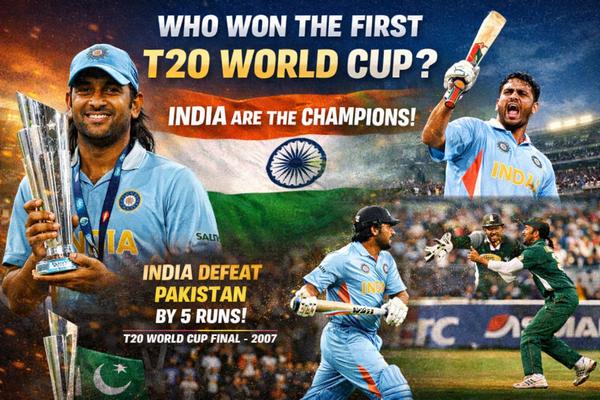
Who won the first T20 World Cup?
You already know T20 cricket moves fast. Blink, and you miss a six. Miss two overs, and the game flips. But have you ever wondered who grabbed the very first T20 World Cup and kickstarted this madness?
India won the first T20 World Cup in 2007.
They defeated Pakistan in a nerve-shredding final and changed the future of cricket forever. That single tournament transformed careers, formats, and even the business side of the sport.
Let’s rewind to 2007 and relive how it all went down.
The Birth of the T20 World Cup
Cricket traditionalists rolled their eyes when T20 cricket entered the scene. Many fans asked, “Can cricket even fit into three hours?” The administrators at the International Cricket Council answered that question with action.
They launched the inaugural ICC World Twenty20 2007 in South Africa. The tournament ran from 11 September to 24 September 2007. Twelve teams participated, and most cricket boards treated the event like an experiment.
Some teams even rested senior players because they didn’t take T20 seriously. That decision looked hilarious in hindsight.
India’s Unexpected Entry Into the Tournament
India did not enter the tournament as favorites. The team had crashed out early in the 2007 ODI World Cup earlier that year. Fans still felt frustrated, and the media pressure weighed heavily.
Senior stars like Sachin Tendulkar, Rahul Dravid, and Sourav Ganguly skipped the tournament. The selectors handed the captaincy to a long-haired youngster named MS Dhoni.
Did anyone predict what would happen next? Not really.
India fielded a young squad filled with energy. The team included Yuvraj Singh, Gautam Gambhir, Rohit Sharma, Sreesanth, RP Singh, and several rising talents.
The squad looked raw. But raw energy sometimes beats polished reputations.
India’s Journey Through the Tournament
India did not cruise smoothly from the start. The group stage already gave fans heart attacks.
The Iconic Bowl-Out Against Pakistan
India faced the Pakistan national cricket team in the group stage. Both teams tied the match.
The organizers used a bowl-out to decide the winner. Think of it like a penalty shootout in football, but with stumps.
India hit all three attempts. Pakistan missed theirs. India walked away with the win.
Fans realized immediately that this format carried drama in every over.
Yuvraj Singh’s Six Sixes
India then played England. Yuvraj Singh smashed six consecutive sixes off Stuart Broad.
He hammered 58 runs off just 16 balls. That innings remains one of the most destructive displays in T20 history.
People still replay that over on YouTube when they need instant entertainment.
Dominating the Knockout Stage
India entered the semifinals with confidence. They defeated Australia in a high-pressure match. Yuvraj again delivered a powerful half-century.
The young team showed no fear. They attacked, improvised, and trusted their instincts.
Then came the big one.
The Final: India vs Pakistan
India and Pakistan met again in the final on 24 September 2007. The teams played the match at Wanderers Stadium in Johannesburg, South Africa.
Could the script have looked more dramatic? Probably not.
India’s Innings
India batted first and scored 157 for 5 in 20 overs.
Gautam Gambhir anchored the innings with a classy 75 off 54 balls. Rohit Sharma chipped in with an unbeaten 30 that pushed the total to a competitive level.
The pitch did not look flat. Both teams needed smart batting.
Pakistan’s Chase
Pakistan fought hard. Shahid Afridi fell early, and that wicket shifted momentum.
Pakistan needed 13 runs in the final over. Dhoni handed the ball to Joginder Sharma. That decision surprised many fans.
Would you trust an inexperienced bowler in that moment? Dhoni did.
Pakistan needed 6 runs off 4 balls when Misbah-ul-Haq attempted a scoop shot. The ball floated toward short fine leg.
Sreesanth settled under the ball and completed the catch.
India won by 5 runs.
Chaos followed.
Why India’s Victory Changed Cricket Forever
India did not just win a trophy. They sparked a revolution.
The tournament proved that T20 cricket could:
-
Attract massive TV audiences
-
Create edge-of-the-seat drama
-
Produce new heroes instantly
-
Fit perfectly into modern schedules
Within months, India launched the Indian Premier League in 2008. The IPL reshaped cricket economics and player opportunities.
Without India winning in 2007, the IPL story might have looked very different.
The Role of MS Dhoni’s Captaincy
Let’s talk about Dhoni for a minute.
He trusted young players. He backed instinct over convention. He stayed calm when others panicked.
He made bold decisions like:
-
Promoting Rohit Sharma in key matches
-
Backing Joginder Sharma in the final over
-
Maintaining aggressive field placements
Dhoni’s leadership style blended confidence with composure. He did not overreact. He read situations clearly.
That tournament built his reputation as a captain who thrives under pressure.
The Complete Statistical Summary
Here’s a clean breakdown of the major numbers from the 2007 tournament:
| Category | Statistic |
|---|---|
| Tournament | ICC World Twenty20 2007 |
| Host Country | South Africa |
| Dates | 11–24 September 2007 |
| Number of Teams | 12 |
| Final Match | India vs Pakistan |
| Venue of Final | Wanderers Stadium, Johannesburg |
| India Final Score | 157/5 (20 overs) |
| Pakistan Final Score | 152/10 (19.3 overs) |
| Margin of Victory | India won by 5 runs |
| Player of the Tournament | Shahid Afridi |
| Yuvraj Singh vs England | 58 off 16 balls |
| Fastest 50 (Yuvraj) | 12 balls |
These numbers still tell a powerful story.
Player of the Tournament: Shahid Afridi
Interestingly, Shahid Afridi won the Player of the Tournament award.
He scored 91 runs and picked up 12 wickets. He dominated with both bat and ball.
Pakistan did not lift the trophy, but Afridi left a huge mark on the tournament.
Cricket often rewards impact, not just final results.
Comparing the 2007 T20 World Cup With Modern Editions
Today’s T20 World Cups look massive. Teams analyze every detail. Data analysts track match-ups. Franchise leagues prepare players year-round.
Back in 2007, teams experimented.
Players improvised scoop shots without practice manuals. Bowlers guessed lengths instead of consulting spreadsheets.
That raw unpredictability made the tournament special.
Modern tournaments offer more polish. The 2007 edition offered pure adrenaline.
Which do you prefer? Structured brilliance or chaotic magic?
Key Moments That Defined the Tournament
Several moments shaped the first T20 World Cup:
-
India’s bowl-out win over Pakistan
-
Yuvraj’s six sixes
-
India defeating Australia in the semifinal
-
Misbah’s failed scoop in the final
Each moment created lasting memories.
Fans still discuss those events in cricket debates.
How Fans Reacted in 2007
Indian fans celebrated wildly. The team returned home to a hero’s welcome.
Crowds lined the streets in Mumbai. Players rode an open bus through the city.
The victory healed wounds from the ODI World Cup exit earlier that year.
Cricket fans love redemption stories. This one delivered perfectly.
The Young Squad That Became Legends
Many players from that squad built remarkable careers.
-
MS Dhoni later won the 2011 ODI World Cup.
-
Rohit Sharma became one of the greatest T20 batters.
-
Yuvraj Singh delivered match-winning performances for years.
The 2007 win gave them belief.
Confidence often fuels greatness.
Tactical Lessons From the First T20 World Cup
The 2007 tournament taught teams several key lessons:
Aggression Wins T20 Matches
Teams that attacked early gained control. Defensive cricket rarely succeeded.
All-Rounders Add Massive Value
Players like Afridi showed how dual skills shift games quickly.
Fielding Changes Outcomes
One sharp catch or direct hit alters momentum instantly.
Nerves Decide Finals
The final over drama proved that composure wins trophies.
Why the 2007 Final Still Feels Special
Every cricket generation remembers one match that hooked them emotionally.
For many fans, the 2007 T20 final holds that place.
The tension, the rivalry, the bold captaincy, and the dramatic finish created a perfect storm.
Modern finals produce excitement, but that first one carried raw authenticity.
It felt new. It felt risky. It felt unpredictable.
Did Anyone Expect India to Win?
Most experts favored stronger T20 domestic nations like Australia or South Africa.
Few analysts predicted India’s dominance.
The young Indian team played fearless cricket. They enjoyed the format instead of fearing mistakes.
Sometimes, freedom produces the best performances.
The Broader Impact on World Cricket
After 2007, cricket boards invested heavily in T20 leagues.
Countries restructured domestic calendars. Players adapted their batting techniques.
Power-hitting became essential. Strike rate gained importance.
The format reshaped training methods and fitness standards.
The first T20 World Cup did not just crown a champion. It rewrote cricket strategy.
Memorable Performances Beyond the Final
Several players delivered standout performances throughout the tournament:
-
Matthew Hayden smashed 265 runs for Australia.
-
Umar Gul picked up 13 wickets for Pakistan.
-
Yuvraj Singh scored 148 total runs at a strike rate above 190.
These contributions built the tournament’s excitement.
Even teams that exited early created unforgettable moments.
What Made the 2007 Edition Unique?
The tournament felt experimental. Teams tried unorthodox shots. Bowlers attempted slower balls without refined variations.
No team possessed a fixed T20 blueprint.
That uncertainty made every game feel open.
Today’s players prepare for specific match-ups. Back then, instinct ruled.
The Legacy of the First T20 World Cup
The first T20 World Cup gave cricket a new heartbeat.
Broadcasters realized they could package cricket into prime-time entertainment. Sponsors jumped in eagerly.
Young fans connected instantly with the fast pace.
The tournament also expanded cricket’s global appeal. Shorter matches attracted casual viewers who avoided five-day Tests.
Cricket evolved because India lifted that first trophy.
So, Who Won the First T20 World Cup?
Let’s answer the question clearly and confidently.
India won the first T20 World Cup in 2007.
They defeated Pakistan by 5 runs in a dramatic final at the Wanderers Stadium in Johannesburg.
They trusted youth. They embraced risk. They delivered under pressure.
That victory transformed the sport forever.
Final Thoughts
The 2007 T20 World Cup did more than crown a champion. It introduced cricket to a faster future.
India’s young squad grabbed an opportunity and created history. MS Dhoni’s calm leadership set the tone for a generation.
The final over still gives fans goosebumps. The six sixes still light up highlight reels.
Cricket keeps evolving, but the first T20 World Cup holds a special place. It reminds us how unpredictability, courage, and belief can rewrite the script.
And honestly, if Misbah had cleared that fine leg fielder, we might tell a completely different story today.
That’s cricket for you.