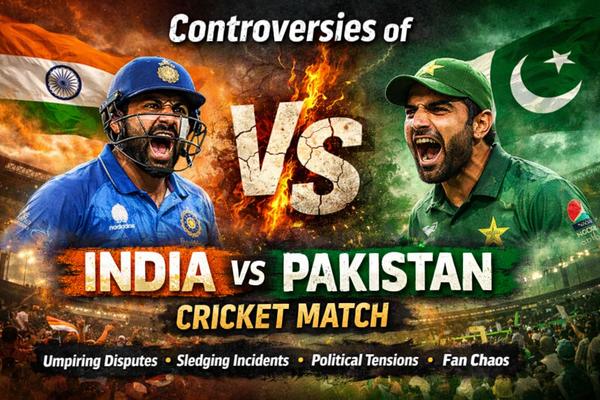
Controversies of India vs Pakistan Cricket Match
You already know this match never stays “just a game.” India vs Pakistan turns into a full-blown emotional rollercoaster every single time. Fans scream, anchors shout, and social media explodes within seconds. One controversial decision can trigger debates that last longer than the tournament itself.
Over the decades, Controversies of India vs Pakistan Cricket Match have shaped narratives, fueled rivalries, and sometimes overshadowed the cricket itself. Umpiring decisions, sledging wars, political tension, walkovers, pitch drama, crowd behavior this rivalry has delivered everything. If cricket thrives on drama, this fixture writes the script.
Let’s break it all down, controversy by controversy, moment by moment.
Contents
- 1 Why India vs Pakistan Matches Always Invite Controversy
- 2 The 1992 World Cup Sledging Incident
- 3 The 1996 World Cup Quarterfinal in Bangalore
- 4 The 1999 Chennai Test and Emotional Aftermath
- 5 The 2003 World Cup Tensions
- 6 The 2007 T20 World Cup Bowl-Out Drama
- 7 The 2010 Asia Cup No-Ball Controversy
- 8 The 2012 Bilateral Series and Political Overtones
- 9 The 2017 Champions Trophy Final Shock
- 10 Umpiring Decisions That Sparked Fury
- 11 The 2019 World Cup Rain Debate
- 12 Political Controversies and Boycott Calls
- 13 Player Clashes and On-Field Aggression
- 14 Media Hype and Manufactured Drama
- 15 Social Media Storms
- 16 Match-Fixing Shadows
- 17 Statistical Overview of Key Controversial Matches
- 18 Fan Behavior and Stadium Incidents
- 19 ICC Scheduling Controversies
- 20 Does Controversy Help the Rivalry?
- 21 Personal Take as a Cricket Fan
- 22 Conclusion
Why India vs Pakistan Matches Always Invite Controversy
Every high-pressure game creates tension. But India vs Pakistan operates on another level.
Both countries share history, politics, and emotional baggage. Players carry national expectations on their shoulders. Fans treat victories like national festivals. Under that kind of pressure, even a minor edge call can spark chaos.
You mix:
-
Political history
-
Military tensions
-
Media hype
-
Massive fanbases
-
ICC tournament knockouts
And you get a recipe for constant controversy.
The 1992 World Cup Sledging Incident
Javed Miandad’s Jumping Antics
The 1992 World Cup clash in Sydney gave us one of the earliest iconic controversies. Javed Miandad mocked Indian wicketkeeper Kiran More by jumping like a kangaroo on the pitch.
Miandad felt More appealed excessively. Instead of ignoring it, he responded theatrically. Cameras caught everything. The moment spread worldwide.
Did it cross the line? Many Indian fans thought so. Pakistani fans loved the humor. The ICC did not impose a major punishment, but the incident cemented sledging as part of this rivalry’s DNA.
The 1996 World Cup Quarterfinal in Bangalore
Crowd Chaos and Amir Sohail’s Gesture
India and Pakistan met in a knockout match in Bangalore. The tension felt electric even before the toss.
Pakistani opener Amir Sohail smashed Venkatesh Prasad through the covers and pointed his bat toward the boundary. He signaled dominance. Prasad answered immediately by bowling Sohail on the next ball.
The crowd erupted. Bottles rained onto the field. Match officials paused play. Security scrambled to restore order.
That moment showed how quickly emotions spiral in this fixture. The gesture lasted seconds, but fans still debate it decades later.
The 1999 Chennai Test and Emotional Aftermath
India and Pakistan produced one of the greatest Test matches in Chennai in 1999. Pakistan won by 12 runs after a heroic effort from Sachin Tendulkar.
Indian fans applauded the Pakistani team during their victory lap. That gesture showed sportsmanship at its best.
Yet controversy followed outside the stadium. Political tensions back home sparked protests. Some groups attacked the pitch in Delhi before the next Test.
The cricket displayed class. Politics created chaos.
The 2003 World Cup Tensions
India chased 274 in Centurion during the 2003 World Cup. Sachin Tendulkar smashed Shoaib Akhtar for a memorable upper cut over third man.
While fans celebrated the innings, off-field tension simmered. Media narratives amplified hostility. Commentators framed the match as a battle beyond sport.
Players later admitted that pressure reached extreme levels. Every ball felt like a referendum on national pride.
The 2007 T20 World Cup Bowl-Out Drama
The Tie That Shocked Everyone
India and Pakistan tied their group match in the inaugural T20 World Cup. The game moved to a bowl-out because the tournament had no Super Over rule yet.
Indian bowlers hit the stumps three times. Pakistani bowlers missed all attempts.
Some critics questioned the format. Others questioned Pakistan’s preparation. The spectacle looked dramatic but chaotic.
Fans loved it, but purists criticized the gimmick. The ICC later replaced bowl-outs with Super Overs.
The 2010 Asia Cup No-Ball Controversy
In the 2010 Asia Cup, India needed three runs off the final ball against Pakistan. Mohammad Amir bowled a waist-high full toss to Suresh Raina.
Umpires called a no-ball. India won.
Pakistani fans argued that Amir delivered a dipping ball. Indian fans pointed to clear height rules. Television replays fueled debate.
That single call dominated headlines for days. People still argue about whether the umpire reacted too quickly.
The 2012 Bilateral Series and Political Overtones
India and Pakistan resumed bilateral cricket in 2012 after a long gap. Political leaders framed the series as a goodwill gesture.
Every dismissal triggered crowd chants. Every appeal received microscopic analysis. Commentators discussed diplomacy as much as cricket.
When Pakistan won the ODI series 2-1, critics questioned India’s selection decisions. Social media blamed everything from pitch preparation to captaincy choices.
Cricket never travels alone in this rivalry.
The 2017 Champions Trophy Final Shock
Pakistan crushed India by 180 runs in the Champions Trophy final. Fakhar Zaman received an early reprieve when umpires called a no-ball on Jasprit Bumrah.
Television replays showed a marginal overstep. Indian fans exploded on social media. They claimed that the no-ball changed the entire match.
Pakistan capitalized fully. Fakhar scored 114. Pakistan lifted the trophy.
Did that call decide the game? Pakistan dominated with both bat and ball, but fans still highlight that no-ball as a turning point.
Umpiring Decisions That Sparked Fury
Umpiring controversies never miss this rivalry.
Notable Disputed Calls
-
LBW decisions during the 2008 Asia Cup triggered heated debates.
-
Umar Akmal’s dismissal in the 2015 World Cup created discussion over a caught-behind appeal.
-
Virat Kohli’s close LBW reviews in ICC tournaments generated endless replay analysis.
Fans dissect every frame. Commentators amplify every doubt. Technology reduces error, but controversy still survives.
DRS solved some issues, but it also created new debates about umpire’s call margins. When millimeters decide outcomes, arguments never end.
The 2019 World Cup Rain Debate
Manchester hosted the 2019 World Cup clash. Rain interruptions affected Pakistan’s chase under the Duckworth-Lewis-Stern method.
Pakistan supporters criticized the revised target. They questioned over allocations and momentum shifts.
India maintained dominance throughout the match. Rohit Sharma scored 140. India won by 89 runs via DLS.
Weather added another layer of unpredictability. Fans debated fairness, but cricket rules left no room for reinterpretation.
Political Controversies and Boycott Calls
No discussion about Controversies of India vs Pakistan Cricket Match stays complete without politics.
Key Political Flashpoints
-
The 2008 Mumbai attacks halted bilateral series.
-
Cross-border tensions led to repeated boycott calls.
-
Players faced criticism for participating in ICC tournaments.
Governments influence scheduling decisions. Boards face pressure from public sentiment. ICC tournaments remain the only consistent platform where both teams meet.
Many fans ask a simple question: Should politics dictate sport? Opinions differ sharply.
Player Clashes and On-Field Aggression
Players rarely hold back emotions in this rivalry.
Famous Verbal Exchanges
-
Gautam Gambhir and Shahid Afridi exchanged heated words multiple times.
-
Shoaib Akhtar and Indian batsmen traded aggressive stares.
-
Hardik Pandya and Pakistani players shared tense moments during ICC matches.
Players channel intensity into performance. Sometimes that intensity crosses lines. Match referees often intervene to calm tempers.
Still, fans secretly enjoy the fire.
Media Hype and Manufactured Drama
Media houses treat India vs Pakistan like a war preview. Headlines scream dramatic narratives. Advertisements fuel patriotic themes.
This hype magnifies minor incidents. A simple send-off suddenly becomes a national insult. A misfield turns into character assassination.
Television ratings skyrocket during these matches. Broadcasters earn millions. Sponsors flood screens with patriotic campaigns.
Controversy drives engagement. Engagement drives revenue.
Social Media Storms
Earlier generations debated in tea shops. Today, fans fight on Twitter and Instagram within seconds.
One umpiring call triggers:
-
Trending hashtags
-
Meme wars
-
Player abuse
-
Conspiracy theories
Players receive direct messages filled with extreme reactions. Former cricketers join debates. Analysts post slow-motion clips repeatedly.
Social media ensures that controversies never fade quietly.
Match-Fixing Shadows
The rivalry also intersected with broader match-fixing scandals in cricket history.
The 2010 spot-fixing scandal involving Pakistani players during the England tour indirectly influenced perceptions during India-Pakistan matches. Suspicion increased scrutiny.
Fans began questioning no-balls, dropped catches, and unusual field placements. Even clean matches faced conspiracy theories.
Cricket authorities strengthened anti-corruption units. Still, fans remain hyper-alert.
Statistical Overview of Key Controversial Matches
Below you will find a consolidated summary of major matches that sparked controversy and shaped the rivalry narrative.
| Year | Tournament | Venue | Result | Key Controversy | Notable Statistic |
|---|---|---|---|---|---|
| 1992 | World Cup | Sydney | Pakistan won by 43 runs | Miandad mocking gesture | Miandad scored 40 |
| 1996 | World Cup QF | Bangalore | India won by 39 runs | Sohail-Prasad altercation | Ajay Jadeja scored 45 off 25 |
| 1999 | Test Series | Chennai | Pakistan won by 12 runs | Political protests | Saqlain Mushtaq took 10 wickets |
| 2007 | T20 World Cup | Durban | India won (Bowl-out) | Bowl-out format debate | India hit 3/3 in bowl-out |
| 2010 | Asia Cup | Dambulla | India won by 3 wickets | Final-ball no-ball | India chased 267 |
| 2017 | Champions Trophy Final | London | Pakistan won by 180 runs | Bumrah no-ball call | Fakhar scored 114 |
| 2019 | World Cup | Manchester | India won by 89 runs (DLS) | Rain target debate | Rohit scored 140 |
These matches shaped narratives far beyond scorecards.
Fan Behavior and Stadium Incidents
Crowd behavior often influences controversy levels.
In high-stakes matches, fans sometimes:
-
Throw objects onto the field
-
Boo opposition players
-
Engage in heated arguments
Security forces deploy massive arrangements during these fixtures. Organizers treat them like high-risk events.
Most fans behave respectfully. A small minority creates headlines.
ICC Scheduling Controversies
The ICC often places India vs Pakistan matches in group stages to maximize revenue.
Critics argue that financial motivation drives scheduling. ICC tournaments generate massive viewership numbers during these clashes.
Broadcasters reportedly earn peak advertising revenue during India-Pakistan matches compared to any other fixture in world cricket.
Fans enjoy frequent encounters. Purists argue that overscheduling reduces novelty.
Does Controversy Help the Rivalry?
Let’s ask an honest question. Would this rivalry feel the same without controversy?
Probably not.
Controversy adds:
-
Emotional investment
-
Long-term memory
-
Narrative depth
-
Media buzz
However, excessive hostility can harm sportsmanship. Players often show respect after matches. Fans should follow that example.
Personal Take as a Cricket Fan
I grew up watching these matches with family members who switched loyalties mid-argument. I remember shouting at television screens over close LBW calls. I remember replaying sixes in my head for weeks.
Controversy keeps fans emotionally attached. But cricket quality ultimately decides legacy.
When Rohit Sharma dominates with a century or Babar Azam crafts a classy fifty, skill overshadows drama. That remains the beauty of this rivalry.
Conclusion
Controversies of India vs Pakistan Cricket Match define one of cricket’s fiercest rivalries. Umpiring calls, political tensions, sledging incidents, rain rules, and social media storms all fuel the fire. Each decade produces new flashpoints.
Yet cricket continues to unite millions across borders for a few electrifying hours. Fans argue passionately. Players compete fiercely. The scoreboard ultimately writes history.