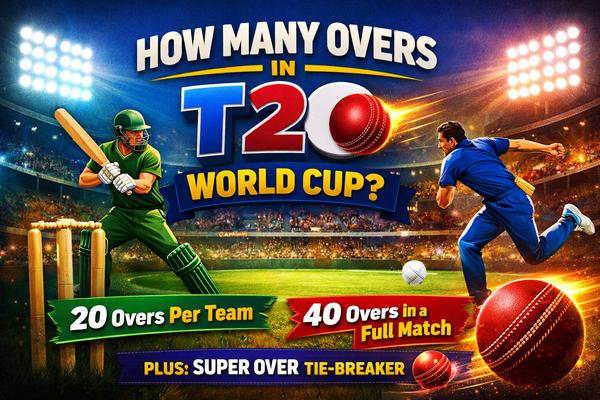
How many overs in T20 World Cup?
Let’s kick things off with a real cricket fan question
Cricket fans love stats. We absorb cricket facts the way bowlers absorb sweat on a hot pitch. So when someone asks “How many overs in T20 World Cup?” we get it. That question feels simple, but it leads into a fascinating conversation about how the whole game works.
Let me answer it straight up first: In every standard T20 World Cup match, each team gets a maximum of 20 overs to bat. That means two innings of up to 20 overs each in every game.
But hold on cricket always has layers, caveats, quirks, and drama built into its rules. That quick answer barely scratches the surface. In this article, we’ll break down everything you ever wanted to know about overs in the T20 World Cup format, including rules, variations, strategies, and more.
Sound good? Let’s dive deep.
Contents
- 1 What does “T20” even mean?
- 2 Why exactly 20 overs?
- 3 T20 World Cup matches use the T20 format
- 4 How long does a T20 World Cup game take?
- 5 What happens if weather interrupts the game?
- 6 How many overs in a full T20 World Cup match?
- 7 How many overs can a bowler bowl?
- 8 What about super overs?
- 9 Why does the T20 World Cup stick to 20 overs?
- 10 Does the World Cup ever have longer formats?
- 11 How does overs structure affect strategy?
- 12 Overs and entertainment
- 13 Common misconceptions about overs in T20 World Cup
- 14 Let’s bring it all together
- 15 A final cricket fan thought
What does “T20” even mean?
Before we answer how many overs there are in the T20 World Cup, we have to understand what T20 stands for.
T20 is short for Twenty20 cricket. Every T20 match limits each team to a maximum of 20 overs per innings. That comes to 120 legal deliveries per team before their turn is over.
This part of the rule is consistent. The World Cup doesn’t magically change how many overs there are. Whether it’s a local club game or the World Cup final, the format remains the same: 20 overs per team per innings.
So, the direct answer to your keyword question How many overs in T20 World Cup? is:
Each team bowls a maximum of 20 overs in every T20 World Cup match.
Why exactly 20 overs?
You might wonder why T20 matches are set at 20 overs per team. Why not 15 or 25? The reason comes down to entertainment value.
When cricket insiders created this format in the early 2000s, they wanted something fast and fun. They knew that a full one-day game (with 50 overs per side) lasted most of the day. Fans couldn’t drop everything and watch an ODI from start to finish on a weeknight.
They also knew that test matches dragged on for days, which is great if you love test cricket, but not ideal for a broader casual audience.
So they sliced the middle ground: 20 overs per side. Long enough to see great cricket strategy and exciting play, short enough to last roughly three hours like a football match. That’s T20, and that’s what the T20 World Cup uses.
T20 World Cup matches use the T20 format
The ICC Men’s T20 World Cup uses the same format as any other T20 International game. Each team bats once, up to 20 overs per innings, unless they get bowled out earlier. There are no extra innings unless the match ends in a tie.
So whether it’s a group match, a Super Eight game, a semifinal, or the final the rule stays the same: 20 overs per team.
How long does a T20 World Cup game take?
People often confuse overs with match length. We answer how many overs, but in real life we also care about how long the match lasts.
In most World Cup T20 games, two innings of 20 overs each take about three hours total. Teams take their batting innings, then switch ends, bowl the other innings, and we end up with a result in that three-hour window.
That’s brilliant because you can plan your evening around it. You can watch a T20 World Cup match and still go to sleep before midnight if it starts in the evening.
What happens if weather interrupts the game?
Here’s where cricket gets tricky.
Rain or bad weather can shorten games. When that happens, the match may turn into something like “10 overs per side” or even fewer if necessary for a result. The official rules govern the minimum overs required for the match to count.
For most group stage World Cup matches, if rain intervenes, both teams must face at least five overs per innings for the match to have a result on that day. That rule aims to give each team enough batting time to produce a fair outcome.
However, for knockout matches such as semifinals and finals, the minimum overs per innings requirement usually goes up (often to about ten overs) to preserve fairness and competitive integrity.
So even though the standard is 20 overs, rain can shrink that number while still keeping the match official.
How many overs in a full T20 World Cup match?
When both teams bat their full quota, a single T20 World Cup game features:
20 overs in the first innings + 20 overs in the second innings = 40 total overs.
That’s 40 overs of action plus follow-ons like super overs if there’s a tie.
Let’s put that in a simple table since you asked for statistics:
Overs Summary Table
| Scenario | Overs per Team | Total Overs | Notes |
|---|---|---|---|
| Standard T20 World Cup match | 20 overs | 40 overs | Each team gets a single innings |
| Shortened match (rain) | 5–19 overs* | 10–38 overs* | Minimum to constitute a game |
| Knockout minimum requirement | Typically 10 overs | 20+ overs | Loss of overs due to weather |
| Super Over (tie) | 1 over each | 2 overs | Extra deciding overs |
*Actual overs depend on match conditions and ICC rules. Matches shortened by weather can be fewer than 20 overs.
How many overs can a bowler bowl?
Overs per team are one thing. Overs per individual bowler are another.
In T20 cricket, no bowler can bowl more than 4 overs per match. That’s because each team has 20 overs and the ICC wants games to use a variety of bowlers, keeping the format competitive and fair.
If you think about it, 4 overs per bowler means a team must use at least five bowlers to cover 20 overs. That forces captains to manage bowlers strategically rather than rely on one superstar bowler for everything.
That’s part of what makes T20 cricket so exciting. Bowlers become specialists in short bursts, bowlers thrive under pressure, and teams rotate bowlers to keep batsmen guessing.
What about super overs?
Occasionally, a T20 World Cup match ends in a tie. That means both teams scored exactly the same number of runs.
In normal T20s, a tie leads to a Super Over: each team gets one extra over to bat, and whoever scores more runs wins. If the Super Over itself ties, more Super Overs are played until we get a winner.
So in theory, a T20 World Cup match could go beyond the standard 40 overs if ties and Super Overs happen.
But let’s be clear: Super Overs do not count as normal overs in the “how many overs” sense. They are short tie-breakers that only happen when needed.
Why does the T20 World Cup stick to 20 overs?
I asked some fellow fans and cricket buddies, and here’s the consensus.
We love the T20 format because it cranks up intensity. In a One Day International (ODI), you get 50 overs per side. That’s a full day of strategy, pacing, patient batting, war of attrition. But in T20, you have limited time.
Batters feel like they have no time to waste. Bowlers feel like they need to attack with precision. Fielders sprint like maniacs even when nothing seems to be happening. That’s because every single ball matters more when you have only 20 overs.
So the T20 World Cup stays with 20 overs because that’s fundamentally what Twenty20 cricket is.
Does the World Cup ever have longer formats?
No. The T20 World Cup always uses the T20 format. If you want longer overs per side, you look at ODI World Cups (50 overs per side) or Test cricket (five days, two innings each, no fixed overs).
There’s no version of the T20 World Cup that gives teams 25 overs or 30 overs per innings. That would make it Twenty50 or T30, and those are different formats entirely.
How does overs structure affect strategy?
This part gets fun.
Every captain knows that limited overs change approach dramatically. With only 20 overs:
-
Batters attack earlier. They sprint to score boundaries instead of pacing innings.
-
Bowlers cut risky deliveries because batsmen charge after every loose ball.
-
Captains plan powerplays, middle overs, and death overs carefully. With only 20 overs, powerplays (which happen typically in the first 6 overs) shape the whole game.
Think of it like this: In ODI (50 overs), powerplays feel like opening moves. In T20, powerplays feel like blitz chess. If you lose momentum there, you might never recover.
Overs and entertainment
Here’s my honest opinion.
If someone told me tomorrow that T20 World Cup should switch to 25 overs per side, I’d probably cringe. I know some fans might like a bit longer play. But part of what makes T20 great is that every single over feels like it matters.
Twenty overs means no comfort zones. Batters cannot just wait for loose balls. Bowlers cannot hide behind long spells. Every over swings momentum, and that unpredictability is why T20 cricket has exploded in popularity globally.
Common misconceptions about overs in T20 World Cup
Let’s tackle a few of them.
Myth #1: T20 World Cup overs include extra balls from wides and no-balls.
Not exactly. Extras like wides and no-balls add legal deliveries, but they don’t increase the official over count. If a bowler bowls wides, they have to bowl additional deliveries until they complete 6 legal balls for that over. But officially it’s still one over.
Myth #2: The final has more overs than group matches.
Wrong. The final like every T20 World Cup match has the same 20 overs per side (unless weather intervenes) rule. That equality is part of fair play.
Myth #3: T20 matches can be eight overs per team in extreme rain.
That’s possible only if both teams agree or the rules allow a minimum for a result. But official rules prioritize a minimum of five overs for group stages and usually ten overs for knockout matches before the game can be called complete.
Let’s bring it all together
You asked a clear question: How many overs in T20 World Cup?
Here’s the bottom line:
-
Each team gets a maximum of 20 overs in every full T20 World Cup match.
-
That makes 40 overs total when both teams bat their full quota.
-
Weather can shorten that number, but never extend it above 20 per team.
-
Bowlers are limited to a maximum of 4 overs each.
-
Tied games can involve additional Super Overs, but these are tie-break mechanisms, not part of the standard overs count.
A final cricket fan thought
It still amazes me how a question as simple as “How many overs in T20 World Cup?” opens up so much conversation about strategy, rules, and why this format has become such a hit globally.
Next time you sit down to watch a T20 World Cup match, keep an eye on how teams pace themselves. Twenty overs doesn’t sound like much, but in cricket terms, it’s a lifetime.
Make your popcorn, settle in, and enjoy those overs every single one counts.