ICC T20 rankings
You check the Current ICC T20 rankings for one reason: you want bragging rights. Maybe you want proof that your team dominates world cricket. Maybe you want ammunition for that never-ending group chat debate. Either way, rankings spark arguments, excitement, and sometimes pure chaos.
T20 cricket moves fast. One explosive series flips the script. One poor tour drops a giant. So if you blink, you miss a shift in power. Let’s break down where teams stand, how the system works, who rules the charts right now, and what it all actually means.
Contents
- 1 How the ICC T20 Ranking System Actually Works
- 2 Current ICC T20 Rankings – Team Standings Overview
- 3 Why India Sits at the Top
- 4 Australia: Relentless and Ruthless
- 5 England: Aggression Without Apology
- 6 New Zealand: The Silent Threat
- 7 Pakistan: Unpredictable Yet Dangerous
- 8 South Africa and West Indies: Power Meets Pressure
- 9 Rising Teams: Afghanistan and Bangladesh
- 10 How Individual Rankings Influence Team Rankings
- 11 What the Rankings Really Mean for ICC Events
- 12 Do Rankings Truly Reflect Reality?
- 13 Key Trends in Current ICC T20 Rankings
- 14 How Frequent Updates Keep the Table Fresh
- 15 Tactical Evolution in T20 Cricket
- 16 The Role of Domestic Leagues
- 17 What Could Change the Rankings Soon?
- 18 Personal Take: Do I Trust the Rankings?
- 19 Why Fans Obsess Over Rankings
- 20 Final Thoughts on Current ICC T20 Rankings
How the ICC T20 Ranking System Actually Works
Before you argue about who deserves the top spot, you need to understand how the system calculates those numbers.
The International Cricket Council, or International Cricket Council, updates T20 rankings based on results from international matches. The system assigns points for wins and deducts points for losses. The rankings factor in the strength of the opposition, which means beating a top team earns more credit than beating a struggling side.
The Core Formula in Simple Terms
The ICC calculates rankings using:
-
Total rating points accumulated
-
Total matches played
-
Weighted value for recent matches
Recent matches carry more weight than older ones. The system values current form over ancient history. That approach keeps the table relevant and dynamic.
If a team dominates for two years and then collapses for six months, the rankings reflect that decline quickly. The ICC does not reward nostalgia.
Why T20 Rankings Shift So Often
T20 cricket rewards aggression and momentum. A single power-hitting masterclass can swing a match in 20 overs. That volatility causes frequent ranking changes.
Long-format cricket rewards consistency. T20 rewards timing, confidence, and fearless intent. Teams that click during short bursts climb fast.
Now let’s look at the Current ICC T20 rankings and see who holds the crown.
Current ICC T20 Rankings – Team Standings Overview
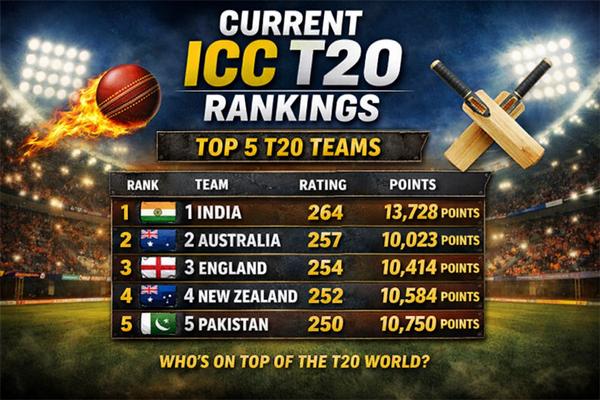
Right now, India leads the men’s T20 team rankings. Australia follows closely. England, New Zealand, and Pakistan fight hard inside the top five.
Every point matters. Teams sit only a few rating points apart at the top, which means one series can shuffle the order dramatically.
Top 10 Men’s T20 Teams (Latest Standings Snapshot)
Below you will find the key statistics summarized clearly in one place.
| Rank | Team | Matches | Rating Points | Total Points |
|---|---|---|---|---|
| 1 | India | 52 | 264 | 13,728 |
| 2 | Australia | 39 | 257 | 10,023 |
| 3 | England | 41 | 254 | 10,414 |
| 4 | New Zealand | 42 | 252 | 10,584 |
| 5 | Pakistan | 43 | 250 | 10,750 |
| 6 | South Africa | 37 | 245 | 9,065 |
| 7 | West Indies | 38 | 243 | 9,234 |
| 8 | Sri Lanka | 36 | 235 | 8,460 |
| 9 | Bangladesh | 34 | 229 | 7,786 |
| 10 | Afghanistan | 31 | 223 | 6,913 |
These numbers shift after every bilateral series or ICC event. So treat this table as a living scoreboard rather than a permanent hierarchy.
Why India Sits at the Top
India dominates T20 cricket right now because it blends youth, depth, and fearless batting. The team attacks from ball one. The bowlers execute plans under pressure.
India wins consistently at home and abroad. That consistency drives its rating upward.
Explosive Batting Depth
India stacks its lineup with hitters who treat bowlers like bowling machines. The top order sets the tone. The middle order accelerates without mercy.
Suryakumar Yadav anchors the modern T20 blueprint with 360-degree stroke play. Hardik Pandya adds finishing power and pace bowling. Young players step in seamlessly when seniors rest.
That depth matters. When one player fails, another steps up.
Tactical Flexibility
India rotates squads intelligently. The management experiments without sacrificing results. That approach builds bench strength while protecting ranking points.
Other teams sometimes cling to fixed combinations. India adapts based on conditions.
Australia: Relentless and Ruthless
Australia always smells opportunity. The team might not always look flashy, but it competes with intensity.
Australia combines power hitters with disciplined bowling units. The side executes plans with brutal efficiency.
Big Tournament Temperament
Australia thrives during ICC tournaments. The players embrace pressure instead of avoiding it.
When crunch moments arrive, Australia attacks. That mindset keeps them near the top of the Current ICC T20 rankings.
Balanced Attack
Australia fields:
-
Aggressive openers
-
Versatile all-rounders
-
Skilled death bowlers
That balance reduces weak links. No opponent gets easy overs.
England: Aggression Without Apology
England transformed white-ball cricket over the last decade. The team plays with fearless intent.
England attacks during the powerplay. It continues attacking in the middle overs. It finishes with a final assault.
Depth That Scares Opponents
England packs hitters down to number eight sometimes. That depth forces bowlers into defensive fields.
England trusts its method completely. That confidence fuels high-scoring wins.
However, occasional inconsistency drops rating points. England sometimes dominates one series and falters in the next.
New Zealand: The Silent Threat
New Zealand rarely makes noise. The team just wins matches.
The players understand their roles. They adapt to conditions quickly. They squeeze opponents in tight games.
Discipline Wins Games
New Zealand builds pressure through:
-
Accurate seam bowling
-
Smart field placements
-
Calculated batting chases
The team avoids reckless collapses. That reliability protects ranking points.
You might not always notice New Zealand climbing, but it always stays close to the top.
Pakistan: Unpredictable Yet Dangerous
Pakistan brings flair and unpredictability. On its day, the team beats anyone.
Pakistan relies heavily on its bowling attack. The pacers often set up victories with early breakthroughs.
Strength in Bowling
Pakistan’s fast bowlers generate pace and movement. The spinners choke runs during middle overs.
However, inconsistent batting sometimes costs crucial matches. Those losses prevent Pakistan from claiming the number one spot consistently.
If the batting stabilizes, Pakistan could surge upward quickly.
South Africa and West Indies: Power Meets Pressure
South Africa and West Indies sit just outside the top five. Both teams carry explosive talent.
West Indies boasts raw T20 pedigree. The players grew up mastering this format. The team holds multiple T20 World Cup titles.
South Africa focuses on structure and discipline. The players execute plans precisely but sometimes struggle in high-pressure ICC events.
Both teams possess the tools to climb higher.
Rising Teams: Afghanistan and Bangladesh
Afghanistan deserves respect. The team evolved rapidly in T20 cricket.
Afghanistan relies on world-class spin bowling. The batters play fearless cricket. The side now competes strongly against established nations.
Bangladesh improves steadily. The team builds stronger domestic T20 structures. Consistency remains the key challenge.
How Individual Rankings Influence Team Rankings
Team rankings grab headlines, but individual performances drive those numbers.
When a batter averages over 40 in T20 cricket with a strike rate above 150, the team benefits. When bowlers concede fewer than eight runs per over regularly, victories follow.
Batting Rankings Impact
Top-ranked batters:
-
Anchor chases
-
Accelerate during powerplays
-
Finish games decisively
Consistent run-scorers lift team ratings by delivering series wins.
Bowling Rankings Impact
Top-ranked bowlers:
-
Take wickets inside powerplays
-
Control death overs
-
Defend low totals
Strong bowling units often separate top-ranked teams from mid-table squads.
What the Rankings Really Mean for ICC Events
Rankings influence tournament seedings. Higher-ranked teams secure favorable group placements.
However, rankings do not guarantee trophies. T20 tournaments reward momentum and form over historical numbers.
You saw this pattern repeatedly in World Cups. Lower-ranked teams sometimes knock out favorites. Rankings reflect consistency, not destiny.
Do Rankings Truly Reflect Reality?
Let’s be honest. Rankings create debate for a reason.
A team might dominate bilateral series but crumble in global tournaments. Another team might peak during ICC events despite a lower ranking.
Rankings measure sustained performance over time. They do not measure clutch moments alone.
So when someone says, “Rankings don’t matter,” ask them why teams fight so hard to protect every rating point.
Key Trends in Current ICC T20 Rankings
Several patterns stand out right now:
-
Asian teams dominate the top spots.
-
Batting strike rates keep rising.
-
All-rounders gain increasing value.
-
Teams prioritize depth over star power.
Modern T20 cricket demands flexibility. Teams that rely on one superstar struggle over long cycles.
How Frequent Updates Keep the Table Fresh
The ICC updates rankings after each series. That frequency keeps fans engaged.
You never wait long for movement. A three-match series can shift positions immediately.
That dynamism adds excitement. Every match carries ranking consequences.
Tactical Evolution in T20 Cricket
You cannot discuss the Current ICC T20 rankings without addressing strategy.
Powerplay Aggression
Teams attack early overs aggressively. They aim for 50-plus runs inside six overs.
Strong starts create scoreboard pressure.
Middle Overs Acceleration
Teams now avoid stagnation during overs 7–15. Batters sweep, reverse-sweep, and innovate constantly.
Strike rotation alone no longer satisfies modern T20 demands.
Death Over Precision
Death bowling separates elite teams from average ones. Yorkers, slower balls, and wide lines decide matches.
Teams that master death overs climb the rankings.
The Role of Domestic Leagues
Domestic leagues like the IPL, BBL, PSL, and The Hundred sharpen player skills.
Players gain exposure to international-level pressure regularly. That exposure improves decision-making.
Countries with strong leagues often maintain higher rankings. Talent pipelines stay full and competitive.
What Could Change the Rankings Soon?
Upcoming bilateral series and ICC tournaments will shake things up.
Watch for:
-
India touring overseas conditions
-
Australia playing in Asia
-
England rebuilding after squad rotations
-
Pakistan stabilizing its batting order
One dominant series could push a team into the number one spot.
Personal Take: Do I Trust the Rankings?
I trust the rankings as a long-term performance barometer. I do not treat them as crystal balls.
If you follow cricket closely, you know momentum shifts fast. One injury, one tactical tweak, or one breakout star can alter everything.
Still, rankings provide structure. They create context. They fuel healthy rivalry.
Why Fans Obsess Over Rankings
Fans love hierarchy. Rankings settle arguments. They give structure to passion.
When your team tops the Current ICC T20 rankings, you celebrate loudly. When it drops, you demand changes.
Cricket thrives on that emotion.
Final Thoughts on Current ICC T20 Rankings
The Current ICC T20 rankings tell a story of modern cricket’s evolution. India leads through depth and aggression. Australia stays relentless. England pushes boundaries. New Zealand remains steady. Pakistan keeps everyone guessing.
Rankings reward consistency. T20 cricket rewards courage. The teams that blend both qualities will dominate the next cycle.
So next time someone dismisses rankings as meaningless, remind them that every match adds weight to that table. Then grab your popcorn and enjoy the chaos, because in T20 cricket, today’s number one can become tomorrow’s underdog faster than you can say “super over.”
And honestly, would we want it any other way?