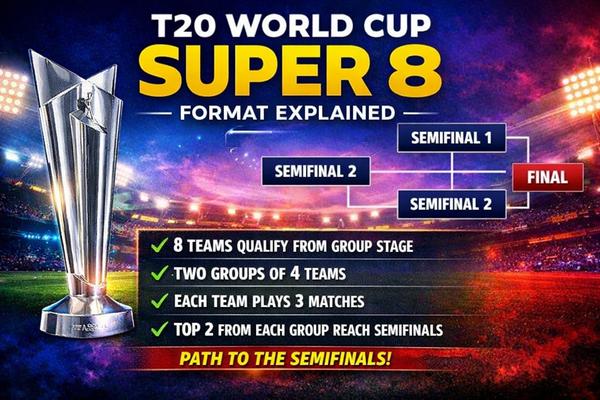
T20 World Cup Super 8 format explained
You love big games, right? You crave India vs Australia under lights, England vs Pakistan with everything on the line, and last-over chaos that wrecks your sleep schedule. The Super 8 stage in the ICC Men’s T20 World Cup exists exactly for that reason.
The group stage filters the field. The Super 8 stage turns up the heat. If you ever wondered how teams move from early round matchups to semifinal showdowns, you need to understand this format properly.
Let’s break it down in a way that actually makes sense.
The Super 8 stage acts as the second round of the T20 World Cup. Organizers created it to ensure the best teams play more high-stakes matches before the knockout rounds.
Instead of sending teams straight from the group stage to semifinals, the tournament inserts another competitive layer. That layer separates contenders from pretenders.
You get more big clashes. You get fewer fluke exits. You also get zero breathing space.
How Teams Reach the Super 8
The journey starts in the group stage. Teams compete in their initial groups and fight for top-two positions.
Each group sends two teams forward. That qualification rule produces eight total teams for the Super 8 phase.
No complicated math. Just finish in the top two and move on.
Why Only Eight Teams?
Eight teams strike a balance between opportunity and intensity. Organizers want enough matches to test consistency, but they also want urgency in every game.
If they allow too many teams, the format drags. If they allow too few, one bad group match ruins everything.
Eight keeps the tension tight.
How the Super 8 Groups Work
Organizers split the eight qualified teams into two groups of four. They usually seed teams before the tournament begins to maintain competitive balance.
Each group operates like a mini league. Every team plays the other three teams in its group.
That structure guarantees three matches per team in this phase.
Round-Robin Format Explained
Round-robin means simple head-to-head action:
-
Team A plays Team B
-
Team A plays Team C
-
Team A plays Team D
-
Team B plays Team C
-
Team B plays Team D
-
Team C plays Team D
Each group produces six matches. Since two groups operate simultaneously, the Super 8 stage delivers 12 total matches.
You blink, and the table changes.
Points System in the Super 8
The Super 8 stage uses the same points system as the group stage.
-
Win = 2 points
-
Loss = 0 points
-
No result = 1 point each
Teams aim for six points because three wins guarantee semifinal qualification.
If teams tie on points, Net Run Rate steps in and decides rankings.
Net Run Rate: The Silent Assassin
Net Run Rate (NRR) measures scoring efficiency. Teams calculate it using the difference between their run rate scored and run rate conceded across matches.
One heavy defeat can wreck NRR. One massive win can rescue a campaign.
Fans often ignore NRR until it suddenly decides everything.
How Teams Qualify for the Semifinals
The top two teams from each Super 8 group advance to the semifinals.
That system creates four semifinalists:
-
Group 1 Winner
-
Group 1 Runner-up
-
Group 2 Winner
-
Group 2 Runner-up
Organizers then match Group 1 Winner against Group 2 Runner-up and vice versa.
From there, knockout rules take over.
Lose once, go home.
Why the Super 8 Format Feels So Intense
Three matches do not allow comfort. Every game feels like a mini knockout.
A single collapse can ruin momentum. A single heroic chase can transform the table.
You cannot hide in this format.
Consistency Beats One-Off Brilliance
In pure knockout tournaments, one freak performance can eliminate a stronger side. The Super 8 format reduces that risk.
Teams must perform consistently across three matches. That requirement rewards depth and adaptability.
You need batting firepower and bowling control. You also need tactical awareness.
Comparison: Super 8 vs Straight Knockouts
Earlier tournaments sent teams directly from group stages to semifinals. That approach created drama but also produced early exits for strong teams.
The Super 8 format fixes that problem.
Straight knockouts:
-
Higher unpredictability
-
Greater risk for favorites
-
Fewer high-profile clashes
Super 8 format:
-
More competitive balance
-
More blockbuster matchups
-
Greater emphasis on consistency
IMO, the Super 8 system feels fairer. It still keeps pressure high, but it removes the randomness factor slightly.
Strategic Implications for Teams
Captains approach Super 8 matches differently. They balance aggression with calculation.
A team that wins its first two matches often manages the third match strategically. They protect key players and guard NRR.
A team that loses early must attack hard in the final games.
Momentum swings fast.
Batting Strategy
Teams often adjust batting tempo based on NRR scenarios. A team chasing 160 might push for a faster finish if qualification depends on margin.
Powerplay overs become crucial. Middle overs decide stability. Death overs decide NRR.
No captain ignores math at this stage.
Bowling Strategy
Bowling units attack weak matchups aggressively. They rotate strike bowlers carefully.
One bad over can cost qualification. One disciplined spell can seal it.
Super 8 cricket punishes sloppy execution.
Total Matches in the Super 8 Stage
Each group contains four teams. A four-team round robin produces six matches.
Two groups create 12 Super 8 matches in total.
Add two semifinals and one final, and the tournament reaches its climax.
Fans get weeks of drama instead of a quick sprint.
Super 8 Format in Recent Tournaments
Recent editions of the T20 World Cup used the Super 8 system to great effect. Top-ranked teams often collided earlier than fans expected.
That structure created mini-tournaments inside the main tournament.
You could see semifinal-level intensity before the semifinals even started.
Common Misunderstandings About the Super 8
Many fans confuse the Super 8 with quarterfinals. The format does not function as a knockout round.
Teams still play league-style matches. They earn points and calculate scenarios.
The Super 8 acts as a second group stage with higher stakes.
Do Points Carry Forward?
Organizers typically do not carry forward group-stage points into the Super 8. Teams start fresh in this stage.
That reset gives everyone equal footing.
You still need momentum, but you do not carry baggage.
Statistical Snapshot of the Super 8 Format
Below you will find a clean summary of the core numbers that define the Super 8 structure.
| Category | Value |
|---|---|
| Teams entering Super 8 | 8 teams |
| Groups in Super 8 | 2 groups |
| Teams per group | 4 teams |
| Matches per team | 3 matches |
| Total Super 8 matches | 12 matches |
| Points for a win | 2 points |
| Points for no result | 1 point |
| Semifinal qualifiers | Top 2 from each group (4 total) |
| Knockout matches after Super 8 | 2 semifinals + 1 final |
These numbers shape the entire middle phase of the tournament.
Pressure Points: Where Campaigns Collapse
The first Super 8 match often sets the tone. A team that loses early must chase margins later.
Teams sometimes panic after one defeat. They overattack and lose shape.
Strong teams stay calm and trust their combinations.
NRR Nightmares
A team that loses heavily in its opening match often struggles to recover NRR.
Chasing 190 and losing by 40 runs hurts more than a narrow defeat.
Teams constantly calculate possible qualification margins during matches.
Fans do the same.
Why Fans Love the Super 8 Stage
You get more heavyweight clashes. You avoid weak mismatches.
The Super 8 compresses quality into a short window. Every match feels meaningful.
Even neutral fans enjoy scoreboard-watching drama.
Do you remember checking multiple screens for NRR updates? That chaos defines this stage.
How the Super 8 Impacts Tournament Favorites
Favorites cannot cruise through this phase. They must perform consistently against other elite teams.
A powerhouse like India or Australia cannot rely solely on reputation. They must execute plans perfectly.
Upsets still happen, but teams earn semifinal spots through sustained performance.
That process builds legitimacy.
Does the Super 8 Make the Tournament Better?
I believe it does.
The format creates narrative arcs. It gives redemption chances. It also ensures fans see top teams clash before the final.
A tournament without the Super 8 might feel shorter but less layered.
Cricket thrives on storylines, and the Super 8 builds them.
Potential Criticisms of the Format
Some critics argue that the Super 8 extends the tournament too long. Others prefer the raw chaos of direct knockouts.
They raise valid points.
However, the Super 8 balances entertainment with fairness.
You cannot satisfy everyone, but this format comes close.
Final Thoughts on the Super 8 Structure
The T20 World Cup Super 8 format explained in simple terms looks like this:
-
Eight teams qualify from the group stage.
-
Organizers divide them into two groups of four.
-
Each team plays three matches.
-
Teams earn two points per win.
-
Net Run Rate breaks ties.
-
The top two from each group reach the semifinals.
-
Knockouts decide the champion.
That structure combines league consistency with knockout pressure. It rewards balance, punishes complacency, and delivers blockbuster matchups.
Next time you watch a Super 8 game and see commentators obsess over NRR or qualification scenarios, you will know exactly why.
And when your team needs a 35-run win to qualify, you will feel every single delivery.