T20 World Cup vs ODI World Cup
Cricket fans love arguments. We argue about strike rates, batting averages, captaincy decisions, and even about who makes the better chai during drinks break. But one debate never dies: T20 World Cup vs ODI World Cup. Which one truly rules the global stage?
You probably picked a side already. Maybe you love the chaos of T20 cricket. Maybe you swear by the drama of 50 overs. Either way, both tournaments deliver unforgettable moments. Let’s break this down properly and settle this debate like true cricket tragics.
Contents
- 1 The Origins: How Each Tournament Started
- 2 Format Differences: 20 Overs vs 50 Overs
- 3 Match Duration and Viewer Attention
- 4 Pressure and Momentum Swings
- 5 Batting Approach: Controlled Aggression vs All-Out Attack
- 6 Bowling Tactics in Both Formats
- 7 Fielding Standards and Fitness
- 8 Global Popularity and Reach
- 9 Iconic Moments That Define Each Tournament
- 10 Financial Impact and Commercial Appeal
- 11 Player Careers: Which Format Shapes Greatness?
- 12 Tournament Structure and Team Participation
- 13 Statistical Comparison: T20 World Cup vs ODI World Cup
- 14 Fan Experience: Stadium vs TV
- 15 Strategy Depth: Which Format Demands More?
- 16 Mental Toughness and Pressure Handling
- 17 Evolution of the Game
- 18 Which Tournament Holds Greater Prestige?
- 19 Memorable Finals: Drama vs Explosion
- 20 Impact on Emerging Nations
- 21 The Future: Where Does Cricket Head?
- 22 So, T20 World Cup vs ODI World Cup: Which One Wins?
- 23 Final Thoughts
The Origins: How Each Tournament Started
The Birth of the ODI World Cup
ICC Cricket World Cup
The ICC launched the first ODI World Cup in 1975 in England. Administrators wanted a global championship after limited-overs cricket gained popularity. They scheduled 60 overs per side back then, and teams wore whites.
Clive Lloyd’s West Indies dominated the early editions. They smashed bowlers without helmets and without mercy. The tournament quickly became cricket’s ultimate prize.
Over the years, organizers reduced matches to 50 overs per side. Colored kits, white balls, and day-night games followed. The ODI World Cup grew into a global spectacle that fans treat as cricket’s Super Bowl.
The Arrival of the T20 World Cup
ICC T20 World Cup
The ICC introduced the T20 World Cup in 2007. Cricket boards wanted a faster format to attract younger audiences and compete with other sports. They packed the game into three explosive hours.
India won the first edition in South Africa. MS Dhoni lifted the trophy and changed Indian cricket forever. That win sparked the IPL revolution and turned T20 into a money-printing machine.
Since then, the T20 World Cup has traveled across continents. Every edition delivers chaos, upsets, and outrageous hitting. Fans rarely blink during a T20 match.
Format Differences: 20 Overs vs 50 Overs
The biggest difference feels obvious. Teams play 20 overs in T20 cricket and 50 overs in ODI cricket. But that number changes everything.
In T20 matches, captains attack from ball one. Batters swing hard without hesitation. Bowlers focus on variations and yorkers instead of long spells.
In ODI matches, teams build innings in phases. Openers settle in. Middle-order batters control the tempo. Bowlers plan longer spells and set up dismissals carefully.
You see strategy unfold in ODIs. You witness chaos unfold in T20s. Which one excites you more?
Match Duration and Viewer Attention
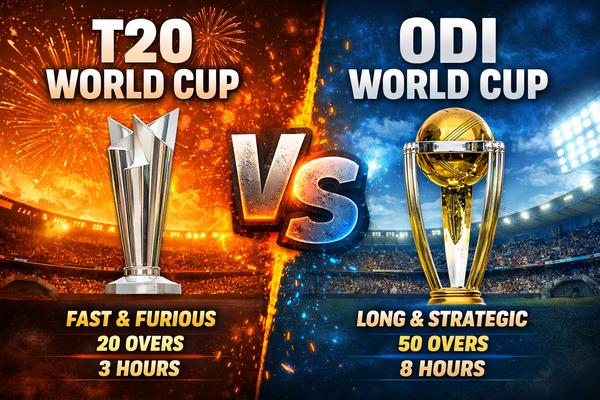
Let’s talk time. A T20 match finishes in about three hours. You can watch one after work and still sleep on time.
An ODI match lasts around eight hours. You commit your entire day. You plan snacks, breaks, and sometimes even emotional therapy.
Modern audiences prefer shorter formats. Broadcasters love T20 because it fits prime-time slots. Yet traditional fans enjoy the slow burn of a 50-over contest.
Pressure and Momentum Swings
T20 cricket punishes mistakes instantly. One bad over can cost 20 runs. One misfield can flip the match.
ODI cricket allows recovery. Teams can rebuild after early wickets. Bowlers can claw back control through tight spells.
In T20, players play with constant urgency. In ODIs, teams manage pressure over longer stretches. Both formats create tension, but they deliver it differently.
Batting Approach: Controlled Aggression vs All-Out Attack
T20 Batting Style
T20 batters attack from the start. Powerplays often decide the match. Players innovate with reverse sweeps, scoops, and switch hits.
Strike rate matters more than average. A quick 35 off 15 balls can change everything. Batters rarely think about “settling in.”
ODI Batting Strategy
ODI batters value partnerships. They rotate strike in middle overs. They accelerate in the final 10 overs.
Centuries still hold prestige in ODIs. Players aim for 100 because they have time to construct innings. The format rewards patience and timing.
Ask yourself this: do you enjoy explosive cameos or elegant centuries more?
Bowling Tactics in Both Formats
T20 bowlers live dangerously. They use slower balls, knuckleballs, wide yorkers, and clever angles. They accept risk because batters attack constantly.
ODI bowlers think long-term. They plan dismissals. They build pressure across multiple overs.
Spinners play different roles too. In T20, they rush through overs and try to trick batters. In ODIs, they control the middle phase and squeeze run rates gradually.
Fielding Standards and Fitness
T20 cricket demands insane athleticism. Fielders dive, sprint, and throw rockets at the stumps. Every saved run matters.
ODI cricket demands endurance. Players stay sharp for 100 overs. They cannot switch off mentally or physically.
Both formats demand elite fitness. However, T20 requires explosive movement, while ODIs require sustained stamina.
Global Popularity and Reach
The ODI World Cup enjoys longer history. Fans associate it with legacy moments like Kapil Dev’s 1983 triumph and Australia’s dominant era in the early 2000s.
The T20 World Cup attracts newer fans. Younger audiences gravitate toward shorter games. Social media thrives during T20 tournaments.
Television ratings often spike for T20 matches. However, the ODI World Cup final still commands massive global audiences. Legacy still carries weight.
Iconic Moments That Define Each Tournament
ODI World Cup moments linger in history books. Think about dramatic finals, marathon centuries, and unforgettable spells. Players cement their legacies in 50-over cricket.
T20 World Cup moments explode across highlight reels. Super overs, last-ball sixes, and crazy run chases define the format.
Both tournaments create heroes. They just shape those heroes differently.
Financial Impact and Commercial Appeal
Sponsors love T20 cricket. Short matches mean prime-time slots and higher advertising value. Franchise leagues also feed into T20’s popularity.
The ODI World Cup still attracts huge sponsorship deals. However, boards often prioritize T20 leagues during packed calendars.
Money talks in modern sport. T20 currently speaks louder in commercial terms.
Player Careers: Which Format Shapes Greatness?
ODI cricket tests complete skill sets. Players must handle different match situations. They must adapt across 50 overs.
T20 cricket rewards specialists. Teams often select players for specific roles. A finisher may only face 10 balls but still win games.
Many players now build careers around T20 leagues. Some even retire from ODIs to focus on franchise cricket. That trend shows where priorities shift.
Tournament Structure and Team Participation
The ODI World Cup often features fewer teams in recent editions. Organizers aim for higher quality and tighter competition.
The T20 World Cup includes more teams. The format allows associate nations to compete and cause upsets.
That inclusivity adds unpredictability to T20 tournaments. Fans love underdog stories, and T20 delivers them frequently.
Statistical Comparison: T20 World Cup vs ODI World Cup
Below you will find a summary of key statistics that highlight differences between the two tournaments.
| Category | T20 World Cup | ODI World Cup |
|---|---|---|
| First Edition | 2007 | 1975 |
| Overs Per Side | 20 overs | 50 overs |
| Approx Match Duration | 3 hours | 8 hours |
| Highest Team Total | 260+ runs | 480+ runs |
| Average First Innings Score | 150–170 runs | 260–290 runs |
| Total Editions (as of 2023) | 8+ editions | 13 editions |
| Trophy Frequency | Every 2 years (recent cycle adjustments) | Every 4 years |
| Player Strike Rate Benchmark | 130+ considered strong | 90+ considered strong |
| Century Frequency | Rare | Common |
| Global Viewership for Final | Hundreds of millions | Over a billion cumulative viewers |
These numbers tell a clear story. T20 cricket moves faster. ODI cricket offers higher scoring ceilings and longer battles.
Fan Experience: Stadium vs TV
T20 matches create party atmospheres. Music blasts between overs. Fans wave banners and dance constantly.
ODI matches build tension gradually. You experience emotional swings across a full day. The final overs often feel epic because of the long buildup.
At the stadium, T20 feels electric. On television, ODI finals often feel historic.
Strategy Depth: Which Format Demands More?
Many fans claim ODIs demand deeper strategy. Captains manage resources over 100 overs. They adjust field placements carefully.
T20 captains must make quick decisions. They react instantly to shifting momentum. They cannot afford slow thinking.
Both formats demand intelligence. However, ODIs allow strategic layers to unfold slowly, while T20 compresses strategy into rapid bursts.
Mental Toughness and Pressure Handling
ODI players manage concentration for hours. They handle momentum swings that stretch across sessions. They stay patient under pressure.
T20 players face relentless intensity. They make split-second decisions. They recover instantly from mistakes.
Both formats test mental strength differently. You cannot label one as mentally easier.
Evolution of the Game
T20 cricket changed how players approach all formats. Batters now attack earlier in ODIs. Strike rates continue to rise.
The ODI format adapted because of T20’s influence. Teams regularly score 300-plus totals now. Aggression defines modern 50-over cricket.
Some fans worry about ODI relevance. However, World Cup years still ignite massive interest. Tradition still commands respect.
Which Tournament Holds Greater Prestige?
Ask a traditionalist, and they will say the ODI World Cup holds the ultimate prestige. Decades of history support that claim.
Ask a younger fan, and they might choose the T20 World Cup. They value pace, entertainment, and constant action.
Prestige often depends on perspective. Legacy favors ODIs. Modern excitement favors T20.
Memorable Finals: Drama vs Explosion
ODI finals often feature grinding pressure. Teams chase under lights with everything at stake. Bowlers defend totals ball by ball.
T20 finals often end with last-over thrillers. One boundary can rewrite history. Fans barely breathe during those final deliveries.
Which drama do you prefer: slow-building tension or heart-racing chaos?
Impact on Emerging Nations
T20 cricket empowers smaller cricket nations. Shorter matches reduce gaps between stronger and weaker teams. Upsets happen more frequently.
ODI tournaments demand sustained performance. Strong teams usually dominate across 50 overs.
T20 helps expand cricket globally. It offers hope and visibility to associate members.
The Future: Where Does Cricket Head?
Cricket boards schedule more T20 leagues every year. Players prioritize shorter formats because of workload and financial incentives.
The ICC continues to protect the ODI World Cup’s prestige. Administrators know fans still value 50-over championships.
Both tournaments will likely coexist. However, T20 may continue to dominate calendar space.
So, T20 World Cup vs ODI World Cup: Which One Wins?
If you crave quick thrills and explosive batting, you will love the T20 World Cup. It delivers non-stop action and frequent surprises.
If you enjoy strategy, endurance, and historic moments, you will treasure the ODI World Cup. It tests complete cricketing ability.
Personally, I enjoy both. I watch T20 matches for entertainment. I watch ODI finals for goosebumps and legacy moments.
Cricket gives us two global spectacles instead of one. Why complain about that?
Final Thoughts
The T20 World Cup vs ODI World Cup debate will never end. Fans will argue in living rooms, stadiums, and online forums for decades.
T20 cricket offers speed, intensity, and commercial appeal. ODI cricket offers tradition, strategy, and long-form drama.
Both tournaments shape cricket’s identity in different ways. One format fuels modern entertainment. The other protects legacy.
So next time someone asks which one you prefer, answer confidently. Then grab some snacks and enjoy whichever World Cup comes next. After all, any day with a World Cup match beats a day without one.