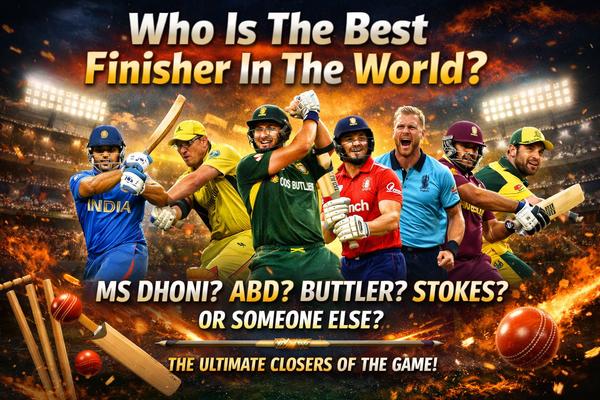
Who Is The Best Finisher In The World
You know that moment. The scoreboard looks ugly. The required run rate climbs like it just drank three energy drinks. Commentators start saying “it’s slipping away.” And then one batter walks in and flips the script.
So who is the best finisher in the world?
Cricket fans love this debate. We argue about it in WhatsApp groups. We bring it up during random tea breaks. We compare eras, formats, pressure moments, and that one insane chase we still cannot believe happened. Let’s break this down properly and settle it like grown adults who secretly enjoy chaos.
Contents
- 1 What Does “Best Finisher” Even Mean?
- 2 MS Dhoni – The Ice-Cold Architect
- 3 Michael Bevan – The Original Chase Machine
- 4 AB de Villiers – The 360-Degree Closer
- 5 Jos Buttler – The Modern T20 Assassin
- 6 Hardik Pandya – The Explosive Game-Changer
- 7 Ben Stokes – The Big-Match Finisher
- 8 Kieron Pollard – T20 Muscle Power
- 9 Glenn Maxwell – Chaos and Genius Combined
- 10 The Statistical Comparison Table
- 11 So, Who Is The Best Finisher In The World?
- 12 Final Thoughts
What Does “Best Finisher” Even Mean?
Before we throw names around, let’s define the term.
A finisher does not just hit sixes. A finisher controls chaos. A finisher calculates risks. A finisher absorbs pressure and then releases it at the perfect moment. That role demands skill, timing, nerve, and a brain that refuses to panic.
A proper finisher usually:
-
Bats in the lower middle order.
-
Chases high targets successfully.
-
Finishes not out more often than not.
-
Maintains a high strike rate under pressure.
-
Wins matches in the last five overs.
You cannot judge finishers only by strike rate. You cannot judge them only by total runs either. Context matters. Situation matters. Nerves matter even more.
So let’s talk about the big names who dominate this conversation.
MS Dhoni – The Ice-Cold Architect
Why Dhoni Owns the Finisher Tag
If you ask most cricket fans, they will say one name without blinking: MS Dhoni.
Dhoni built his legacy on chases. He mastered the art of taking a game deep. He refused to panic. He trusted his calculation. He backed his ability to finish in the final over.
Remember the 2011 World Cup final? He promoted himself ahead of an in-form batter. He smashed that iconic six to seal the trophy. That moment alone defines what finishing means.
Dhoni’s Finishing Strengths
Dhoni never rushed. He read bowlers like an open book. He targeted weaker options. He turned singles into doubles with elite fitness. Then he launched calculated attacks in the death overs.
He finished games with calm authority. He rarely looked flustered. Bowlers felt pressure even when they defended 15 runs in the last over against him.
Dhoni’s Key Stats Snapshot
Dhoni scored over 10,000 ODI runs with an average above 50. He finished with over 70 not-outs in ODIs, which tells you everything about his role. He maintained a strike rate around 87+ in ODIs, which rises sharply in death overs.
He also smashed over 200 international sixes in ODIs and built a reputation as the ultimate chase master.
Does anyone else combine longevity, trophies, and finishing success like that? Very few.
Michael Bevan – The Original Chase Machine
The Man Who Defined ODI Finishing
Before Dhoni took over the spotlight, Michael Bevan ruled the finishing game.
Bevan dominated the late 1990s and early 2000s. He chased targets with surgical precision. He rotated strike brilliantly. He rarely wasted balls. He turned tricky totals into routine wins.
Why Bevan Deserves Respect
Bevan averaged above 53 in ODIs, which looks insane for a middle-order batter. He stayed not out in a huge number of successful chases. He controlled the scoreboard rather than attacking blindly.
He did not rely on brute power. He relied on intelligence and placement. He used gaps like a chess master uses strategy.
Fans sometimes forget him because T20 cricket changed expectations. But in pure ODI finishing terms, Bevan stands tall.
AB de Villiers – The 360-Degree Closer
Controlled Madness at Its Best
Now let’s talk about AB de Villiers.
AB did not just finish games. He demolished bowling attacks. He switched gears instantly. He attacked from ball one if needed. He could also anchor and accelerate later.
He scored the fastest ODI century in 31 balls. Yes, 31. That stat alone explains his destructive ability.
Why AB Feels Different
AB brought innovation to finishing. He scooped fast bowlers. He reverse-swept pacers. He smashed 360 degrees. Bowlers had no safe zone.
He averaged above 50 in ODIs with a strike rate above 100. That combination screams elite.
However, critics often point out one thing. He did not always finish knockout games on the biggest stages. Does that hurt his claim? Maybe slightly. But skill-wise, he ranks among the best ever.
Jos Buttler – The Modern T20 Assassin
Power Meets Precision
In the T20 era, Jos Buttler dominates finishing conversations.
Buttler attacks spin. He punishes pace. He reads field placements instantly. He chases targets with fearless intent.
He plays one of the cleanest power games in world cricket. He rarely mistimes lofted shots. His bat swing looks effortless.
Why Buttler Fits the Modern Era
T20 cricket demands aggression. Buttler delivers exactly that. He strikes at over 140 in T20 internationals. He finishes games inside the final overs with brutal efficiency.
He also played match-winning knocks in World Cups. He sealed the 2022 T20 World Cup semifinal with a clinical chase. That shows big-match temperament.
But can he match Dhoni’s ODI chase legacy? That debate still continues.
Hardik Pandya – The Explosive Game-Changer
Impact Finishing in Pressure Moments
Hardik Pandya brings explosive finishing to India’s modern setup.
He attacks bowlers from ball one. He targets straight boundaries. He handles pace comfortably. He backs himself in clutch moments.
He delivered several match-winning T20 knocks, including a composed finish in the 2022 T20 World Cup against Pakistan.
The Limitation
Hardik does not yet have Dhoni-level consistency across formats. He shines brilliantly, but his body struggles with injuries. Longevity matters in this debate.
Still, in pure T20 finishing ability, he competes strongly.
Ben Stokes – The Big-Match Finisher
Pressure Makes Him Dangerous
Ben Stokes thrives under chaos.
He delivered one of the greatest ODI innings in the 2019 World Cup final. He held his nerve during that dramatic Super Over finish. He also played a match-winning knock in the 2022 T20 World Cup final.
Stokes may not always strike at 150. But he finishes big tournaments. That matters a lot.
Why He Stands Apart
Stokes adapts. He fights. He refuses to quit. When pressure rises, he steps up. That trait separates elite finishers from flashy hitters.
He may not dominate league cricket finishing stats. But in World Cups, he writes history.
Kieron Pollard – T20 Muscle Power
The Franchise Era Finisher
Kieron Pollard built a reputation in T20 leagues worldwide.
He hits long sixes. He clears boundaries with minimal effort. He wins games in five-over bursts.
He smashed six sixes in an over in T20 internationals. That shows raw power.
The Catch
Pollard did not replicate the same dominance consistently in ODIs. His T20 legacy remains strong, but he lacks a defining World Cup final knock.
Still, in franchise cricket finishing, few match his power.
Glenn Maxwell – Chaos and Genius Combined
Maxwell lives on the edge. He attacks relentlessly. He invents shots mid-delivery. He flips games within overs.
He played one of the greatest ODI innings in 2023 World Cup history, rescuing Australia from collapse and sealing an impossible chase. That knock alone strengthens his finishing case massively.
He strikes at above 120 in ODIs and above 150 in T20 cricket. That aggression changes games quickly.
Consistency remains his biggest question mark. But when he clicks, he destroys logic.
The Statistical Comparison Table
Below you will find a summarized statistical comparison of major finishers. These stats focus primarily on limited-overs cricket and highlight their finishing credentials.
| Player | ODI Runs | ODI Average | ODI Strike Rate | Not Outs (ODI) | T20I Strike Rate | Major Tournament Finishes |
|---|---|---|---|---|---|---|
| MS Dhoni | 10,773 | 50.57 | 87.56 | 73 | 126+ | 2011 WC Final |
| Michael Bevan | 6,912 | 53.58 | 74.16 | 67 | N/A | Multiple ODI Chases |
| AB de Villiers | 9,577 | 53.50 | 101.09 | 39 | 135+ | Multiple |
| Jos Buttler | 4,800+ | 40+ | 117+ | 20+ | 140+ | 2022 T20 WC |
| Ben Stokes | 3,400+ | 39+ | 95+ | 15+ | 130+ | 2019 & 2022 Finals |
| Glenn Maxwell | 3,700+ | 33+ | 124+ | 14+ | 150+ | 2023 WC Knock |
| Hardik Pandya | 1,700+ | 33+ | 110+ | 10+ | 140+ | Key T20 Wins |
These numbers tell a story. Dhoni and Bevan dominate ODI averages and not-outs. AB combines average and strike rate beautifully. Buttler and Maxwell dominate modern T20 aggression.
Now comes the real question.
So, Who Is The Best Finisher In The World?
If you prioritize ODI chases and composure under pressure, MS Dhoni wins.
If you admire classic accumulation and flawless chase construction, Michael Bevan competes strongly.
If you love modern explosive finishing across formats, AB de Villiers and Jos Buttler shine.
If you value big-match finals impact, Ben Stokes demands respect.
IMO, the complete package still points to MS Dhoni. He combines longevity, consistency, trophies, and finishing aura. He redefined how teams approach chases. He built a blueprint others follow.
You can argue era differences. You can argue strike rates. But you cannot ignore his record in pressure games.
Final Thoughts
Cricket evolves. T20 leagues reshape finishing roles. Strike rates skyrocket. Power-hitting becomes common.
Yet finishing remains more mental than physical. The best finisher reads pressure like a novel. He controls tempo. He calculates risk. He finishes with clarity.
So next time someone asks, “Who is the best finisher in the world?” you can smile and say, “Depends on the format. But if I need one batter to chase 20 off 12 in a World Cup final, I know my answer.”
And if that batter walks in calmly, adjusts his gloves, and takes the game deep, you already know what happens next.