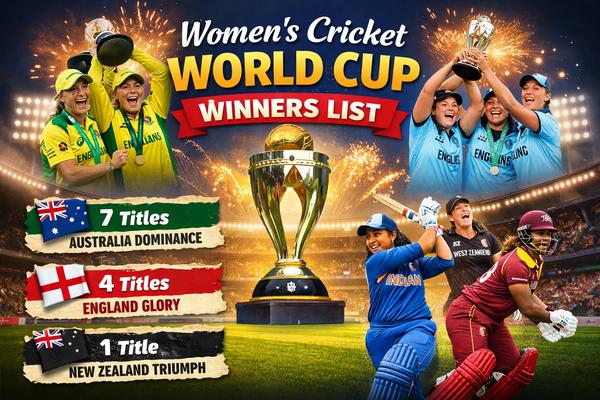
Women’s Cricket World Cup Winners List
Cricket fans love a good trophy story. We remember centuries, hat-tricks, and last-over thrillers, but nothing hits quite like lifting a World Cup. The Women’s Cricket World Cup has delivered drama, dominance, heartbreak, and some serious legacy-building moments. If you ever argued about which team truly owns women’s ODI cricket, this is where that debate starts and ends.
Let’s walk through the Women’s Cricket World Cup Winners List, break down who ruled when, and figure out why certain teams turned this tournament into their personal playground.
Contents
- 1 The Evolution of the ICC Women’s Cricket World Cup
- 2 Complete Women’s Cricket World Cup Winners List (1973–2022)
- 3 Australia: The Undisputed Queens of the Tournament
- 4 England: The Trailblazers and Comeback Specialists
- 5 New Zealand: The Lone Kiwi Triumph
- 6 Early Years: Foundation of Women’s Global Cricket
- 7 1990s: Competitive Shift and Wider Recognition
- 8 2000–2013: Professionalism Changes Everything
- 9 2017: A Tournament That Changed Everything
- 10 2022: Australia’s Ruthless Statement
- 11 Statistical Summary of All Women’s Cricket World Cup Winners
- 12 Why Australia Dominates the Women’s Cricket World Cup Winners List
- 13 Why England Stays Relevant
- 14 Teams Still Chasing Their First Title
- 15 Memorable Individual Performances in World Cup Finals
- 16 How the Tournament Impacted Global Women’s Cricket
- 17 Comparing Eras: Which Champion Stands Tallest?
- 18 Key Takeaways from the Women’s Cricket World Cup Winners List
- 19 The Future of the Women’s Cricket World Cup
- 20 Final Thoughts on Women’s Cricket World Cup Winners List
The Evolution of the ICC Women’s Cricket World Cup
ICC Women’s Cricket World Cup started in 1973. Yes, 1973. That means women played a World Cup two years before the men launched theirs in 1975. Funny how that rarely gets mentioned in casual cricket debates, right?
England hosted the first edition, and the tournament grew steadily from there. Administrators expanded participation, broadcasters increased coverage, and players raised the standard every decade. Today, this tournament represents the peak of women’s ODI cricket.
You cannot talk about modern women’s cricket without acknowledging how this World Cup shaped it.
Complete Women’s Cricket World Cup Winners List (1973–2022)
Here’s the full breakdown of champions across every edition.
Year-by-Year Champions
-
1973 – England
-
1978 – Australia
-
1982 – Australia
-
1988 – Australia
-
1993 – England
-
1997 – Australia
-
2000 – New Zealand
-
2005 – Australia
-
2009 – England
-
2013 – Australia
-
2017 – England
-
2022 – Australia
Notice a pattern? Australia does not just participate. Australia dominates.
Australia: The Undisputed Queens of the Tournament
Australia women’s national cricket team leads the winners list with seven titles. That number alone should end most debates.
Australia won in:
-
1978
-
1982
-
1988
-
1997
-
2005
-
2013
-
2022
Seven trophies. That does not happen by accident.
Australia built systems, invested early, and produced consistent match-winners. Players like Meg Lanning and Ellyse Perry carried modern dominance, but earlier generations laid the foundation.
Australia never relies on one superstar. They build squads that suffocate opponents with discipline. They chase efficiently, bowl aggressively, and field like their lives depend on it.
Ask yourself this: How many finals have you watched where Australia looked nervous? Exactly.
England: The Trailblazers and Comeback Specialists
England women’s cricket team sits second with four titles.
England won in:
-
1973
-
1993
-
2009
-
2017
England made history in 1973 by winning the inaugural edition. That victory gave the tournament credibility and momentum.
The 2017 win stands out for sheer drama. England beat India in a thrilling final at Lord’s. Anya Shrubsole produced a spell for the ages and flipped the match on its head.
England thrives on big moments. They sometimes wobble during group stages, but they show up when finals arrive. You cannot discount a team that understands pressure.
New Zealand: The Lone Kiwi Triumph
New Zealand women’s national cricket team captured the title in 2000. They remain the only team outside Australia and England to win more than once? Actually, they won once. That fact shows how tight this elite club remains.
The 2000 tournament saw New Zealand outplay heavyweights and hold nerve in crunch matches. They relied on disciplined bowling and collective batting rather than flashy individual dominance.
New Zealand often reaches knockout stages, but converting those chances into trophies challenges them. Still, that 2000 victory cemented their place in the Women’s Cricket World Cup winners list forever.
Early Years: Foundation of Women’s Global Cricket
The 1973 edition set the tone. England lifted the trophy in front of a modest but passionate audience.
Australia then grabbed control from 1978 to 1988. They won three consecutive titles during that stretch. That early dominance built a winning culture that still echoes today.
Those early tournaments lacked television coverage and commercial backing. Players balanced jobs and cricket commitments. Yet they delivered competitive, structured tournaments that shaped the modern era.
1990s: Competitive Shift and Wider Recognition
The 1993 tournament returned to England, and the hosts capitalized on home conditions. England’s victory revived interest and expanded international participation.
Australia reclaimed supremacy in 1997 with another commanding campaign. That era saw improved fitness standards and sharper tactical planning.
The 1997 final also highlighted the growing fan base. Larger crowds attended matches, and media coverage increased significantly.
2000–2013: Professionalism Changes Everything
The 2000 edition in New Zealand produced a refreshing champion. That victory broke the Australia-England monopoly temporarily.
Australia then reasserted control in 2005. They built depth across batting and bowling units and crushed opposition consistently.
England struck back in 2009. They combined disciplined seam bowling with smart captaincy and balanced team selection.
Australia followed with another title in 2013. They outclassed teams tactically and physically. Their fielding alone saved crucial runs in knockout games.
By this period, cricket boards invested heavily in women’s programs. Contracts improved, training facilities upgraded, and the gap between top teams widened.
2017: A Tournament That Changed Everything
Mithali Raj led India to the 2017 final and inspired a generation despite the loss.
England defeated India in one of the most thrilling finals in tournament history. The match swung back and forth before England sealed the win by nine runs.
Crowds filled Lord’s. Millions watched globally. Sponsors finally noticed the commercial potential of women’s cricket.
That tournament accelerated professional contracts worldwide. Young girls suddenly saw viable cricket careers ahead.
2022: Australia’s Ruthless Statement
Australia crushed the 2022 tournament in New Zealand. They went unbeaten. They dominated every department.
Alyssa Healy smashed 170 runs in the final, one of the greatest innings in World Cup history. Australia set massive totals and applied relentless pressure with the ball.
That victory marked their seventh title. Seven.
When people debate the greatest women’s cricket team ever, Australia’s 2022 squad usually ends the argument quickly.
Statistical Summary of All Women’s Cricket World Cup Winners
Below, you will find a complete statistical breakdown of titles and runner-up appearances.
| Team | Titles | Runner-Up Finishes | First Title | Most Recent Title |
|---|---|---|---|---|
| Australia | 7 | 5 | 1978 | 2022 |
| England | 4 | 5 | 1973 | 2017 |
| New Zealand | 1 | 2 | 2000 | 2000 |
| West Indies | 0 | 1 | ||
| India | 0 | 2 | ||
| South Africa | 0 | 1 |
This table tells a blunt story. Australia and England control the tournament historically. Other teams reach finals, but they struggle to convert those opportunities.
Why Australia Dominates the Women’s Cricket World Cup Winners List
Australia invests in grassroots cricket aggressively. They identify talent early and develop players through structured pathways.
They also build bench strength. Injuries rarely derail their campaigns because replacements match the standard.
Their domestic system feeds international success consistently. The Women’s Big Bash League strengthens competitiveness and prepares players for pressure situations.
You cannot fake that infrastructure.
Why England Stays Relevant
England adapts quickly. They analyze losses, tweak strategies, and rebuild efficiently.
They also benefit from strong county structures and centralized contracts. England maintains a culture that values tactical awareness and situational control.
Their 2017 win demonstrated how preparation and composure win tight games.
Teams Still Chasing Their First Title
India has reached two finals. West Indies and South Africa have also come close. None of them lifted the trophy yet.
India’s 2017 and 2020s performances show massive growth. South Africa’s consistent semifinal appearances signal steady improvement.
Will one of these teams break the Australia-England grip soon? I think they will. Professional contracts and league exposure continue narrowing the gap.
Memorable Individual Performances in World Cup Finals
Certain performances deserve permanent spotlight:
-
Alyssa Healy’s 170 in 2022 final
-
Anya Shrubsole’s 6-wicket haul in 2017 final
-
Match-winning spells in early Australia title runs
-
Captaincy masterclasses from multiple eras
Finals demand nerve. These players seized those moments instead of hiding from them.
How the Tournament Impacted Global Women’s Cricket
The Women’s Cricket World Cup winners list reflects more than trophies. It reflects progress.
Each edition increased participation. Each final inspired new fans. Each televised broadcast expanded visibility.
Boards increased funding after strong tournament viewership numbers. Young players gained role models. Sponsors invested confidently.
The ripple effect continues.
Comparing Eras: Which Champion Stands Tallest?
Comparing 1970s teams with 2020s squads challenges fairness. Fitness levels differ. Equipment evolved. Professionalism transformed preparation.
However, Australia’s multi-era dominance stands out. They dominated amateur years and professional eras alike.
England’s ability to rebound across decades also impresses. They never fade permanently.
IMO, Australia’s 2022 squad combines skill, depth, and athleticism better than any previous champion.
Key Takeaways from the Women’s Cricket World Cup Winners List
-
Australia leads with 7 titles
-
England follows with 4 titles
-
New Zealand owns 1 historic triumph
-
Other teams reached finals but await breakthroughs
-
Professionalism widened performance gaps early but now shrinks them again
Simple numbers, powerful story.
The Future of the Women’s Cricket World Cup
More teams now compete seriously. Ireland, Pakistan, Bangladesh, and others continue strengthening their squads.
Domestic leagues sharpen talent pools worldwide. Fitness standards improve yearly.
I expect the next few editions to produce tighter knockouts. One upset can change history quickly.
If you love unpredictability, you should stay tuned.
Final Thoughts on Women’s Cricket World Cup Winners List
The Women’s Cricket World Cup winners list tells a story of dominance, resilience, and growth. Australia built a dynasty. England maintained legacy. New Zealand grabbed a historic window.
Other nations circle closer each tournament. They knock on the door louder every four years.
One day, someone will break Australia’s stranglehold. When that happens, cricket fans will remember this list and realize they watched history evolve in real time.
Until then, Australia sits comfortably on the throne. Seven titles say everything.
And if anyone doubts the significance of women’s cricket, just hand them this winners list and let the numbers speak.