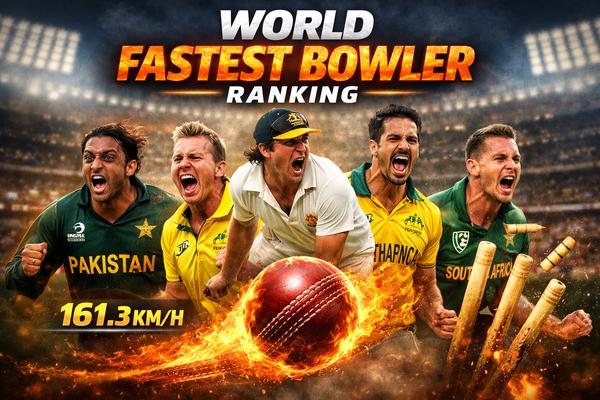
World Fastest Bowler Ranking
Speed thrills. Speed scares batters. Speed makes crowds jump out of their seats before they even realize what happened. And when you talk about the world fastest bowler ranking, you talk about raw pace, shattered stumps, and pure adrenaline.
Every cricket fan loves a good fast bowler debate. Who bowled the quickest ball? Who scared batters the most? Who actually backed up speed with wickets? You and I both know that speed alone means nothing if the ball flies to the boundary every other delivery. So let’s settle in and break down the world fastest bowler ranking properly.
I will talk about verified speeds, career impact, consistency, and the aura these bowlers carried. And yes, I will throw in a few opinions because cricket without opinions feels boring.
Contents
- 1 What Defines the World Fastest Bowler Ranking?
- 2 Shoaib Akhtar – The Benchmark of Raw Pace
- 3 Brett Lee – Pace With Precision
- 4 Shaun Tait – Wild, Fast, and Fearless
- 5 Jeff Thomson – The 1970s Speed Machine
- 6 Mitchell Starc – Modern-Day Speed Demon
- 7 Andy Roberts – Silent but Deadly
- 8 Fidel Edwards – Underrated Speedster
- 9 Mitchell Johnson – Aggression Meets Impact
- 10 Dale Steyn – Speed With Skill
- 11 Mohammad Sami – Flashes of Extreme Pace
- 12 Complete Statistical Summary
- 13 Does Speed Alone Define Greatness?
- 14 Modern Speed Guns vs Old Legends
- 15 Evolution of Fast Bowling
- 16 Who Truly Deserves Number One?
- 17 The Psychology of Facing Extreme Pace
- 18 Why Modern Cricket Needs Express Pacers
- 19 Final Thoughts on World Fastest Bowler Ranking
What Defines the World Fastest Bowler Ranking?
Before we jump into names, let’s clear one thing. Speed guns give us numbers. But numbers alone do not tell the whole story.
A proper world fastest bowler ranking should consider:
-
Highest recorded speed
-
Average bowling speed
-
Longevity at high pace
-
Impact on international cricket
-
Performance in Tests and ODIs
-
Ability to intimidate batters
Anyone can bowl one freak delivery at 155 km/h. Very few bowlers maintain 145+ km/h across spells and series.
That difference matters.
Shoaib Akhtar – The Benchmark of Raw Pace
If you talk about speed, you cannot skip Shoaib Akhtar. He bowled 161.3 km/h (100.23 mph) during the 2003 World Cup against England. That delivery still stands as the fastest officially recorded ball in international cricket.
Akhtar did not just bowl fast. He attacked. He glared. He ran in like a man chasing history. His battles with top batters defined an era.
He did struggle with injuries. He did not always maintain rhythm. But when he hit his stride, he looked unplayable.
IMO, when someone mentions the world fastest bowler ranking, Akhtar owns the top seat.
Brett Lee – Pace With Precision
Brett Lee brought aggression with control. He clocked 161.1 km/h (100.1 mph) in 2005 against New Zealand. He came extremely close to Akhtar’s record.
Lee impressed fans because he combined:
-
High pace
-
Smooth action
-
Consistent line and length
-
Serious wicket-taking ability
He grabbed 310 Test wickets and 380 ODI wickets. He maintained speeds above 145 km/h for years.
Lee did not just rely on intimidation. He planned dismissals. That gives him serious ranking points.
Shaun Tait – Wild, Fast, and Fearless
Now here comes chaos in human form. Shaun Tait clocked 161.1 km/h in 2010 against England.
Tait bowled absolute rockets. He never looked fully in control, but batters never felt comfortable against him.
His problem? Longevity.
He played only a handful of Tests and limited overs matches. Injuries cut his career short. But if we rank pure speed, he sits near the top.
Jeff Thomson – The 1970s Speed Machine
People often forget Jeff Thomson because speed guns did not exist in the 1970s like today. But players from that era swear that Thomson bowled faster than anyone they faced.
Many experts estimate that he consistently bowled above 155 km/h. His action looked slingy and brutal.
Viv Richards once admitted that Thomson frightened him. That says everything.
If modern technology existed back then, he might have topped every world fastest bowler ranking list.
Mitchell Starc – Modern-Day Speed Demon
Mitchell Starc does not always top speed charts, but he regularly touches 160 km/h. He swings the ball at insane pace.
Starc combines:
-
Express pace
-
Lethal yorkers
-
World Cup dominance
-
Test match consistency
He leads modern pace attacks with authority. He delivers in big tournaments.
That balance makes him one of the most complete fast bowlers in the world today.
Andy Roberts – Silent but Deadly
Andy Roberts did not rely on drama. He relied on skill and speed.
Experts estimate that Roberts bowled around 159 km/h during his peak. He dominated during the golden era of West Indies cricket.
He set up batters with variation. He hid his faster ball cleverly. He did not need theatrics.
He built fear quietly.
Fidel Edwards – Underrated Speedster
Fidel Edwards surprised many fans with his slingy action. He clocked around 157.7 km/h.
He never dominated rankings consistently, but he delivered raw speed.
He played in an era filled with West Indies pace legends. That sometimes overshadowed him.
Still, he deserves recognition in any serious world fastest bowler ranking conversation.
Mitchell Johnson – Aggression Meets Impact
You remember the 2013–14 Ashes, right? Mitchell Johnson terrorized England with pace and bounce.
He clocked 156.8 km/h during his career. But numbers do not capture his intimidation factor.
He targeted body lines. He forced mistakes. He dismantled batting line-ups.
Johnson showed how pace and aggression can completely change a series.
Dale Steyn – Speed With Skill
Dale Steyn rarely gets called the fastest ever. But he consistently bowled around 150–155 km/h while swinging the ball both ways.
He took 439 Test wickets. He maintained a bowling average under 23.
That combination of speed and skill makes him elite.
Steyn might not own the top speed record, but he owned batters worldwide.
Mohammad Sami – Flashes of Extreme Pace
Mohammad Sami touched 156.4 km/h during his career.
He possessed natural speed. He lacked consistent control.
Fans often wondered what he could achieve with better discipline. He still ranks among the quickest bowlers ever recorded.
Complete Statistical Summary
Below you will find a summary of key speed records and career highlights for clarity.
| Bowler | Country | Fastest Recorded Speed | Test Wickets | ODI Wickets |
|---|---|---|---|---|
| Shoaib Akhtar | Pakistan | 161.3 km/h | 178 | 247 |
| Brett Lee | Australia | 161.1 km/h | 310 | 380 |
| Shaun Tait | Australia | 161.1 km/h | 5 | 62 |
| Jeff Thomson | Australia | Estimated 155+ km/h | 200 | 55 |
| Mitchell Starc | Australia | 160 km/h | 350+ | 220+ |
| Andy Roberts | West Indies | Estimated 159 km/h | 202 | 87 |
| Fidel Edwards | West Indies | 157.7 km/h | 165 | 60 |
| Mitchell Johnson | Australia | 156.8 km/h | 313 | 239 |
| Dale Steyn | South Africa | 155 km/h | 439 | 196 |
| Mohammad Sami | Pakistan | 156.4 km/h | 85 | 121 |
Does Speed Alone Define Greatness?
Now let me ask you something.
Would you rather face a bowler who bowls 160 km/h but misses line every second ball? Or someone who bowls 148 km/h and hits the top of off stump consistently?
Exactly.
Speed creates headlines. Skill builds legacy.
The world fastest bowler ranking should always balance speed and effectiveness.
Modern Speed Guns vs Old Legends
Technology changed cricket massively.
Modern speed guns provide accurate measurements. Earlier generations relied on estimates.
Many experts believe that bowlers like:
-
Dennis Lillee
-
Malcolm Marshall
-
Michael Holding
would have clocked extreme speeds if modern equipment existed.
We cannot ignore context when discussing rankings.
Evolution of Fast Bowling
Fast bowling evolved through eras.
-
1970s: Raw aggression and intimidation
-
1990s: Pace combined with reverse swing
-
2000s: Fitness-driven express bowling
-
Modern era: Data-driven speed and workload management
Today’s fast bowlers train differently. They use biomechanics, strength training, and recovery science.
That explains why more bowlers now cross 150 km/h consistently.
Who Truly Deserves Number One?
If we judge purely by recorded speed, Shoaib Akhtar wins.
If we judge by longevity and performance, Brett Lee and Dale Steyn dominate.
If we judge intimidation factor, Mitchell Johnson during Ashes might top the list.
So who wins?
The answer depends on your criteria.
But the official world fastest bowler ranking still places Shoaib Akhtar at the top because of that 161.3 km/h thunderbolt.
The Psychology of Facing Extreme Pace
Fast bowling affects more than technique.
It affects:
-
Reaction time
-
Confidence
-
Footwork
-
Shot selection
When a batter sees 155+ km/h on the speed gun, panic creeps in.
Even top players admit that extreme pace forces mistakes.
That mental edge makes fast bowlers special.
Why Modern Cricket Needs Express Pacers
T20 leagues dominate headlines today. Batters smash sixes effortlessly.
Fast bowlers restore balance.
A genuine 150+ km/h bowler changes field settings. He forces defensive strokes. He adds excitement.
Cricket thrives on that contest.
Final Thoughts on World Fastest Bowler Ranking
The world fastest bowler ranking sparks endless debate for a reason.
Speed fascinates fans. It creates drama. It defines eras.
Shoaib Akhtar owns the official speed record. Brett Lee blends pace with longevity. Dale Steyn combines skill with aggression. Mitchell Johnson shows how pace wins series. Shaun Tait proves that raw speed shocks everyone.
Every era produces its own speed king.
You can argue statistics all day. You can compare eras endlessly. But nothing beats the thrill of seeing stumps fly at 160 km/h.
And honestly, if you love cricket, you secretly wait for that speed gun to flash 155+ every single time.
That anticipation keeps the game alive.