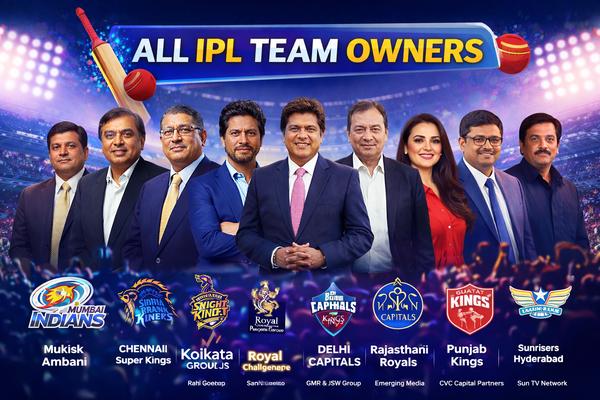
All IPL Team Owner
You cheer for sixes, scream at umpires, and argue about strike rates with strangers online. But have you ever paused and wondered who actually signs the cheques behind your favorite IPL team? The IPL does not run on vibes alone. It runs on billionaires, business empires, film stars, and corporate giants who treat cricket like both passion and power play.
Let’s talk about all IPL team owner details, break down who controls what, and understand how these owners shape the biggest T20 league in the world.
Why IPL Team Owners Matter More Than You Think
Team owners do far more than just sit in VIP boxes and clap. They build squads, hire management, shape branding, and influence long-term strategy.
Owners decide how aggressively teams bid at auctions. Owners decide whether teams back youth or chase superstars. Owners also decide whether franchises build legacy or simply chase quick headlines.
In short, owners set the tone. And tone wins tournaments.
Mumbai Indians Owner
If IPL had a royal family, Mumbai Indians would claim the throne. And Mukesh Ambani, through Reliance Industries, runs that kingdom.
Mukesh Ambani owns Mumbai Indians under the Reliance umbrella. He bought the franchise in 2008 for around $111.9 million. Since then, he turned it into one of the most successful sports brands in India.
Mumbai Indians won 5 IPL titles. The franchise built a winning culture under Rohit Sharma and invested heavily in scouting young talent like Jasprit Bumrah and Hardik Pandya. Ambani’s business precision clearly spills into cricket strategy.
You cannot ignore the financial muscle here. Reports value Mumbai Indians at over $1.3 billion, making it one of the most valuable IPL teams.
Chennai Super Kings Owner
Chennai Super Kings enjoys almost mythic loyalty. And N. Srinivasan, through India Cements, steers that ship.
India Cements owns CSK. The franchise paid around $91 million during the inaugural auction. Fans know CSK for consistency, calm leadership, and smart planning.
CSK also won 5 IPL titles, matching Mumbai Indians. The franchise trusts experienced players and backs leadership stability under MS Dhoni. That formula works, and it keeps working.
CSK commands a valuation of around $1.15 billion, which reflects both trophies and fan devotion.
Royal Challengers Bangalore Owner
RCB fans live on hope and memes. But United Spirits, now under the Diageo group, owns the franchise.
The group bought RCB for approximately $111.6 million in 2008. Despite zero IPL trophies, RCB enjoys massive brand value thanks to stars like Virat Kohli and AB de Villiers.
RCB focuses heavily on marketing and fan engagement. The team often builds star-studded squads, although trophies continue to slip away. Still, the franchise valuation crosses $1.05 billion.
No trophy cabinet dominance yet, but brand dominance? Absolutely.
Kolkata Knight Riders Owner
KKR brings Bollywood glamour to cricket. Shah Rukh Khan, Juhi Chawla, and Jay Mehta own Kolkata Knight Riders.
The ownership group bought KKR for about $75.09 million in 2008. Shah Rukh Khan actively promotes the team and turns KKR into a global brand.
KKR won 2 IPL titles under Gautam Gambhir’s captaincy. The franchise invests in analytics, overseas scouting, and youth systems.
KKR now holds a valuation of around $1.1 billion, proving that strong branding plus smart cricket works.
Delhi Capitals Owner
Delhi Capitals runs under a partnership model. GMR Group and JSW Group share ownership.
GMR initially bought the franchise for approximately $84 million. JSW later acquired a 50 percent stake and reshaped the management structure.
Delhi never won an IPL title yet, but the team reached the final in 2020. The franchise focused heavily on youth, backing players like Rishabh Pant and Prithvi Shaw early in their careers.
Delhi Capitals now carry a valuation close to $950 million.
Rajasthan Royals Owner
Rajasthan Royals surprised everyone in 2008. Manoj Badale, through Emerging Media, leads the ownership group.
The franchise cost only $67 million, making it the cheapest original IPL team. Yet Rajasthan Royals won the very first IPL title under Shane Warne.
The team often hunts undervalued players and builds balanced squads rather than flashy lineups. That Moneyball-style approach keeps them competitive.
Rajasthan Royals now enjoy a valuation of around $850 million.
Sunrisers Hyderabad Owner
Sunrisers Hyderabad operates under Kalanithi Maran and the Sun TV Network.
The franchise replaced Deccan Chargers in 2013. Sun TV acquired the team for approximately $85.05 million per year over a five-year deal.
SRH won 1 IPL title in 2016 under David Warner. The franchise traditionally builds strong bowling units and invests in overseas pace talent.
Sunrisers Hyderabad currently hold a valuation near $970 million.
Punjab Kings Owner
Punjab Kings operates under a group that includes Preity Zinta, Mohit Burman, Ness Wadia, and Karan Paul.
The ownership group bought the franchise for around $76 million in 2008. The team rebranded from Kings XI Punjab to Punjab Kings in 2021 to refresh its identity.
Punjab Kings reached the IPL final once in 2014. The franchise frequently experiments with leadership and auction strategies.
Punjab Kings carry a valuation close to $925 million.
Gujarat Titans Owner
Gujarat Titans entered IPL in 2022. CVC Capital Partners owns the franchise.
CVC Capital acquired the team for approximately $700 million during the expansion auction. That number stunned many fans.
Gujarat Titans won the IPL title in their debut season in 2022. The franchise emphasized balance and backed Hardik Pandya as captain immediately.
The team valuation already sits around $850–900 million, which shows how quickly success translates into value.
Lucknow Super Giants Owner
Lucknow Super Giants also joined IPL in 2022. Sanjiv Goenka, through RPSG Group, owns the team.
RPSG Group paid around $940 million, which marked the highest expansion bid in IPL history. That aggressive move showed serious ambition.
Lucknow reached playoffs in their first two seasons. The franchise builds squads around power hitters and flexible bowling options.
Lucknow Super Giants now hold a valuation close to $1 billion.
Key Statistics at a Glance
Below you will find all major ownership and financial statistics summarized in one place.
| Team | Owner | Year Acquired | Initial Cost (Approx) | IPL Titles | Estimated Current Valuation |
|---|---|---|---|---|---|
| Mumbai Indians | Mukesh Ambani (Reliance) | 2008 | $111.9M | 5 | $1.3B+ |
| Chennai Super Kings | India Cements (N. Srinivasan) | 2008 | $91M | 5 | $1.15B |
| Royal Challengers Bangalore | United Spirits (Diageo) | 2008 | $111.6M | 0 | $1.05B |
| Kolkata Knight Riders | Shah Rukh Khan Group | 2008 | $75.09M | 2 | $1.1B |
| Delhi Capitals | GMR & JSW Group | 2008 | $84M | 0 | $950M |
| Rajasthan Royals | Manoj Badale | 2008 | $67M | 1 | $850M |
| Sunrisers Hyderabad | Sun TV Network | 2013 | $85.05M/year | 1 | $970M |
| Punjab Kings | Preity Zinta & Partners | 2008 | $76M | 0 | $925M |
| Gujarat Titans | CVC Capital Partners | 2022 | $700M | 1 | $850–900M |
| Lucknow Super Giants | RPSG Group | 2022 | $940M | 0 | ~$1B |
Corporate Owners vs Celebrity Owners
Corporate giants like Reliance and RPSG operate IPL teams like structured businesses. They rely on analytics, planning, and long-term growth.
Celebrity owners like Shah Rukh Khan bring global attention and emotional branding. They amplify fan engagement and boost visibility beyond cricket.
Both models work. Mumbai Indians show corporate efficiency. KKR shows brand storytelling power.
Which approach feels better? That depends on whether you love spreadsheets or spotlights.
Who Spends the Most at Auctions?
Owners like Mukesh Ambani and Sanjiv Goenka rarely hesitate during auctions. They chase impact players aggressively.
Teams like Rajasthan Royals often avoid bidding wars. They scout hidden gems instead.
Punjab Kings frequently surprise fans with bold buys. RCB often goes all-in on star names.
Auction strategy reflects ownership personality. Aggressive owners chase headlines. Patient owners chase systems.
How Owners Influence Team Culture
Ownership shapes identity. CSK values stability because India Cements supports continuity.
Mumbai Indians emphasize youth scouting because Reliance invests in grassroots systems. Rajasthan Royals experiment because their leadership encourages risk.
Ownership also impacts captain selection, coaching hires, and brand campaigns. You cannot separate team culture from boardroom vision.
Financial Growth of IPL Franchises
When IPL started in 2008, most teams cost under $120 million. Today, almost every franchise touches or exceeds $900 million in valuation.
Expansion teams fetched $700 million and $940 million bids. That jump highlights IPL’s explosive commercial growth.
Broadcast deals, sponsorships, and global streaming platforms drive revenue. Owners understand that IPL now operates as a billion-dollar entertainment industry.
Cricket fans debate strike rates. Owners calculate return on investment.
Most Successful Owner in IPL History
Mukesh Ambani leads the race if you measure success by trophies and valuation growth. Mumbai Indians combine five titles with strong brand equity.
N. Srinivasan also deserves recognition for building CSK into a dynasty. Five titles demand respect.
Shah Rukh Khan deserves credit for turning KKR into a global lifestyle brand. Two titles plus international recognition mark serious achievement.
Each owner wins in different ways. Some win trophies. Some win money. Some win hearts.
Do Owners Interfere in Cricket Decisions?
Some owners stay hands-on. Others delegate responsibility.
Shah Rukh Khan actively engages with players and fans. Mukesh Ambani allows professional management to handle operations.
Sanjiv Goenka often takes visible interest in strategy discussions. Rajasthan Royals ownership relies heavily on analytics teams.
Owner involvement varies, but smart owners trust cricket experts. Ego rarely wins championships.
What Makes a Great IPL Owner?
A great IPL owner must:
-
Invest long term
-
Back management during tough phases
-
Build strong scouting networks
-
Maintain financial discipline
-
Engage fans consistently
Owners who chase instant glory often struggle. Owners who build systems usually dominate.
Consistency wins leagues.
The Future of IPL Ownership
IPL valuations will likely rise further. Global investors already monitor franchise growth.
Owners now explore international leagues like SA20 and ILT20. Mumbai Indians and KKR already operate multiple global franchises.
Cross-league ownership expands brand reach. IPL owners now think globally, not just domestically.
Do you see IPL teams becoming global cricket corporations? That future looks very real.
Final Thoughts on All Ipl Team Owner
IPL team owners shape far more than balance sheets. They shape rivalries, culture, branding, and long-term dominance.
Mukesh Ambani built a powerhouse in Mumbai Indians. N. Srinivasan crafted a legacy in Chennai. Shah Rukh Khan blended cinema with cricket magic. Sanjiv Goenka made bold expansion history.
Each owner plays a different game off the field. Some chase trophies. Some chase valuation. The smartest ones chase both.
Next time you celebrate a last-ball six, remember that someone in a corporate boardroom probably smiled just as wide. Cricket entertains us. Ownership sustains the spectacle.
And honestly, without these ambitious owners writing massive cheques and taking calculated risks, IPL would never have become the financial and cultural monster that we obsess over every summer.