How Many Countries Play Cricket
You probably think cricket belongs to a handful of nations that treat it like religion. India. Australia. England. Maybe Pakistan and South Africa. That’s the usual mental shortlist, right?
But here’s the twist: cricket stretches way beyond those familiar giants. The sport quietly spreads across continents, cultures, and climates that might surprise you. So how many countries play cricket? The real answer tells a much bigger story than most fans expect.
Let’s break it down properly.
The Straight Answer: How Many Countries Play Cricket?
Right now, over 100 countries play cricket in an organized, recognized format.
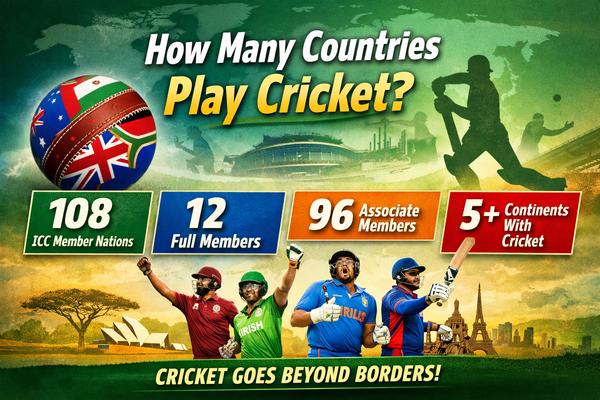
The global governing body, the International Cricket Council (ICC), includes 108 member nations. That number includes:
-
12 Full Members
-
96 Associate Members
That means more than half the world’s countries actively participate in cricket at some official level. Not all of them play packed stadium matches in front of 80,000 fans. But they field teams, run leagues, and compete internationally.
And yes, even countries you never associate with cricket run national squads.
Surprised? You should be.
What Does “Play Cricket” Actually Mean?
Before you imagine every one of those 108 countries hosting five-day Test matches, let’s clarify something.
When we say a country plays cricket, we mean:
-
It has an official cricket board recognized by the ICC.
-
It organizes domestic competitions.
-
It fields national teams in ICC tournaments or qualifiers.
-
It invests in development programs.
That doesn’t mean every country plays Test cricket. Only the top-tier nations get that privilege. The rest compete in limited-overs formats like ODI and T20 at varying levels.
Still, 100-plus nations actively competing? That shows serious global reach.
Full Members: The Elite 12 Nations
The ICC grants Full Member status to the strongest cricketing nations. These teams can play Test matches, which remain the sport’s most traditional and demanding format.
Here are the 12 Full Members:
-
India
-
Australia
-
England
-
Pakistan
-
South Africa
-
New Zealand
-
Sri Lanka
-
West Indies
-
Bangladesh
-
Zimbabwe
-
Afghanistan
-
Ireland
Each of these nations competes across all formats: Test, ODI, and T20.
Why Only 12?
The ICC maintains strict performance and infrastructure standards. A country must:
-
Show consistent competitive performance.
-
Develop domestic cricket structures.
-
Demonstrate financial stability.
-
Grow participation numbers.
Afghanistan and Ireland earned Full Member status in 2017 after years of strong performances. That promotion proved that smaller cricket nations can climb the ladder.
Associate Members: The Expanding Cricket World
Now here’s where things get interesting.
The ICC lists 96 Associate Members. These countries do not play Test cricket, but they compete in ODI and T20 formats and participate in qualification tournaments.
You’ll find some expected names:
-
Nepal
-
Scotland
-
Netherlands
-
United Arab Emirates
But you’ll also see countries that raise eyebrows:
-
Germany
-
United States
-
Japan
-
Brazil
-
Canada
-
Denmark
-
Namibia
-
Oman
Yes, Germany plays cricket. Japan fields a national team. Brazil runs development leagues.
Cricket spreads quietly in places where football dominates headlines.
Cricket Across Continents
Let’s take a continental tour and see how widely cricket spreads.
Asia: The Powerhouse
Asia dominates global cricket participation and viewership.
Countries actively playing cricket in Asia include:
-
India
-
Pakistan
-
Bangladesh
-
Sri Lanka
-
Afghanistan
-
Nepal
-
UAE
-
Oman
-
Hong Kong
-
Malaysia
-
Singapore
Asia drives massive TV audiences and commercial revenue. India alone generates billions in cricket revenue annually. The Indian Premier League influences global cricket economics more than any other competition.
You cannot discuss global cricket without acknowledging Asia’s dominance.
Europe: Tradition Meets Growth
Europe offers both historical roots and new growth markets.
Key European cricket nations include:
-
England
-
Ireland
-
Scotland
-
Netherlands
-
Germany
-
Denmark
-
Italy
England gave birth to modern cricket. Ireland now competes at Test level. Scotland and Netherlands regularly upset bigger teams in ICC events.
Germany builds cricket infrastructure rapidly due to immigrant communities who bring cricket culture with them.
Europe blends history with expansion.
Africa: Rising Talent
Africa continues to produce exciting talent.
Major cricket-playing African nations include:
-
South Africa
-
Zimbabwe
-
Namibia
-
Kenya
-
Uganda
South Africa remains a global powerhouse. Namibia impressed audiences in recent T20 World Cups. Uganda continues steady development progress.
African cricket grows faster than many fans realize.
Americas: The Emerging Market
The Americas offer one of cricket’s biggest growth opportunities.
Active cricket nations include:
-
West Indies
-
United States
-
Canada
-
Brazil
-
Argentina
The United States gained ODI status recently and now hosts major ICC tournaments. Investors pour money into American franchise leagues. Canada brings long cricket history dating back to the 19th century.
If cricket cracks the US market properly, the sport’s global footprint will explode.
Oceania: Small Region, Big Impact
Australia and New Zealand dominate this region.
Papua New Guinea also competes internationally and shows strong grassroots participation.
Even smaller Pacific nations invest in development programs.
The Real Global Numbers
Let’s summarize the key statistics clearly.
| Category | Number |
|---|---|
| Total ICC Member Countries | 108 |
| Full Members | 12 |
| Associate Members | 96 |
| Continents with Active ICC Members | 5+ |
| Countries Playing Test Cricket | 12 |
These numbers show cricket’s genuine global spread. Football still dominates worldwide participation, but cricket commands significant reach.
Why Don’t People Realize Cricket Spreads This Wide?
You rarely see Germany vs Brazil cricket highlights on sports channels. Media coverage focuses heavily on top-tier nations.
Three main reasons hide cricket’s global footprint:
-
Broadcasting prioritizes high-revenue markets.
-
Test cricket remains limited to 12 nations.
-
Football overshadows cricket in many regions.
Still, grassroots participation grows steadily.
Does Every Country Play Competitive Cricket?
Not at the same level.
Full Members maintain professional domestic leagues and world-class stadiums. Associate Members often rely on semi-professional setups.
Some nations operate with limited funding and minimal infrastructure. Yet players still train, compete, and represent their countries proudly.
That passion keeps cricket expanding.
T20: The Game Changer
T20 cricket changed everything.
The shorter format allows newer nations to compete more easily against established teams. A 20-over game reduces the skill gap compared to five-day Test matches.
One explosive batting performance can shift an entire tournament.
T20 World Cups now feature more Associate nations than ever before. This format accelerates cricket’s global reach faster than traditional formats ever did.
If you want cricket to grow worldwide, T20 offers the most effective vehicle.
Olympic Inclusion: A Future Boost?
Cricket will return to the Olympics in 2028.
Olympic inclusion will push more countries to invest in cricket infrastructure. National Olympic committees prioritize sports that appear in the Games.
That single decision could increase ICC membership further.
Imagine countries like France, Spain, or China pushing structured cricket programs just to compete at Olympic level. That scenario changes global dynamics dramatically.
Comparing Cricket to Other Global Sports
Let’s stay realistic.
Football claims over 200 national associations. Basketball spans nearly every continent. Tennis operates globally with individual players.
Cricket sits somewhere in between.
However, cricket dominates deeply in its strongholds. India, Pakistan, Bangladesh, and Sri Lanka treat cricket as a national obsession.
When you measure fan intensity rather than sheer country count, cricket competes strongly with any sport.
Would you rather have mild interest in 200 countries or extreme passion in 100? That debate gets interesting quickly.
How Many Countries Play Cricket Competitively?
All 108 ICC members compete at some level.
But only around 30–35 nations consistently appear in major ICC global qualifiers and tournaments.
These include:
-
Scotland
-
Netherlands
-
Nepal
-
Namibia
-
Oman
-
USA
-
UAE
These teams regularly challenge Full Members in T20 competitions.
You cannot label them as minor anymore.
Grassroots Cricket: The Hidden Layer
Official ICC membership tells only part of the story.
Many non-member territories still play recreational cricket. Expats, immigrants, and students introduce cricket into communities worldwide.
Local clubs operate in countries without formal ICC recognition. Friendly tournaments take place in unexpected regions.
The true number of countries where people physically play cricket likely exceeds 120.
Which Region Shows Fastest Growth?
North America currently shows rapid expansion.
Major franchise leagues attract investors and broadcasters. Youth academies open across multiple states in the US. Canada continues rebuilding its cricket ecosystem.
Europe also experiences steady growth due to migration patterns.
Germany, Italy, and Spain build structured leagues fueled by South Asian communities.
Growth rarely grabs headlines, but it happens steadily.
Why Cricket Still Feels Limited Globally
Cricket requires:
-
Specialized equipment
-
Dedicated playing surfaces
-
Longer match durations
-
Strategic depth
Football requires a ball and open space. That simplicity explains football’s broader global penetration.
Cricket demands more planning and resources.
However, T20 reduces time commitment and lowers entry barriers. That format helps expansion significantly.
Does More Countries Mean Better Competition?
Not automatically.
Quality matters more than quantity.
If 200 countries play cricket casually but only 12 compete seriously, competitive balance stays concentrated.
However, as Associate nations gain experience, upsets occur more frequently.
Afghanistan reached Full Member status within two decades of serious development. That rapid climb proves growth remains possible.
My Honest Take on Cricket’s Global Future
I believe cricket will cross 120 ICC members within the next decade.
Olympic inclusion will accelerate investment. T20 leagues will attract commercial interest. Youth development programs will expand participation.
Will cricket ever rival football’s 200-plus country reach? Probably not.
Will cricket deepen its influence across 120–130 nations? Absolutely.
And honestly, quality engagement matters more than raw numbers.
Final Thoughts: So, How Many Countries Play Cricket?
More than 100 countries officially play cricket today. Specifically, 108 nations hold ICC membership, with 12 Full Members competing at the highest level.
Cricket spreads across Asia, Europe, Africa, the Americas, and Oceania. It thrives deeply in some nations and grows steadily in others.
The sport no longer belongs to just a handful of Commonwealth countries. It continues expanding into new markets, cultures, and audiences.
Next time someone claims cricket only matters in five countries, you can correct them confidently. Over 100 nations pick up the bat and ball with pride.
And if you still think cricket feels small globally, just wait. The next decade will surprise you.