How does T20 World Cup qualification work?
Introduction
I’m going to break this down like we’re at a cricket bar debating over a chai after watching an intense T20 game. Let’s explore how does T20 World Cup qualification work. You know the ICC Men’s T20 World Cup 2026 features 20 nations battling it out on Indian and Sri Lankan pitches. But before the tournament starts, every one of those 20 teams had to punch their ticket through a pretty wild qualification journey. Trust me, this isn’t just rankings and random selections. The process feels complicated until you unpack it piece by piece exactly what I’ll do here.
If you ever wondered how teams from Canada to Nepal earned their spots in this massive event, you’re in the right place. I’ll walk you through every qualifying route: direct qualification, regional qualifiers, what the ICC ranking rules really mean, and how underdogs like Italy made history. Let’s get right into it.
Contents
Direct Qualification Explained
First things first, not every team sweat in regional qualifiers. Some earned direct entry based on clear criteria.
Hosts and Top Performers
The tournament gives priority to a few key groups. The first is the hosts India and Sri Lanka. Hosts always get automatic spots. That’s tradition, not negotiation.
Next, the ICC handed direct qualification spots to the top teams from the previous T20 World Cup. These weren’t top 8 or top 10. They picked the top seven teams excluding the hosts. That meant teams that performed well in 2024 rolled their success straight into 2026.
Here’s how that list shaped up:
-
Afghanistan
-
Australia
-
Bangladesh
-
England
-
South Africa
-
United States
-
West Indies
-
(Plus the hosts: India & Sri Lanka)
That gave us 10 teams right off the bat without spinning a ball in regional qualifiers.
ICC Rankings Fill the Gaps
Then the ICC looked at the T20I rankings on 30 June 2024 to fill a few more direct spots. They picked the highest-ranked teams not yet qualified. No debates here it’s pure numbers.
So this batch added:
-
Ireland
-
New Zealand
-
Pakistan
That pushed the direct qualifiers count to 13 teams before regional play began.
Regional Qualification Where the Underdogs Shine
After the direct qualification was sorted, the ICC still needed to fill 8 spots to complete the 20-team field. That’s where regional qualification came in.
This phase gave teams from every continent a fighting chance to make it to the World Cup. It wasn’t a single tournament it was a whole qualification ecosystem with sub-regional and regional rounds.
The regional qualifiers worked like this:
Americas
-
A sub-regional tournament brought nine teams together.
-
The top top three teams (Bahamas, Bermuda, Cayman Islands) went forward.
-
Canada entered the regional final directly (they skipped sub-regional play).
-
Canada eventually earned the Americas spot for the World Cup.
Europe
Europe had a busy path:
-
Teams competed in European sub-regional qualifiers.
-
Top performers advanced to a regional final.
-
Two teams Italy and the Netherlands emerged victorious. Italy even made its first World Cup appearance.
Asia + East Asia-Pacific (EAP)
This region combined Asia and EAP qualifiers:
-
Teams competed in sub-regional and regional finals.
-
Nepal, Oman, and UAE advanced from this route.
Africa
Africa’s path included sub-regional and regional rounds too.
-
Teams like Zimbabwe and Namibia made it through that process.
So those regional battles filled the remaining World Cup slots. The final eight teams from qualifiers ended up being:
-
Canada
-
Italy
-
Netherlands
-
Namibia
-
Zimbabwe
-
Nepal
-
Oman
-
United Arab Emirates
Total Team Breakdown
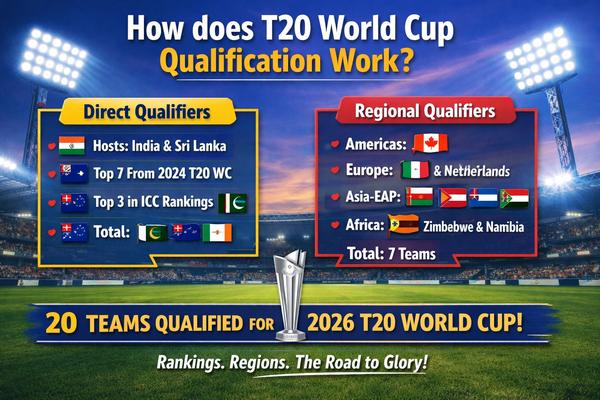
Let’s summarize how all 20 teams got in:
| Route | Number of Teams | Examples |
|---|---|---|
| Hosts | 2 | India, Sri Lanka |
| Top teams from 2024 WC | 7 | West Indies, Afghanistan, etc. |
| ICC Rankings | 3 | Ireland, Pakistan, New Zealand |
| Americas qualifier | 1 | Canada |
| Europe qualifiers | 2 | Italy, Netherlands |
| Africa qualifiers | 2 | Zimbabwe, Namibia |
| Asia-EAP qualifiers | 3 | Nepal, Oman, UAE |
This adds up exactly to 20 qualified teams.
And for those wondering, this is the largest field the T20 World Cup has ever featured. The tournament expanded to 20 teams precisely so more countries could take part including first-timers like Italy.
Why Does the ICC Use This Qualification System?
You might ask: Why not just rankings or qualifiers alone?
The ICC wants global representation and competitive balance.
If they only used rankings, small cricketing nations would rarely make it. If they only used qualifiers, top teams might miss out due to one bad series. Combining both rewards performance and opens doors for emerging teams. That’s actually genius when you think about it.
Plus, regional qualification gives associate members real competitive experience. You don’t grow cricket overnight with friendly matches alone.
So yes, the system feels messy on paper, but it works toward a bigger goal:
Grow the game, but keep quality high.
The Road Inside the Tournament Group and Super 8
Getting into the T20 World Cup is just step one. Once the 20 teams arrive in India and Sri Lanka, the actual tournament qualification still has layers.
Here’s how it rolls once the competition begins:
Group Stage Structure
The 20 teams get split into four groups of five.
-
Each plays four matches (round robin).
-
The top two teams from each group move forward.
-
That gives us 8 teams advancing.
Super 8 Round
After the group stage, the competition moves to a second phase called the Super 8.
-
Those eight teams divide into two groups of four.
-
Each team plays three matches.
-
Top two from each Super 8 group earn semifinal spots.
Knockouts
Once you hit the semifinals, it’s do or die:
-
Two semifinal matches
-
Winners meet in the final
This structure means qualification inside the World Cup is a tournament of its own. A team might qualify through regional play, but still needs to earn each round spot in the main event.
Interesting Things About 2026 Qualification
Now that you know the system, let’s geek out a bit:
1. Italy Made History
Italy had never played in a T20 World Cup before 2026. Their qualification is massive for European associate cricket.
2. Routes Were Tough But Fair
Countries like Oman and UAE didn’t just get lucky. Their regional finals were proper competitions with pressure matches, and only the strongest moved forward.
3. Rankings Still Matter
Even with qualifiers, the ICC ranking system earned Ireland, Pakistan, and New Zealand their tournament entry. Rankings weren’t ignored they just weren’t everything.
4. The System Rewards Consistency
Teams that performed well in the 2024 World Cup earned straight entry for 2026. That means every match in a World Cup cycle has long-term consequences.
Side Stories That Matter
While qualification ended in 2025, the 2026 T20 World Cup itself has already thrown curveballs that show why this qualification system feels right.
Semi-Final Drama
Once inside the tournament, teams like India, England, South Africa, and New Zealand reached the semifinals based on performance in the Super 8 round.
Upsets and Surprises
Rain wiped a match without a ball bowled and affected group standings another reminder that qualification performance matters when every point counts.
Discipline and Accountability
Cricket boards are reacting to performance pressure. Pakistan players faced fines for failing expectations, showing that qualification isn’t just prestige it carries real consequences.
Conclusion
Understanding how T20 World Cup qualification works for the 2026 tournament feels like learning a new cricket rule confusing at first, but absolutely logical once you unpack it. Here’s the short version, friendly style:
-
Hosts get in automatically.
-
Top performers from the previous World Cup get direct entry.
-
ICC rankings fill the next slots.
-
Regional qualifiers decide the last spots.
-
Once in, teams battle in group stages, Super 8s, and then knockouts for glory.
The system blends performance, opportunity, fairness, and growth for the global game. That balance makes cricket more inclusive without watering down competition.
Now next time someone says “It’s too hard to get into the T20 World Cup,” you can break it down like a seasoned fan and probably win that bar debate too.