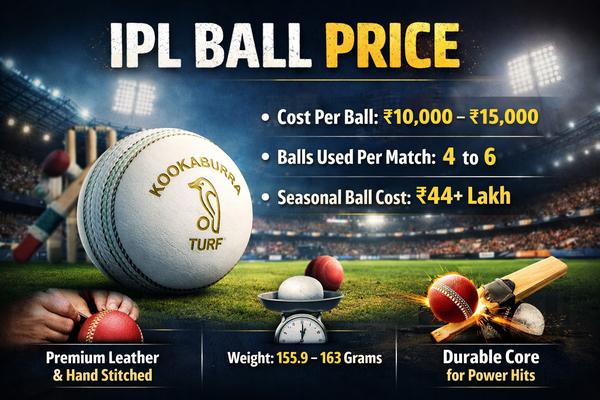
IPL Ball Price
You watch a last-over thriller in the IPL, the batter smashes the ball into the stands, and you jump off your couch. Then a random thought hits you. How much does that little white missile actually cost? You see it swing, seam, reverse, and sometimes disappear into the crowd forever. So what does the IPL ball price really look like?
Let’s break it down like true cricket nerds.
Contents
- 1 What Exactly Determines Ipl Ball Price?
- 2 Which Brand Supplies the IPL Ball?
- 3 What Is the Current Ipl Ball Price?
- 4 Why Does the IPL Ball Cost So Much?
- 5 How Many Balls Does One IPL Match Use?
- 6 Total Seasonal Ball Cost in IPL
- 7 Ipl Ball Price Compared to Other Cricket Balls
- 8 Does the Ball Change During an IPL Match?
- 9 Why White Balls Cost More Than Red Balls
- 10 Can You Buy an Official IPL Ball?
- 11 What Happens to Used IPL Balls?
- 12 How Ipl Ball Price Impacts Teams and Franchises
- 13 Do Bowlers Have Preferences?
- 14 How Long Does an IPL Ball Stay Hard?
- 15 Does Ipl Ball Price Affect Grassroots Cricket?
- 16 Detailed Statistics Table
- 17 Does the Price Justify the Performance?
- 18 Ipl Ball Price vs Bat Price
- 19 How Manufacturing Precision Drives Cost
- 20 Influence of Broadcast and Sponsorship
- 21 Does Weather Affect Ball Replacement Frequency?
- 22 Why Fans Should Care About Ipl Ball Price
- 23 My Personal Take on Ipl Ball Price
- 24 Final Thoughts on Ipl Ball Price
What Exactly Determines Ipl Ball Price?
You cannot treat an IPL cricket ball like a tennis ball from your neighborhood store. Manufacturers design this ball for elite-level cricket. They craft it with precision, durability, and consistency in mind.
Several factors push the IPL ball price up:
-
Brand and manufacturer
-
Leather quality
-
Hand stitching
-
Core material
-
Import costs and logistics
-
Match standards set by the league
The IPL demands international quality. That demand automatically pushes the price higher than standard domestic cricket balls.
Which Brand Supplies the IPL Ball?
The Indian Premier League uses premium white balls supplied by Kookaburra. Kookaburra holds a strong reputation across international cricket.
Kookaburra manufactures balls for many top-level matches worldwide. The company focuses heavily on durability and consistent seam shape. That consistency helps bowlers grip and swing the ball properly under lights.
When you pay for an IPL ball, you pay for that global standard.
What Is the Current Ipl Ball Price?
Now let’s talk numbers.
The IPL cricket ball price usually ranges between ₹10,000 and ₹15,000 per ball. Prices fluctuate depending on bulk orders, import duties, and annual contracts. Retail buyers sometimes pay slightly more if they manage to find the exact match-spec version.
Yes, you read that right. One single ball can cost more than a decent smartphone from five years ago.
Why so expensive? Because the IPL demands elite performance every single over.
Why Does the IPL Ball Cost So Much?
Premium Leather
Manufacturers use top-grade alum-tanned leather. That leather allows shine retention and seam stability. Cheap leather cracks quickly under floodlights and humidity.
Premium leather keeps the ball hard and shiny longer. That shine helps fast bowlers generate swing in the first six overs.
Hand-Stitched Seam
Skilled craftsmen stitch each seam by hand. They use heavy-duty thread and tight alignment. The seam height matters a lot.
Bowlers rely on seam position for movement. If the seam shifts or flattens early, the ball loses its bite. IPL standards do not allow that drop in quality.
Strict Quality Control
Manufacturers test every batch. They check weight, circumference, hardness, and bounce response.
Each ball must meet ICC-approved dimensions:
-
Weight: 155.9 to 163 grams
-
Circumference: 22.4 to 22.9 cm
That strict filtering increases production costs.
High-Speed Impact Resistance
IPL batters hit massive sixes. A ball must survive edges, toe-ends, and full-blooded slog sweeps.
Manufacturers design the inner cork core to absorb shock without deforming quickly. That durability comes at a price.
How Many Balls Does One IPL Match Use?
You might think one match uses one ball. That idea sounds logical. Reality says otherwise.
An IPL match usually uses:
-
2 new balls per innings in certain seasons
-
Replacement balls for lost balls
-
Replacement balls for damage
On average, one match can use 4 to 6 balls depending on conditions and mishits into the crowd.
Multiply that by over 70 matches in a season. You suddenly see serious money rolling into cricket balls alone.
Total Seasonal Ball Cost in IPL
Let’s do quick math.
If one ball costs around ₹12,000 on average and a match uses 5 balls:
₹12,000 × 5 = ₹60,000 per match.
If the season has 74 matches:
₹60,000 × 74 = ₹44,40,000.
That figure crosses ₹40 lakh per season just on match balls.
And that estimate stays conservative.
Cricket does not play cheap at this level.
Ipl Ball Price Compared to Other Cricket Balls
You might wonder how IPL ball pricing compares with domestic or international matches.
Here’s a quick comparison:
-
Local club white ball: ₹800 to ₹1,500
-
Ranji Trophy red ball: ₹4,000 to ₹6,000
-
International white ball: ₹8,000 to ₹12,000
-
IPL match ball: ₹10,000 to ₹15,000
The IPL sits at the top tier because of broadcast pressure, lighting conditions, and brand standards.
Broadcasters show every scratch in 4K resolution. The ball must look perfect on screen.
Does the Ball Change During an IPL Match?
Yes. Umpires change the ball under specific conditions.
They replace the ball if:
-
It goes into the crowd and does not return quickly
-
It gets damaged
-
It loses shape
-
It gets excessively wet due to dew
Dew plays a huge role in night matches. Wet conditions reduce grip. Officials sometimes allow a ball change if it becomes unfit for play.
Teams even strategize around dew because a fresh ball can alter swing patterns.
Why White Balls Cost More Than Red Balls
White balls require extra processing. Manufacturers bleach and coat them to achieve that bright white finish.
That coating helps visibility under floodlights. However, that coating also wears out faster than natural red dye.
So manufacturers invest more effort to maintain durability in white balls. That added process pushes up production cost.
The IPL uses only white balls since the tournament runs entirely under lights.
Can You Buy an Official IPL Ball?
Yes, but not easily.
Kookaburra sells similar match-quality white balls in the retail market. However, IPL-specific match balls often carry league stamping and batch markings.
Collectors sometimes purchase used match balls from auction platforms. Prices vary widely depending on match significance.
Imagine owning the ball that Virat Kohli smashed for a last-over six. You would not complain about paying extra.
What Happens to Used IPL Balls?
Ground staff collect used balls after matches. Some balls go back to practice sessions. Some enter auction or charity sales.
Players often sign balls for fans. Franchises sometimes use them for promotional events.
No one simply throws away a ₹12,000 ball.
How Ipl Ball Price Impacts Teams and Franchises
Franchises operate with multi-crore budgets. Ball costs do not break their bank. However, logistics teams still track equipment expenses carefully.
The league centralizes match equipment procurement. That central system ensures uniformity across venues.
Uniform balls maintain fairness. No team gains advantage from slight variations in seam or hardness.
Do Bowlers Have Preferences?
Absolutely.
Fast bowlers prefer a pronounced seam. Spinners prefer slightly worn surfaces for grip.
Some bowlers even inspect multiple new balls before selecting one at the start of an innings. They check seam height and lacquer shine.
Small differences influence swing and control. At IPL level, tiny edges decide matches.
How Long Does an IPL Ball Stay Hard?
White balls lose shine faster than red balls. In T20 cricket, bowlers rarely use a ball beyond 20 overs in one innings.
Within 8–10 overs, the ball starts losing that brand-new gloss. Fielders constantly polish one side to maintain reverse swing potential later in the innings.
Hardness remains decent through the innings, but visual wear appears quickly.
The IPL demands replacement if the ball degrades excessively.
Does Ipl Ball Price Affect Grassroots Cricket?
Indirectly, yes.
High-profile leagues drive brand positioning. Premium pricing at the top tier influences aspirational buying in domestic circuits.
Young cricketers want the same brand as IPL players. Retail demand increases for Kookaburra white balls.
However, grassroots players usually choose affordable alternatives.
Spending ₹12,000 per ball for weekend cricket would cause family arguments.
Detailed Statistics Table
Below you’ll find a consolidated table summarizing all relevant numbers related to IPL ball pricing and usage.
| Category | Statistic / Price |
|---|---|
| Average IPL Ball Price | ₹10,000 – ₹15,000 |
| Average Working Estimate | ₹12,000 per ball |
| Balls Used Per Match | 4 – 6 |
| Average Cost Per Match | ₹60,000 |
| Approx Seasonal Matches | 74 |
| Estimated Seasonal Ball Cost | ₹44,40,000+ |
| Ball Weight Standard | 155.9 – 163 grams |
| Ball Circumference | 22.4 – 22.9 cm |
| Local Club Ball Price | ₹800 – ₹1,500 |
| Ranji Trophy Ball Price | ₹4,000 – ₹6,000 |
This table sums up every major number you need in one place.
Does the Price Justify the Performance?
In my opinion, yes.
You watch bowlers clock 145 km/h regularly. You watch batters smash 100-meter sixes. The ball absorbs insane punishment.
A cheap ball would deform quickly and ruin competitive balance. Nobody wants a semifinal decided by a poorly stitched seam.
The IPL markets itself as elite entertainment. Premium equipment supports that identity.
Ipl Ball Price vs Bat Price
Let’s add perspective.
An IPL-quality English willow bat can cost anywhere between ₹20,000 and ₹60,000. Compared to that, a ₹12,000 ball does not look outrageous.
However, players reuse bats across matches. Organizers replace balls frequently.
So over a season, total ball expenses can rival equipment budgets.
How Manufacturing Precision Drives Cost
Manufacturers do not rush production.
Craftsmen shape the cork core carefully. They wrap it tightly with string layers. They press the leather shell under controlled pressure.
Each step demands skill and time. Mass automation would reduce cost but compromise performance.
The IPL demands perfection, not shortcuts.
Influence of Broadcast and Sponsorship
You rarely think about camera visibility. Broadcasters do.
Ultra HD cameras capture every scuff mark. A dull or discolored ball looks terrible on television.
Sponsors expect aesthetic quality. That expectation indirectly supports premium ball manufacturing.
Presentation matters in a billion-dollar league.
Does Weather Affect Ball Replacement Frequency?
Yes, especially in coastal venues.
Humidity affects lacquer retention. Dew impacts grip significantly. Umpires monitor ball condition actively during night games.
Chennai and Mumbai often experience heavy dew. That moisture increases the likelihood of ball changes.
More replacements mean higher overall seasonal usage.
Why Fans Should Care About Ipl Ball Price
You might think this topic feels random. It actually reveals how deeply professional cricket invests in quality control.
The IPL does not compromise on equipment. That commitment keeps gameplay fair and thrilling.
Next time you see a ball disappear into the stands, remember that someone just launched ₹12,000 into the crowd.
That six suddenly feels even more expensive.
My Personal Take on Ipl Ball Price
I once bought a high-quality leather ball for club cricket. I paid around ₹3,500 and felt broke for a week.
Now imagine organizing a tournament that burns through lakhs just on cricket balls.
The IPL treats equipment as part of its brand value. That mindset explains its global reputation.
IMO, the pricing makes sense when you factor in broadcast scale, sponsorship pressure, and global standards.
Final Thoughts on Ipl Ball Price
So what did we uncover?
-
An IPL match ball costs between ₹10,000 and ₹15,000.
-
A single match can consume up to ₹60,000 worth of balls.
-
Seasonal ball expenses cross ₹40 lakh easily.
-
Premium leather, hand stitching, and strict standards drive the price.
-
White-ball processing increases production complexity.
The IPL invests heavily in quality because the league refuses mediocrity.
Next time you watch a last-over thriller, appreciate the humble cricket ball. That small white sphere carries serious engineering, craftsmanship, and money behind it.
And if you ever catch one in the stands, maybe hold onto it. You just grabbed something worth more than your monthly broadband bill.