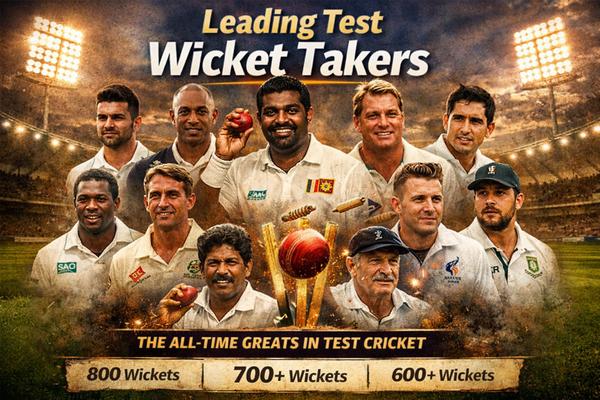
Leading Test Wicket Takers
You cannot fake greatness in Test cricket. The format exposes every weakness, every shortcut, and every fragile ego. If a bowler dominates here, you know he earns it the hard way. When you look at the leading Test wicket takers, you stare at a list filled with stubborn competitors who hunted batters for years without mercy.
Test cricket does not hand out 500 or 700 wickets as a participation trophy. A bowler needs fitness, skill, mental steel, and a borderline obsessive love for long spells under the sun. So let’s talk about the men who refused to stop taking wickets even when their bodies begged for rest.
Contents
- 1 Why Test Wickets Matter More Than You Think
- 2 The Elite Club: 500+ Test Wickets
- 3 The Top Leading Test Wicket Takers
- 3.1 1. Muttiah Muralitharan – The Unmatched King
- 3.2 2. Shane Warne – The Showman With Bite
- 3.3 3. James Anderson – The Swinging Machine
- 3.4 4. Anil Kumble – The Relentless Competitor
- 3.5 5. Stuart Broad – The Big-Match Hunter
- 3.6 6. Glenn McGrath – The Precision Assassin
- 3.7 7. Courtney Walsh – The Ironman
- 3.8 8. Dale Steyn – The Modern Fast-Bowling Artist
- 3.9 9. Kapil Dev – The Pioneer
- 3.10 10. Richard Hadlee – The All-Round Genius
- 4 Complete Statistical Summary
- 5 Spin vs Pace: Who Dominates the Wicket Charts?
- 6 Longevity: The Hidden Superpower
- 7 Era Comparison: Fair or Foolish?
- 8 Five-Wicket Hauls: The Real Impact Metric
- 9 Home vs Away Performance
- 10 The Psychological Edge
- 11 Modern Bowlers Chasing the Record
- 12 Personal Take: Who Impressed Me Most?
- 13 Why Leading Test Wicket Takers Inspire Young Bowlers
- 14 Records That Might Never Break
- 15 Final Thoughts on Leading Test Wicket Takers
Why Test Wickets Matter More Than You Think
Anyone can have a good day in white-ball cricket. A bowler can swing it for five overs, grab three wickets, and walk off as a hero. Test cricket laughs at that.
Test cricket demands:
-
Control over long spells
-
Tactical intelligence
-
Adaptability across continents
-
Patience when nothing happens
-
Ruthlessness when opportunity knocks
A batter might survive one spell. He might survive two. But over five days, a world-class bowler eventually breaks through.
That’s why the leading Test wicket takers command so much respect. They did not succeed because of luck. They succeeded because they built systems, strategies, and stamina.
The Elite Club: 500+ Test Wickets
Crossing 500 Test wickets feels like entering cricket’s Hall of Fame. Only a handful of bowlers ever reach that number. Reaching 600 or 700? That territory feels almost mythical.
Let’s break down the giants of the game.
The Top Leading Test Wicket Takers
1. Muttiah Muralitharan – The Unmatched King
When fans discuss leading Test wicket takers, Muralitharan owns the throne. He collected 800 Test wickets. No one else even touches that number.
He combined a sharp off-spin with a wicked doosra. Batters knew what came, yet they still struggled. He averaged 22.72 with the ball, which sounds almost unfair across 133 Tests.
He hunted wickets in Sri Lanka, India, England, and everywhere else. He did not rely on one pitch or one condition. He built pressure and forced mistakes like clockwork.
2. Shane Warne – The Showman With Bite
Warne made leg-spin cool again. He grabbed 708 Test wickets and turned the art of spin into theatre.
He attacked relentlessly. He set traps. He talked. He backed himself every single time.
Warne averaged 25.41, and he delivered magic moments that fans still replay decades later. His “Ball of the Century” against England signaled a new era of spin dominance.
3. James Anderson – The Swinging Machine
Anderson leads fast bowlers in Test wicket charts. He crossed 690+ wickets and kept going well into his late 30s and early 40s.
He mastered swing bowling like few others. He tormented left-handers. He evolved with age and adjusted his lengths across continents.
Many critics once questioned his overseas record. He answered them with relentless performances in Asia and Australia. Longevity plus skill equals greatness.
4. Anil Kumble – The Relentless Competitor
Kumble did not spin the ball extravagantly. He attacked with accuracy, bounce, and discipline.
He finished with 619 Test wickets. He averaged 29.65, and he often carried India’s bowling attack alone.
He bowled marathon spells. He broke jaws and kept bowling with bandages. He embodied toughness without drama.
5. Stuart Broad – The Big-Match Hunter
Broad loved the big stage. He grabbed 600+ wickets and delivered spells that shifted entire series.
Remember his 8 for 15 against Australia? He destroyed a batting lineup in less than a session. He thrived on rhythm and confidence.
He combined seam movement with clever angles. When he smelled blood, he attacked like a shark.
6. Glenn McGrath – The Precision Assassin
McGrath never relied on express pace. He built careers on discipline.
He picked up 563 Test wickets at an average of 21.64. That average screams efficiency.
He attacked the corridor outside off stump. He forced batters to play. He never gave easy runs. Simple plan. Ruthless execution.
7. Courtney Walsh – The Ironman
Walsh carried West Indies pace bowling through a transitional era. He took 519 Test wickets.
He bowled long spells without complaint. He generated bounce and movement even on flat tracks.
He led by example and refused to back down.
8. Dale Steyn – The Modern Fast-Bowling Artist
Steyn combined pace, swing, and aggression. He finished with 439 wickets, but his impact felt even larger.
He averaged 22.95, which places him among the most effective fast bowlers ever.
He attacked stumps. He hunted tailenders. He celebrated like every wicket mattered deeply.
9. Kapil Dev – The Pioneer
Kapil Dev changed Indian fast bowling forever. He claimed 434 wickets and inspired generations.
He swung the ball. He attacked with heart. He played fearless cricket in an era dominated by pace giants from other nations.
He proved that India could produce world-class fast bowlers.
10. Richard Hadlee – The All-Round Genius
Hadlee dominated in the 1980s. He grabbed 431 wickets in just 86 Tests.
He averaged 22.29, which shows elite consistency. He also delivered with the bat.
He carried New Zealand cricket on his shoulders and never blinked.
Complete Statistical Summary
Below you’ll find a consolidated statistical snapshot of the leading Test wicket takers discussed above.
| Player | Matches | Wickets | Bowling Average | 5-Wicket Hauls | 10-Wicket Hauls |
|---|---|---|---|---|---|
| Muttiah Muralitharan | 133 | 800 | 22.72 | 67 | 22 |
| Shane Warne | 145 | 708 | 25.41 | 37 | 10 |
| James Anderson | 180+ | 690+ | ~26.00 | 32 | 3 |
| Anil Kumble | 132 | 619 | 29.65 | 35 | 8 |
| Stuart Broad | 167 | 604 | 27.68 | 20 | 3 |
| Glenn McGrath | 124 | 563 | 21.64 | 29 | 3 |
| Courtney Walsh | 132 | 519 | 24.44 | 22 | 3 |
| Dale Steyn | 93 | 439 | 22.95 | 26 | 5 |
| Kapil Dev | 131 | 434 | 29.64 | 23 | 2 |
| Richard Hadlee | 86 | 431 | 22.29 | 36 | 9 |
This table tells a clear story. Longevity matters. Strike rate matters. Consistency matters even more.
Spin vs Pace: Who Dominates the Wicket Charts?
Spin bowlers dominate the very top. Muralitharan and Warne sit comfortably at one and two.
Why does spin work so well in Test cricket?
-
Spinners bowl longer spells
-
Captains trust them for control
-
They exploit wearing pitches
-
They attack both edges of the bat
Fast bowlers face physical limits. Their bodies break down faster. Yet Anderson, McGrath, and Walsh still pushed beyond expectations.
So who holds the advantage? Spin bowlers often collect more wickets overall. Fast bowlers often strike fear more visibly. Both styles create legends.
Longevity: The Hidden Superpower
You cannot reach 600 Test wickets in five years. A bowler must perform across 12–15 years at the highest level.
Anderson reinvented himself multiple times. Kumble adapted to different batting eras. Broad survived form dips and came back stronger.
Longevity separates good bowlers from leading Test wicket takers. Talent starts the journey. Durability finishes it.
Era Comparison: Fair or Foolish?
Fans love comparing eras. Some argue that modern batters dominate weaker bowling attacks. Others claim older pitches favored bowlers more.
Let’s be honest. Every era brings challenges.
-
Earlier eras offered uncovered pitches
-
Modern eras demand fitness standards that border on extreme
-
Technology exposes technical flaws quickly
-
DRS changes LBW strategies
You cannot downgrade one era to elevate another. Great bowlers dominate whatever era they play in.
Five-Wicket Hauls: The Real Impact Metric
A bowler can grab 800 wickets, but five-wicket hauls show match-winning influence.
Muralitharan claimed 67 five-wicket hauls. That number feels absurd.
Hadlee managed 36 five-wicket hauls in just 86 Tests. That ratio screams dominance.
Five-wicket hauls tell you when a bowler took control of a game. They define careers.
Home vs Away Performance
Some critics love dissecting home records. They ask whether a bowler dominated only in familiar conditions.
Great bowlers silence that debate.
-
Warne delivered in England and South Africa
-
Anderson found success in Asia later in his career
-
Steyn destroyed teams on subcontinental pitches
Leading Test wicket takers prove their class everywhere. True greatness travels well.
The Psychological Edge
Numbers tell part of the story. Fear tells the rest.
When Warne marked his run-up, batters felt pressure instantly. When McGrath hit a consistent length, batters second-guessed every leave.
Leading Test wicket takers create doubt. They force batters into defensive shells. They attack weaknesses repeatedly.
Cricket becomes chess at that level. These bowlers always thought three moves ahead.
Modern Bowlers Chasing the Record
Can anyone catch 800 wickets? That question feels ambitious.
Modern cricket schedules prioritize white-ball formats. Workload management limits long Test careers.
Yet some bowlers continue pushing boundaries. Fitness science improves recovery times. Rotations extend careers.
Still, reaching 700 or 800 requires obsession. It requires hunger beyond trophies.
Personal Take: Who Impressed Me Most?
I admire Muralitharan’s numbers. They defy logic.
But I lean toward McGrath and Steyn when I talk about pure fast-bowling artistry. McGrath’s control impressed me endlessly. Steyn’s aggression energized every spell.
Anderson’s longevity also amazes me. He kept refining his craft while younger bowlers faded.
Different styles. Same impact. That diversity makes cricket addictive.
Why Leading Test Wicket Takers Inspire Young Bowlers
Young bowlers watch these legends and dream big. They study grip, wrist position, and seam angles.
They also learn:
-
Discipline beats raw pace
-
Patience builds pressure
-
Fitness protects careers
-
Mental strength wins sessions
Legends do not emerge from talent alone. They grow through repetition and relentless work.
Records That Might Never Break
Some records stand strong for decades.
-
800 wickets by Muralitharan
-
Most wickets by a fast bowler by Anderson
-
Lowest averages among high-volume wicket takers
Future bowlers face shorter Test windows and tighter schedules. Breaking these records will require near-perfect conditions and extraordinary commitment.
Final Thoughts on Leading Test Wicket Takers
The leading Test wicket takers did not rely on hype. They relied on skill, strategy, and stamina.
They bowled through injuries. They bowled through criticism. They bowled when nothing happened for hours.
They built legacies session by session.
When you look at 500, 600, or 800 wickets, you see numbers. When you understand the grind behind them, you see greatness.
Next time you watch a Test match and see a bowler start a long spell, ask yourself a simple question. Could this be the start of another legend climbing the all-time wicket chart?
Because every record once started at zero.