Longest Six In Cricket History
You know that feeling when a batter connects so cleanly that everyone in the stadium just freezes? The bowler turns around slowly. The crowd rises before the ball even lands. And someone in the commentary box yells, “That’s out of here!”
We all love boundaries. But sixes? Sixes hit different. And when we talk about the longest six in cricket history, we’re talking about raw power, perfect timing, and a little bit of madness.
So who actually hit the longest six ever? How far did it travel? And do modern bats really make it easier? Let’s break it down like two cricket nerds arguing over tea.
Contents
- 1 The Official Longest Six In Cricket History
- 2 Other Contenders For The Longest Six Ever
- 3 Why Afridi’s 158-Meter Six Stands Out
- 4 Longest Six In IPL History
- 5 Longest Six In Cricket History – Statistical Summary
- 6 Does Modern Technology Make Longer Sixes Easier?
- 7 The Physics Behind A 150+ Meter Six
- 8 Most Powerful Hitters In Cricket History
- 9 Longest Six In Domestic And Club Cricket
- 10 Why Fans Obsess Over The Longest Six
- 11 Can Anyone Break The 158-Meter Record?
- 12 My Honest Take On The Longest Six Debate
- 13 Conclusion: Longest Six In Cricket History
The Official Longest Six In Cricket History
If you ask most cricket fans, one name pops up instantly: Shahid Afridi.
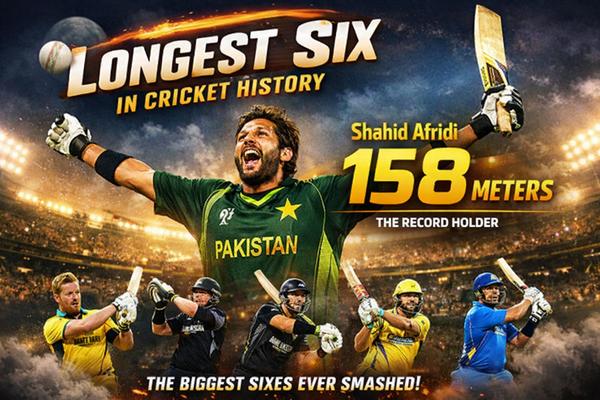
In 2013, during a match against South Africa in Johannesburg, Afridi smashed a six that reportedly traveled 158 meters. Yes, you read that right. 158 meters.
That’s not a six. That’s a missile.
Afridi launched the ball off Ryan McLaren, and the ball reportedly went over the Wanderers Stadium roof. People still debate the exact measurement, but most sources list it as the longest recorded six in international cricket.
Now, here’s the thing. Measurement systems vary. Different stadiums use different tracking technologies. But even with that debate, Afridi’s 158-meter strike dominates every longest six conversation.
And honestly, would you expect anyone else? The man built his career on outrageous hitting.
Other Contenders For The Longest Six Ever
Afridi grabs headlines, but cricket history includes several monster hits that deserve respect.
Brett Lee – 143 Meters
Yes, a fast bowler. Lee reportedly smashed a 143-meter six during a charity match. That swing shocked everyone because we associate Lee with speed, not brute batting power.
Martin Guptill – 127 Meters
Guptill smashed a 127-meter six in an international game. He generates incredible bat speed, and when he connects, the ball disappears.
Corey Anderson – 122 Meters
Anderson built a reputation for power hitting during his peak years. His 122-meter strike proved he could clear any boundary on the planet.
Liam Livingstone – 122 Meters+
Livingstone hit a 122-meter six during a T20I match. He combines modern bat technology with insane bat speed. The result? Absolute carnage.
MS Dhoni – 112 Meters (Multiple Times)
Dhoni never chased distance records, but he casually launched 110+ meter sixes like he ordered them off a menu. His helicopter shot remains one of the cleanest power techniques in cricket.
Why Afridi’s 158-Meter Six Stands Out
You might ask, “What makes 158 meters so unbelievable?”
Let’s break it down.
-
Most international sixes travel between 70–90 meters.
-
A big six crosses 100 meters.
-
Anything beyond 120 meters feels outrageous.
-
158 meters feels like someone switched sports mid-swing.
Physics plays a role here. A batter must generate massive bat speed, hit the sweet spot perfectly, and launch at the right angle. Wind conditions also matter.
Afridi’s aggressive style helped him. He didn’t block. He didn’t defend. He swung like every ball owed him money.
That fearless approach produced magical moments and a lot of wickets but when it worked, it looked ridiculous.
Longest Six In IPL History
Now let’s talk about the cash-rich, six-happy league everyone loves: the IPL.
The longest six in IPL history often gets credited to Albie Morkel, who smashed a 125-meter six while playing for Chennai Super Kings.
Livingstone also entered the IPL record books with a 117+ meter strike for Punjab Kings.
IPL pitches favor batters. Smaller boundaries help too. But even in a league full of power hitters, clearing 120 meters remains rare.
So when someone hits a 120+ meter bomb, fans lose their minds.
Longest Six In Cricket History – Statistical Summary
Here’s a clean breakdown of the biggest hits ever recorded.
| Player | Distance (Meters) | Match Type | Year | Notable Context |
|---|---|---|---|---|
| Shahid Afridi | 158 m | International | 2013 | vs South Africa |
| Brett Lee | 143 m | Charity Match | 2005 | Exhibition Game |
| Martin Guptill | 127 m | International | 2012 | T20I |
| Albie Morkel | 125 m | IPL | 2008 | CSK |
| Corey Anderson | 122 m | International | 2014 | ODI |
| Liam Livingstone | 122+ m | T20I/IPL | 2021–22 | Multiple leagues |
| MS Dhoni | 112 m | International | Various | Signature helicopter |
Afridi remains at the top with 158 meters.
Does Modern Technology Make Longer Sixes Easier?
This question always sparks debate.
Modern bats use thicker edges, better wood compression, and improved sweet spots. Manufacturers design bats to maximize power transfer.
But here’s the truth. Technology helps, but it doesn’t swing the bat.
Players today train harder. They lift weights. They practice power hitting drills daily. They analyze launch angles like baseball sluggers.
Still, even with all that support, no one has officially crossed Afridi’s 158-meter mark in international cricket.
So maybe power comes down to fearless intent more than bat thickness.
The Physics Behind A 150+ Meter Six
Let’s keep this simple.
To hit a ball 150+ meters, a batter must:
-
Generate extreme bat speed.
-
Strike the exact sweet spot.
-
Launch at an optimal angle between 30–40 degrees.
-
Maintain perfect timing.
-
Benefit from minimal wind resistance.
Miss any one of those elements, and the ball travels 20 meters shorter.
You can’t fake this kind of distance. You earn it with perfect execution.
And yes, some natural strength helps too.
Most Powerful Hitters In Cricket History
Distance records matter, but consistent power defines greatness.
Let’s talk about players who regularly scared bowlers.
Chris Gayle
Gayle treated bowlers like bowling machines. He smashed over 500 international sixes. His T20 leagues dominance remains unmatched.
AB de Villiers
ABD combined power with creativity. He hit 100+ meter sixes without even looking at the ball sometimes. He redefined 360-degree batting.
Rohit Sharma
Rohit relies on timing more than brute strength. But when he lofts effortlessly, the ball sails deep into the stands.
Andre Russell
Russell swings with pure force. He clears boundaries like they annoy him personally.
These players may not own the single longest six record, but they dominate conversations about consistent power.
Longest Six In Domestic And Club Cricket
Some claims exceed 160 meters. However, official verification remains tricky.
Club matches often lack advanced tracking systems. People estimate distances visually.
Stories mention 170-meter hits. But without reliable measurement technology, those numbers remain folklore.
Afridi’s 158 meters stands as the most widely accepted and documented figure.
Why Fans Obsess Over The Longest Six
Let’s be honest. We love spectacle.
A 150-meter six feels primal. It feels like watching someone break physics rules.
It also changes momentum instantly. One massive six can:
-
Shift pressure.
-
Silence opposition crowds.
-
Ignite teammates.
-
Break a bowler’s rhythm.
Distance excites fans because it symbolizes dominance.
And who doesn’t love dominance in sport?
Can Anyone Break The 158-Meter Record?
Modern players like Livingstone and Russell definitely have the strength.
But breaking 158 meters requires perfect conditions and outrageous timing.
T20 leagues promote aggressive batting. Players swing harder now than ever before.
So yes, someone could break it.
But they must catch lightning in a bottle.
And cricket rarely gifts that twice.
My Honest Take On The Longest Six Debate
IMO, numbers matter, but moments matter more.
Afridi’s six lives on because fans remember the shock. They remember the disbelief.
Distance records can change. Technology might update figures tomorrow.
But when fans talk about the longest six in cricket history, Afridi’s name always leads the conversation.
That says everything.
Conclusion: Longest Six In Cricket History
Let’s recap quickly.
-
Shahid Afridi holds the record with a reported 158-meter six.
-
Several players have crossed 120 meters.
-
Modern bats and training improve power.
-
No one has officially surpassed 158 meters in international cricket.
-
Fans obsess over distance because it represents raw dominance.
Cricket evolves constantly. New stars rise every year. But until someone officially sends a ball farther than 158 meters in a verified international match, Afridi keeps his crown.
And honestly? That record feels safe.
So next time someone launches a 110-meter six and commentators lose control, just smile and think, “Nice hit… but not 158.”