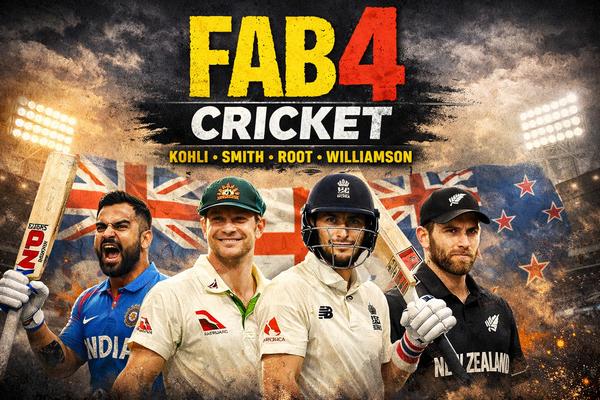
Fab 4 Cricket
Cricket fans love debates. We argue about eras, formats, strike rates, cover drives, and even beard styles. But one debate keeps popping up in every group chat and every tea stall conversation: who truly rules the modern batting world? The answer usually circles back to one phrase Fab 4 Cricket.
You already know the names. Virat Kohli, Steve Smith, Joe Root, and Kane Williamson. Four different personalities. Four different techniques. Four different cricketing cultures. Yet they dominate the same era. Coincidence? Not a chance.
Let’s break down why the Fab 4 conversation refuses to die and why it actually deserves the hype.
What Does Fab 4 Cricket Actually Mean?
Cricket fans coined the term “Fab 4” to describe four modern-day batting giants who defined the post-2010 era. These players stepped up right after legends like Sachin Tendulkar, Ricky Ponting, Jacques Kallis, and Kumar Sangakkara walked away.
Fans needed new heroes. These four stepped up and said, “Relax, we’ve got this.”
The Fab 4 includes:
-
Virat Kohli (India)
-
Steve Smith (Australia)
-
Joe Root (England)
-
Kane Williamson (New Zealand)
Each player dominates in his own style. Each player carries his team in crunch moments. Each player racks up ridiculous numbers across formats.
But here’s the real question do they truly belong in one category?
Why These Four? Not Five or Six?
You might ask, “Why only four?” Fair question.
Several talented batters emerged during this era. Players like Babar Azam and Marnus Labuschagne built strong resumes. Yet fans group these four together because they:
-
Debuted around the same period.
-
Took over after the previous generation retired.
-
Maintained elite consistency across formats.
-
Produced big performances in tough conditions.
They did not just score runs. They scored runs everywhere.
You can’t ignore that.
Virat Kohli: The Run Machine
The Attitude, The Hunger, The Numbers
Let’s start with the loudest personality in the group. Virat Kohli built his reputation on aggression and obsession with fitness.
He does not just want runs. He wants dominance.
Kohli smashed centuries in Australia, England, South Africa, and everywhere in between. He chased targets like a man on a mission. When India needed 320 under pressure, Kohli often stood there at the end.
He built a career around intensity. That intensity fueled massive consistency.
Why Fans Put Kohli Ahead
Many fans argue that Kohli leads the Fab 4 because:
-
He dominated ODI cricket like few in history.
-
He maintained an average above 50 in all formats for a long stretch.
-
He scored 70+ international centuries.
-
He carried India during transitions.
You may not like his celebrations, but you cannot ignore his numbers.
Steve Smith: The Unorthodox Genius
Technique? What Technique?
Steve Smith looks awkward. He shuffles across the crease. He fidgets. He leaves balls in strange ways. Yet bowlers lose sleep over him.
Smith reads line and length early. He adjusts quickly. He turns good deliveries into singles and bad deliveries into boundaries.
You watch him bat and think, “How does this even work?” Then he scores 150.
Smith’s Test Supremacy
Smith dominates Test cricket like a classic old-school great. He thrives in long innings. He absorbs pressure. He scores daddy hundreds.
He played Ashes series where he looked untouchable. He built innings under extreme pressure after controversies and still delivered.
That mental strength sets him apart.
Joe Root: The Silent Accumulator
Calm But Deadly
Joe Root rarely screams at bowlers. He rarely grabs headlines with drama. He simply scores runs.
And he scores a lot of them.
Root builds innings patiently. He rotates strike constantly. He finds gaps with surgical precision. Bowlers struggle to trap him because he rarely gets stuck.
Root’s Recent Explosion
Root went through a phase where he piled up centuries for fun. He dominated Test cricket during 2021 and 2022. He scored double hundreds and anchored England in tough tours.
He adapted to the Bazball era without losing control. That balance shows class.
You cannot overlook someone who scores thousands of runs quietly while everyone argues about others.
Kane Williamson: The Calm Architect
The Thinking Cricketer
Kane Williamson plays cricket like he solves puzzles. He calculates risk. He reads field placements. He waits for mistakes.
He rarely shows emotion. He rarely talks trash. He simply constructs innings.
Many fans call him the “nice guy” of world cricket. That label hides his competitive fire.
Big Tournament Impact
Williamson led New Zealand to:
-
A Cricket World Cup final.
-
A T20 World Cup final.
-
A World Test Championship title.
He delivered runs in crucial matches. He handled pressure with composure. That leadership boosts his Fab 4 status.
Format Breakdown: Who Dominates Where?
Each member of the Fab 4 shines differently depending on format.
Test Cricket
-
Smith dominates with incredible averages.
-
Root racks up massive totals.
-
Williamson plays classy match-winning knocks.
-
Kohli delivers iconic overseas centuries.
ODI Cricket
-
Kohli stands ahead with chase mastery.
-
Root anchors England’s aggressive system.
-
Williamson balances aggression and stability.
-
Smith plays more selective roles.
T20 Cricket
T20 does not define the Fab 4 narrative. Yet all four adapted to franchise cricket and international T20 formats when needed.
Still, Test cricket drives this debate the most.
The Numbers That Fuel Fab 4 Cricket
Stats do not tell the full story. But they definitely strengthen arguments.
Below you will find a summary of key international career statistics across formats. These figures highlight why fans group them together.
Fab 4 Career Statistics Summary
| Player | Tests Runs | Test Avg | Test 100s | ODI Runs | ODI Avg | ODI 100s | Total Intl 100s |
|---|---|---|---|---|---|---|---|
| Virat Kohli | 8,800+ | 49+ | 29 | 13,000+ | 57+ | 47+ | 70+ |
| Steve Smith | 9,000+ | 58+ | 32 | 5,000+ | 43+ | 12 | 44+ |
| Joe Root | 11,000+ | 50+ | 30+ | 6,000+ | 49+ | 16 | 46+ |
| Kane Williamson | 8,000+ | 54+ | 28 | 6,500+ | 47+ | 13 | 40+ |
These numbers explain the hype.
Each player maintains elite averages. Each player crosses the 8,000-run mark in Tests or pushes toward it. Each player stacks centuries consistently.
Fans do not create the Fab 4 narrative randomly. Performance drives it.
Overseas Performance: The True Test
Anyone can score runs at home. Legends score runs abroad.
Kohli answered critics with centuries in Australia and England. Smith scored heavily in England during Ashes tours. Root delivered runs in Sri Lanka and India. Williamson built centuries in Asia and the UK.
Overseas success separates good players from great players.
Each member of the Fab 4 ticked that box.
Captaincy Factor
Leadership adds another layer to this discussion.
-
Kohli transformed India’s fitness culture.
-
Smith led Australia before and after controversy.
-
Root captained England through transition.
-
Williamson guided New Zealand to global finals.
Captaincy brings pressure. Pressure reveals character.
Each of these players handled scrutiny while maintaining performance. That combination impresses fans.
Playing Styles: Four Different Flavors
Kohli’s Intensity
Kohli attacks bowlers with body language and intent. He celebrates every milestone loudly. He brings energy to every contest.
Some fans love that fire. Some fans prefer calm. Either way, Kohli demands attention.
Smith’s Calculation
Smith studies bowlers obsessively. He leaves balls strategically. He manipulates angles. He frustrates opponents into errors.
He does not look stylish. He looks effective.
Root’s Flow
Root flows across the crease smoothly. He times the ball sweetly. He rarely forces shots early.
He builds innings like a craftsman shaping wood.
Williamson’s Balance
Williamson balances patience and aggression. He reads conditions quickly. He shifts gears subtly.
He makes batting look easier than it actually is.
The Era Context
The Fab 4 era includes:
-
High-quality fast bowling attacks.
-
Data-driven analysis.
-
Packed international schedules.
-
Intense social media scrutiny.
They did not dominate weak bowling eras. They faced James Anderson, Mitchell Starc, Kagiso Rabada, Dale Steyn, Jasprit Bumrah, and many others.
That matters.
Do All Four Truly Stand Equal?
Now we reach the spicy part.
Do they truly stand equal? Or does one clearly lead?
Many fans rank them like this:
-
Kohli for all-format dominance.
-
Smith for Test greatness.
-
Root for consistency and longevity.
-
Williamson for balance and leadership.
Others swap positions easily.
Your ranking depends on what you value most flair, technique, mental toughness, or versatility.
Criticism and Slumps
Every great player faces slumps.
Kohli went through a century drought that lasted nearly three years. Smith struggled after returning from suspension. Root faced captaincy pressure. Williamson battled injuries.
Yet each player bounced back.
Comebacks reveal greatness more than peak years do.
Impact Beyond Numbers
Fab 4 Cricket goes beyond statistics.
Kohli inspired a fitness revolution in India. Smith reshaped unconventional technique acceptance. Root anchored England’s middle order for a decade. Williamson elevated New Zealand’s global reputation.
They changed perceptions.
That influence strengthens their collective label.
The Next Generation Threat
Cricket never stands still.
Babar Azam builds his case. Marnus Labuschagne piles up runs. Shubman Gill shows promise. Young talents push hard.
Will fans eventually talk about a new Fab 4?
Probably.
But this original group built the blueprint.
Personal Take: Why Fab 4 Cricket Works
In my opinion, the Fab 4 concept works because it creates conversation.
Fans love comparisons. We debate endlessly about who edges ahead. We share stats. We argue passionately. We enjoy the drama.
At the same time, we appreciate greatness across nations.
India, Australia, England, and New Zealand each produced a generational batter simultaneously. That coincidence excites fans.
It feels like we witnessed a golden era.
What Separates Them From Past Legends?
Previous generations also had clusters of great players. Ponting, Tendulkar, Kallis, and Dravid dominated together.
Yet social media amplified the Fab 4 discussion. Every inning triggers instant comparison graphics. Every century sparks ranking debates.
Modern coverage keeps the rivalry alive constantly.
Will One Finish Clearly Ahead?
Time will answer that question.
Root may finish with the highest Test runs. Kohli may top century charts. Smith may retain the highest average. Williamson may stack ICC trophies.
Fans will still argue.
And honestly, that argument keeps cricket fun.
Conclusion: Why Fab 4 Cricket Defines an Era
Fab 4 Cricket represents more than four names. It represents transition. It represents consistency. It represents modern greatness.
Each player brought something unique:
-
Kohli delivered intensity and ODI dominance.
-
Smith mastered Test match batting.
-
Root built relentless consistency.
-
Williamson balanced leadership with calm excellence.
They pushed each other indirectly. They raised standards collectively. They gave fans endless debates.
Years from now, when young fans ask about this era, people will not just mention random stats. They will say, “You had to watch the Fab 4.”
And honestly, we feel lucky that we did.
Because watching four giants battle across formats at the same time? That does not happen often.
So next time someone asks who rules modern cricket, smile and say, “Depends on the day. But the Fab 4 own the era.”
That answer never fails to spark a debate.