How Many Creases Are There in Cricket?
The Lines That Run the Game
If you have ever watched cricket and wondered what all those white lines on the pitch are for, you are not alone. Most casual fans assume they are just boundary markers. In reality, each crease serves a very specific purpose that directly affects how the game is played and decided.
A batter can be run out because of a crease. A bowler can be called for a no-ball because of a crease. Even a wicket-keeper can be penalized if a fielder stands in the wrong place relative to a crease. These lines are not decoration. They are the architecture of the game.
This guide breaks down all four creases, explains what each one does, and tells you exactly where they are positioned on the pitch. By the end, you will understand cricket at a level most viewers never reach.
The Four Creases in Cricket
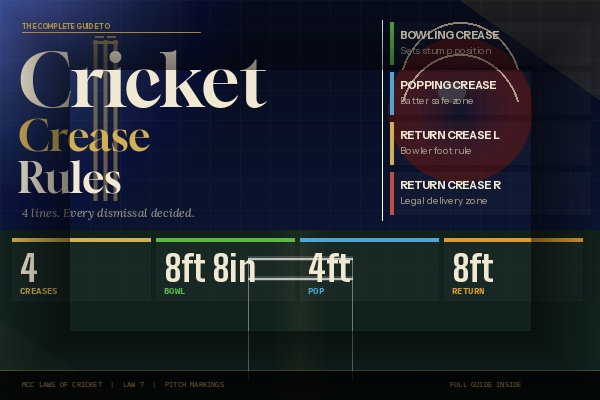
Cricket officially recognizes four creases at each end of the pitch. Since a cricket pitch has two ends, that means eight crease lines exist on the full pitch surface. But when people ask how many creases there are in cricket, the standard answer refers to the four distinct types at one end:
- Bowling crease
- Popping crease
- Return crease (left side)
- Return crease (right side)
These four lines together form a rectangular zone around the stumps. Each crease has a defined width, position, and function under the Laws of Cricket, which are maintained by the Marylebone Cricket Club (MCC).
At a Glance: Cricket Creases Summary
| Crease | Position | Length/Measurement | Primary Purpose |
| Bowling Crease | At the level of the stumps | 8 feet 8 inches (2.64 m) | Marks where stumps are set |
| Popping Crease | 4 feet in front of stumps | Unlimited length (min 6 ft each side) | Safe zone for batter; no-ball line for bowler |
| Return Crease (×2) | Perpendicular to popping/bowling | 8 feet behind popping crease minimum | Restricts bowler’s foot placement (no-ball) |
Each Crease Explained in Plain Terms
1. The Bowling Crease
The bowling crease is the line that runs through the base of the three stumps. It is exactly 8 feet 8 inches (2.64 metres) long, and the stumps are positioned right in the centre of it.
In terms of gameplay, the bowling crease itself is less directly involved in dismissals than the other creases. Its main job is structural: it tells you where the stumps belong. However, it works in coordination with the return crease to create the legal delivery zone for a bowler.
Think of the bowling crease as the foundation line. Everything else is measured from or relative to it.
2. The Popping Crease
The popping crease is arguably the most important crease in the game. It sits 4 feet (1.22 metres) in front of the bowling crease, measured towards the bowler’s end.
For batters, the popping crease is their safety line. When a batter has part of their bat or body grounded behind this line, they cannot be run out or stumped. The moment they move beyond it without making their ground, they are vulnerable.
For bowlers, the popping crease is the no-ball line. When a bowler delivers, their front foot must land with some part of it behind or on the popping crease. If the foot lands entirely beyond the line, it is a no-ball.
The popping crease has no official length limit. The Laws require it to extend at least 6 feet on either side of the middle stump, but in practice it is painted across the full width of the pitch.
3 and 4. The Return Creases
The two return creases run at right angles to both the bowling and popping creases. One is on each side of the stumps. They are drawn from the back of the bowling crease and extend at least 8 feet (2.44 metres) towards the batter’s end.
These lines exist primarily to regulate the bowler’s back foot placement. When a bowler delivers, their back foot must land inside the return crease, or on it, but not outside it. A foot landing beyond the return crease on the outside results in a no-ball.
This prevents bowlers from running too wide before delivery, which would give them an unnatural angle of attack and potentially make the ball harder to see or judge for the batter.
How Creases Directly Affect What Happens in a Match
Run Outs and Stumpings
A run out occurs when a batter is out of their crease while the ball is live and the fielding side breaks the stumps. The batter must have some part of their bat or body behind the popping crease to be safe.
A stumping is similar but happens specifically when the wicket-keeper dislodges the bails while the batter is out of the crease and has not hit the ball. It is a fast dismissal that only the keeper can execute.
In both cases, the decision comes down to one question: was any part of the bat or body of the batter grounded behind the popping crease at the moment the wicket was broken?
No-Balls and the Crease Rules for Bowlers
A bowler commits a no-ball related to the crease in one of two ways:
- Their front foot lands entirely beyond the popping crease at the moment of delivery
- Their back foot lands on or outside the return crease (beyond the outer edge)
No-balls are costly in modern cricket. The batting side receives a free hit on the next delivery in limited-overs formats, meaning the batter cannot be dismissed off that ball by most methods. Bowlers who consistently overstep the popping crease are flagged by umpires and often lose rhythm.
What the Laws of Cricket Say About Creases
The Laws of Cricket, specifically Law 7, defines the crease markings. The key specifications are:
- The bowling crease must be 8 feet 8 inches long, centred on the middle stump.
- The popping crease must be marked at least 6 feet (1.83 m) on both sides of the middle stump, running parallel to the bowling crease, 4 feet in front of it.
- The return creases connect the ends of the bowling crease to the popping crease, running perpendicular, with a minimum length of 8 feet from the popping crease.
These are minimum and positional requirements. The markings are made with white paint on the pitch surface before each match. Umpires use them as reference points throughout the game, sometimes consulting third umpire reviews via ball-tracking and slow-motion footage when close decisions are involved.
Things People Get Wrong About Cricket Creases
Misconception: The popping crease is only for batters
Many viewers think the popping crease only matters for run-outs and stumpings. In fact, it also governs no-ball decisions for bowlers. Both batting and bowling sides are equally regulated by this single line.
Misconception: There are only two creases
Some casual fans are only familiar with the two most visible lines at either end of the pitch and assume there are just two. The return creases are thinner and shorter, so they are often overlooked by viewers who do not know what to look for.
Misconception: Breaking the stumps automatically means the batter is out
A fielder can shatter the stumps brilliantly, but if the batter had any part of bat or body behind the popping crease at the exact moment of contact, they are not out. The crease takes priority over everything else in those decisions.
Crease Dimensions: Quick Reference
| Measurement | Value (Imperial) | Value (Metric) |
| Bowling crease total length | 8 ft 8 in | 2.64 m |
| Distance: bowling crease to popping crease | 4 ft | 1.22 m |
| Popping crease minimum width (each side) | 6 ft | 1.83 m |
| Return crease minimum length | 8 ft | 2.44 m |
| Number of stumps per end | 3 | 3 |
| Total distinct crease lines per end | 4 | 4 |
| Total crease lines on full pitch | 8 | 8 |
A Real-Game Scenario That Shows Why Creases Matter
Imagine a tight run chase in the final over of a Twenty20 match. The batting team needs three runs off the last ball to win. The batter hits the ball hard into the covers and runs. The fielder fires the ball in.
The wicket is broken. The crowd erupts. But is the batter out?
The third umpire reviews the footage frame by frame. At the exact moment the bails are disturbed, the batter’s bat is seen touching the ground just behind the popping crease. Safe. The batting team wins the match.
That is the weight a four-foot white line carries in professional cricket. The precision of crease laws, combined with modern technology, means these decisions are rarely disputed once reviewed.
Frequently Asked Questions
How many creases are there in cricket?
There are four types of creases in cricket: the bowling crease, the popping crease, and two return creases. Since a pitch has two ends, there are eight crease lines in total across the full playing surface.
What is the most important crease in cricket?
The popping crease is considered the most functionally significant crease. It determines whether a batter is safe from run-outs and stumpings, and whether a bowler has delivered a legal ball or overstepped.
What happens if a bowler steps over the popping crease?
If the bowler’s front foot lands completely over the popping crease at the point of delivery, the umpire signals a no-ball. In limited-overs cricket, the next ball becomes a free hit for the batter.
Are return creases visible on TV broadcasts?
They can be hard to spot because they are shorter and narrower than the bowling and popping creases. Camera angles in TV coverage often focus on the batting end, where the return creases may not be clearly visible unless the broadcast specifically cuts to an overhead or wide-angle shot.
Are crease rules different in Test cricket vs T20?
The crease lines and Laws governing them are the same in all formats. What differs is the consequence: in T20 and one-day cricket, a no-ball from overstepping results in a free hit on the next delivery, which is not the case in Test cricket.
Final Word
Cricket has four creases, eight in total if you count both ends of the pitch. The bowling crease anchors the stumps. The popping crease governs dismissals and no-balls. The return creases keep bowlers within legal angles.
Each one is precise in its placement and purpose. They might look like simple white lines when you watch a match, but they are the reason thousands of decisions every season go one way or the other.
Next time you watch cricket and a run-out review goes to the third umpire, you will know exactly which line the technology is measuring against.